

‘Armenia can be at the heart of European developments’ – an interview with EU Ambassador Vassilis Maragos
Armenia is going through a pivotal moment in its modern history, seeking to redefine its geopolitical position, deepen ties with the European Union, and navigate growing regional and domestic challenges.
For Vassilis Maragos, the Head of EU Delegation to Armenia, EU Ambassador, the significance of the moment goes beyond diplomacy.
“Armenia sent an important message to Europe,” he said in an exclusive interview with three European media outlets.
We also had a chance to discuss the new economic and infrastructure opportunities and the country’s strategic diversification efforts to avoid over-dependence on any particular partner.
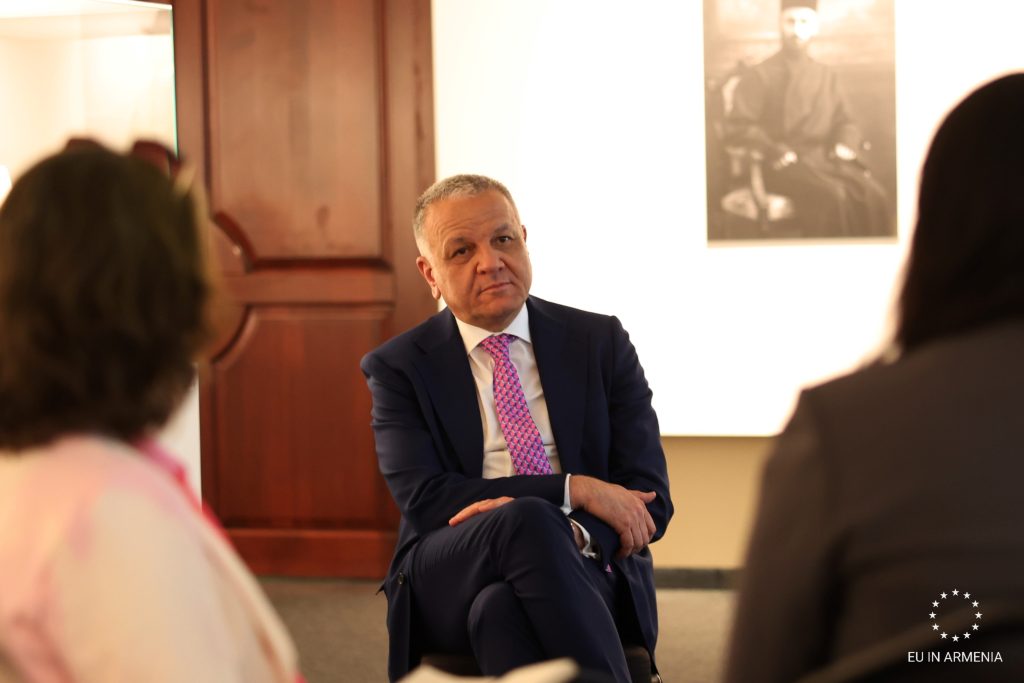
You recently said EU-Armenia relations are closer than ever before. Does this bring Armenia closer to a European future, at least in some sectors? And how does the EU plan to help Armenia strengthen its economy and reduce possible risks linked to its past dependence on Russia?
We launched a process of strengthening Armenia-EU relations in all their dimensions. That was a task given to us by the leaders of the EU Member States in the European Council. Based on that, we have been engaging with Armenia in trying to identify what we can do together. This has already led us to launch several flagship projects with Armenia in the last three years.
The main tool we have been using is the €270 million Resilience and Growth Plan. This was announced in April 2024 and is now close to implementation. The plan aims to strengthen Armenia’s resilience in the economic field, in the energy field, in society, and also to strengthen support for the private sector and infrastructure.
What does that mean in practical terms for Armenia’s economy?
When it comes to trade and energy, I can cite some of our focus areas.
The first is support for the adoption of European standards for products, which allows Armenian products and Armenian produce to reach new markets.
One of the objectives of Armenia’s economic and trade policy is to diversify both investments and trade, and EU support focuses on both.
It is not that we are against a particular relationship. Of course, when it comes to Russia, which you mentioned, we cooperate with Armenia to prevent sanctions circumvention.
So this is really to make sure that the sanctions for dual-use goods and other goods covered by sanctions are respected, and Armenia is very committed to that. There may still be some challenges, but overall, I think it is a very important area of bilateral cooperation.
But Armenia wants to diversify its markets to make sure that there is no overdependence on a particular trade relationship, for instance. And here we are also helping them.
Can you give a concrete example?
Last year alone, we advised more than 40 enterprises through technical assistance on how to export to other markets. These companies can increase their exports to the EU.
This shows that the potential is there, but that it also requires investment.
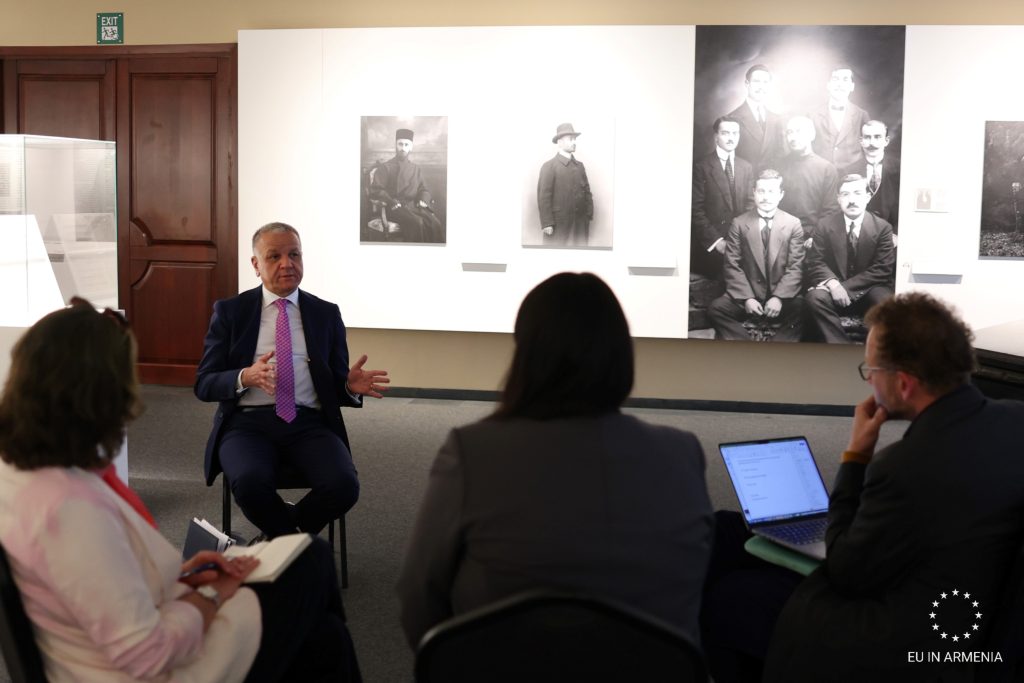
What support is the EU providing to Armenia’s private sector?
Just recently, we signed a guarantee agreement together with the Vice-President of the European Investment Bank, Karl Nehammer.
We work with the banking sector in order to provide support to private businesses. The total amount of support for the private sector from the European Investment Bank over the last two years has been €330 million. More than 27,000 jobs have been created.
So there is a range of tools that are being used to support the competitiveness of the Armenian economy.
And of course, the final outcome also depends on the innovative spirit and entrepreneurial spirit of the Armenian people.
Energy security remains one of Armenia’s key vulnerabilities. What is the EU doing in this area?
On energy, one of the main areas of focus in which we have been investing is interconnectivity, with a very important ongoing project, the Caucasus Transmission Network, with an overall investment of more than €500 million. This is to upgrade the electricity grid with Georgia, which will allow the export of renewable energy from Armenia.
There have been a lot of investments in this area to reach Georgia, because this is the only border which is open currently, as you know, towards the west.
And then, of course, other markets, in particular, the Black Sea Connectivity Submarine Electricity Cable, which Armenia is aspiring to participate in. It has not been built yet. It would connect the South Caucasus and the EU and has the potential to help achieving ambitious green targets, by enabling the export of green energy from the South Caucasus.
Armenian officials often speak about normalisation with Turkey as strategically important. Does the EU consider the opening of borders and transport links between Armenia and Turkey a realistic prospect in the coming years?
Of course. Absolutely realistic.
Does the EU have a role in that process?
The EU does not have a role in the bilateral negotiations between Turkey and Armenia. But the EU does have a very important role in facilitating broader cross-regional interconnectivity.
There will be further connectivity forums, in which Armenia is participating, as well as participation from other countries in the region.
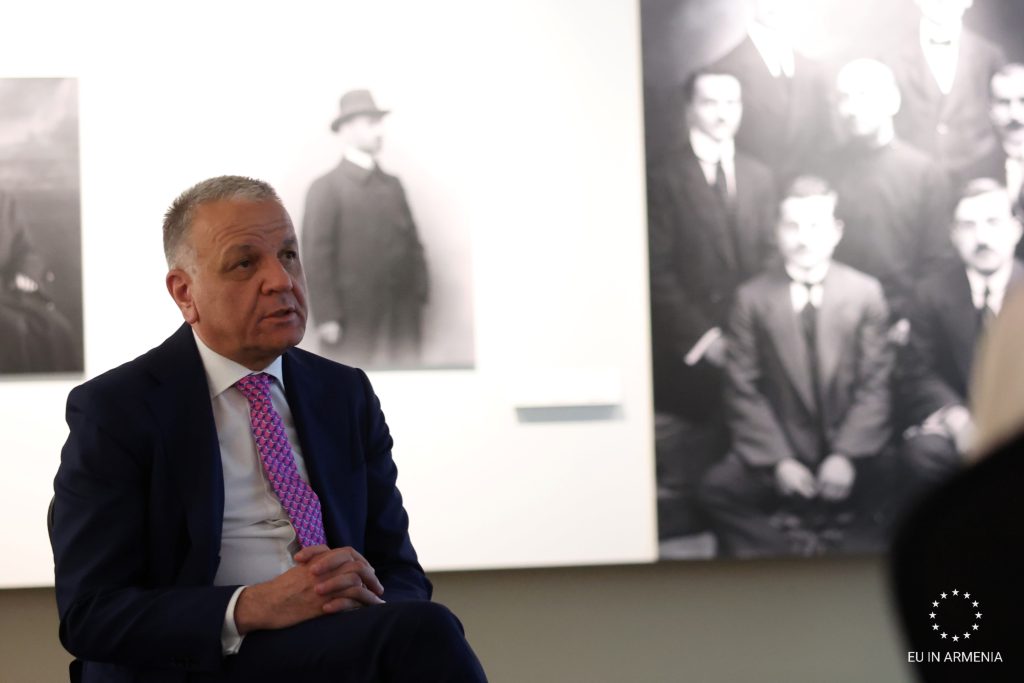
So this is not only about Armenia. It is about connecting Armenia as a hub with the rest of the Middle Corridor. This creates interdependencies, but also more independence, if you like, when more partners are involved.
Certainly, opening the border between Armenia and Turkey would create more opportunities, including for local communities.
By the way, over the past few years, we have supported engagement between civil society organisations and chambers of commerce on both sides of the border. We are also ready to use our financial instruments to facilitate investments – not only in infrastructure, but also in private sector development.
One important deliverable from the EU-Armenia summit was the announcement that we are going to work on the construction of three border crossings. One is connected to Azerbaijan, in the south.
Two others relate to the Armenian-Turkish frontier. One is at Margara, where some infrastructure already exists, but we are ready to support its expansion.
The second one is Akhurik, which is expected to become a new border crossing between Kars and Gyumri. These are concrete projects that are now being developed with international financial institutions.
Armenia is approaching elections. From your perspective, what would constitute a successful election?
You know, we are very interested in the partnership with Armenia and the Armenian people.
So we are, of course, very interested to know what policies the future government will follow when it comes to EU-Armenia cooperation.
But we are non-partisan when it comes to the elections. It is up to the Armenian people to vote and decide on the future of their country.
Our role is to support the institutions which take care of the integrity of the elections.
European Union support is used to strengthen Armenian institutions, to prepare them to address particular challenges that they may face. Challenges which have to do with for example cyber security or challenges which have to do with illicit financing.
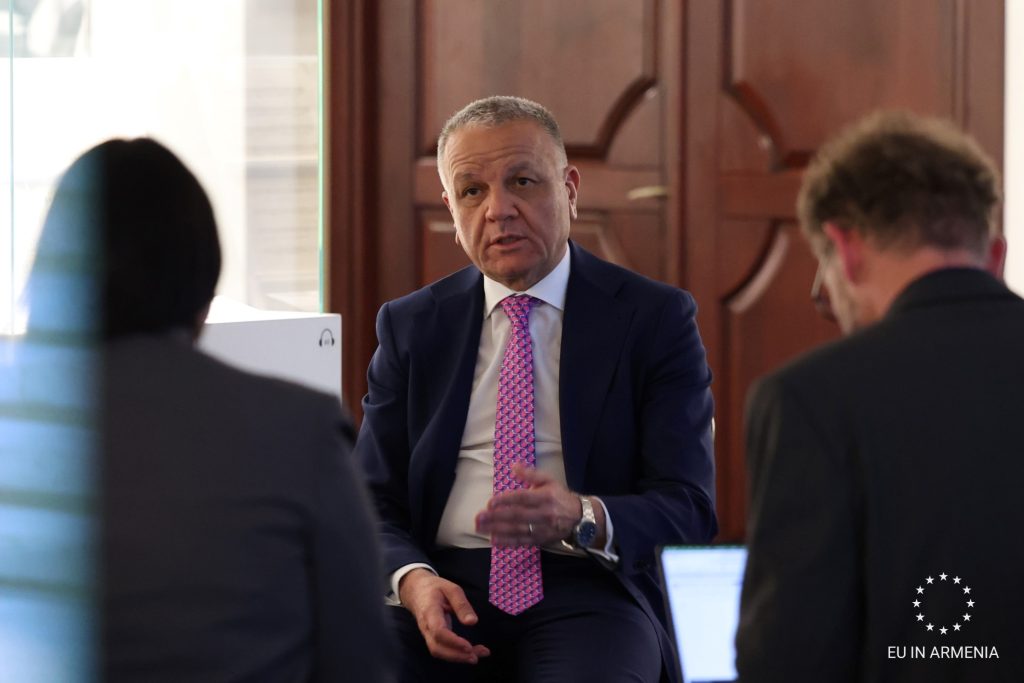
Also, we have had some cooperation when it comes to support against foreign information manipulation and interference.
So we are supporting the electoral process. We’re not talking about the concrete outcome. That is up to the Armenian voters to decide.
It is about sharing our experiences, our toolbox, that may be useful for Armenian institutions and which they can use as they see fit. For instance, we work with the Central Election Commission, and with many countries through the UNDP, when it comes to supporting its role in the organisation of the elections.
Will there still be international monitoring?
Yes. There will also for example be an electoral observation mission by the OSCE/ODIHR.
Of course, we will cooperate with them as they talk with many different stakeholders to assess the election environment. But they are an independent mission and their role is exclusively election observation.
Were the first-ever EU-Armenia Summit and EPC summit symbolically significant for Armenia’s international positioning?
Yes. We also had, for the first time, participation from Canada. That was another important signal.
I think that here we sent a message to the Armenian public, a message of solidarity and support.
But I believe also that the Armenian public and the Armenian participants have passed a message to Europe that Armenia is here, Armenia exists, Armenia can be at the heart of European developments.
And I’m very confident that when the political leaders discuss the issues which the citizens have in their mind, this is precisely what democracy is about.
Author: Olga Konsevych
The original interview was published in Ukrainian by TSN.UA
MOST READ

SEE ALSO
Armavir citizens mobilise for safe drinking water

‘Europe became real faces and real stories’: Young European Ambassadors look back on ten years of friendships and community projects
Stories hidden in wood
Small ideas, real impact: how students built a natural food brand
Crafted by youth, inspired by tradition: the Hinunik story, a school where new ideas are born within old walls


The information on this site is subject to a Disclaimer and Protection of personal data. © European Union,
