

Stories hidden in wood
“Wood is not just a material for me. When you work with it, you are not creating something entirely new – you are discovering what is already within it: its color, its texture, its story,” says Haykaram Ghalumyan, a participant and sub-grant recipient of the ‘SKYE NET: Skills and Knowledge for Youth Empowerment’ project, who has managed to bring real change to his community through his work.
The SKYE NET project is implemented by World Vision Armenia with the financial support of the European Union within the framework of EU4Youth programme, in partnership with Iris Business Incubator, World Vision Georgia, and the Millennium Training and Development Institute.
Haykaram was born in Dilijan, but due to family circumstances, he moved to Yerevan, where he spent his childhood and teenage years. Initially, he was interested in art, and later in architecture, but for various reasons, he did not pursue higher education in that field.
In 2019, he returned to Dilijan and decided to shape his own creative path. His interest in woodcraft was not new – he had been engaged in wood carving since 2012, and over the years, this interest evolved into a family business.
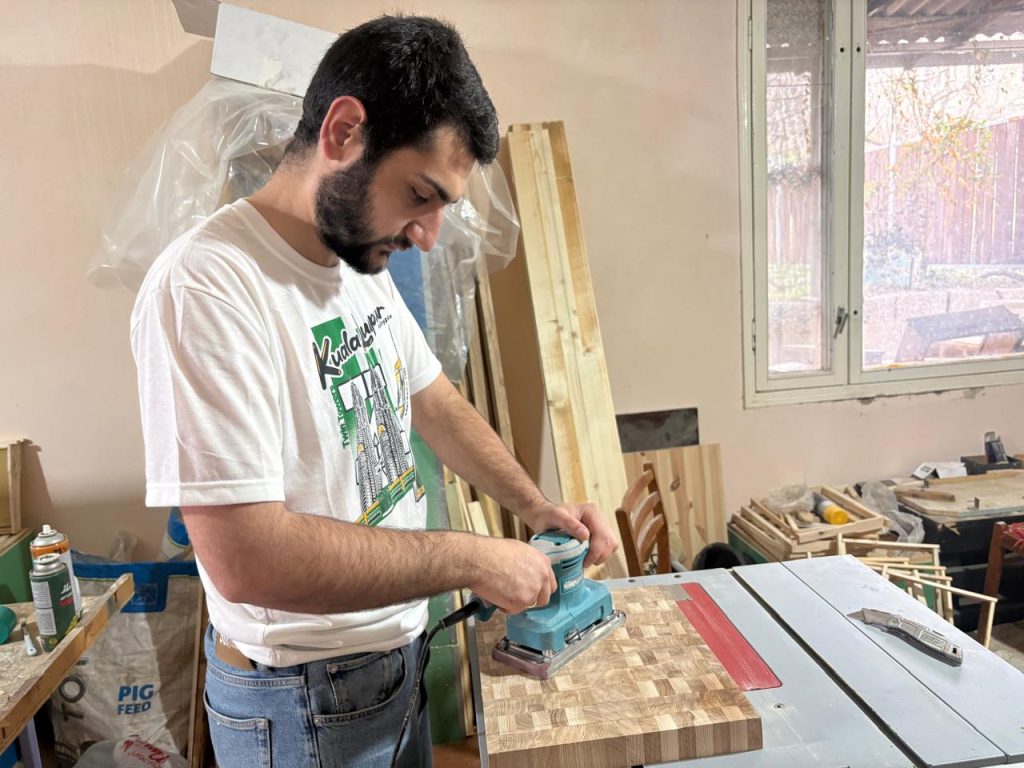
Haykaram decided to transform their ancestral house in Dilijan, which had remained unused for a long time, into not only his workspace but also a centre that would be beneficial for the community. “I kept thinking – why not bring this space back to life and turn it into a place where I can create, but also be useful to others?” he says. Now he has established the Ghalum’s Home centre.
The first order
His first major order was to produce chairs for a yoga centre. The order came from his sister, but these were not ordinary chairs – they required a specific design and dimensions. Although he lacked sufficient experience and proper tools at the time, he accepted the challenge. After extensive research, trials, and mistakes, he successfully completed the order, which became one of the key starting points of his professional journey.
Haykaram’s grandfather was a blacksmith – a man who created value through his craftsmanship. Today, the love for the craft inherited from his grandfather has become the foundation of Haykaram’s professional path, combining traditional skills with modern thinking.
In 2024, he received a professional education in furniture making, and began working on larger-scale production, creating kitchen and bedroom furniture. Later, he received a collaboration offer from the Margahovit Educational Centre, where he also carried out restoration works.
For him, restoration is not simply repair – it is a process of understanding and preserving the story of the material. When working on old doors or furniture, hidden layers are often revealed, damaged parts and changes formed over the years. His approach is not to replace everything, but to preserve as much of the original material as possible. Sometimes, the work turns into real research, as he experiments with different materials to find the best solution and colour.
‘SKYE NET in my life’
“I learned about the SKYE NET programme through my friends. It was the first grant programme I had participated in. At first, I had some fears, but my goal was stronger – to develop our community and be useful to it. During the programme, I gained knowledge in marketing, financial management, and sales organisation, and I also learned better to understand my target audience,” says Haykaram.
After participating in the programme, Haykaram was among the young people who received a sub-grant of AMD 1,500,000. With this support, he was able to acquire essential tools such as a saw, a compressor, and other equipment, which allowed him to expand his activities and attract new orders.
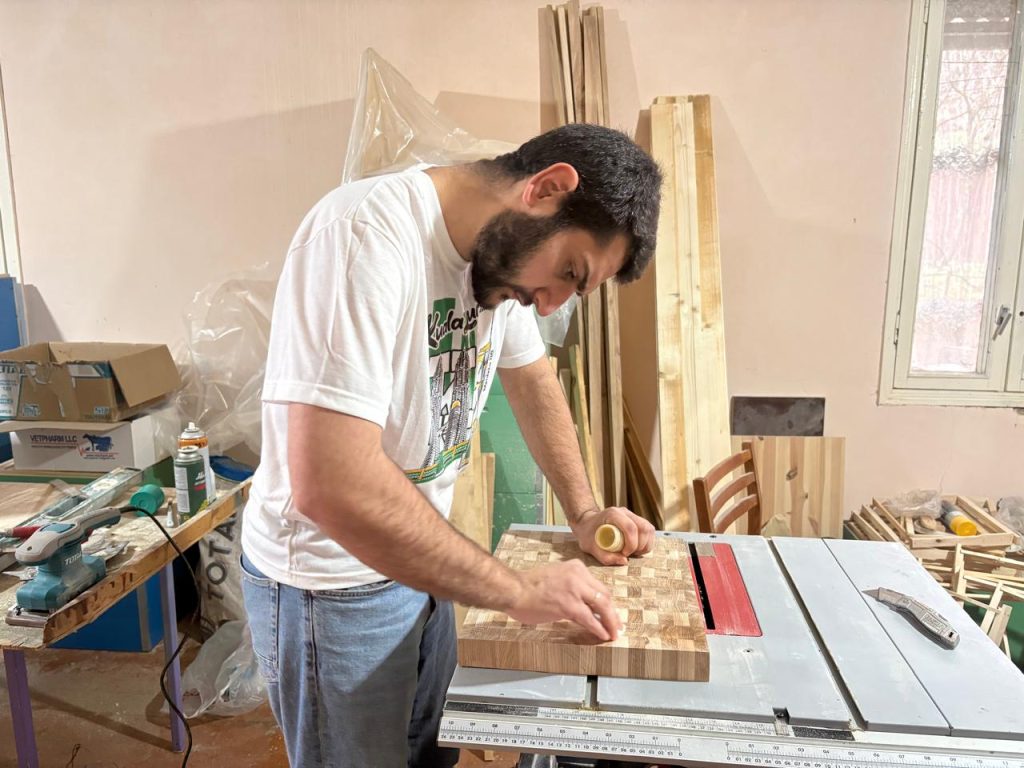
“One of the key components of the programme is social impact, which is very important to us. We aim to pass on craftsmanship skills to children, encouraging their creativity and practical abilities. For this purpose, we have created a comfortable and inspiring space in our home, where children can learn woodworking for free – gaining not only professional skills, but also confidence and creative thinking,” he notes.
Haykaram is also supported by his fiancée, Ani Ghalumyan, and his friend, Vazgen Mitoyan, who assist with marketing and order management.
The vision
Haykaram’s goal is not only to develop production. He strives to improve mechanisms and introduce new technologies, while preserving the value of handmade work. His vision also includes entering international markets to demonstrate that Armenian culture is not only preserved, but continuously evolving.
“We don’t want simply to create products. It is important for us that what we do is connected to the environment, people, and culture, that it is not just commercial work, but something that has its own story,” says Haykaram.
He emphasises that their work is rooted in preserving the values of traditional craftsmanship, even in an era of mass mechanised production.
“Today it is very easy to replace everything with machine-based production, but in that case, the energy of handmade work is lost. For us, it is important that the culture of craftsmanship does not disappear,” he adds.
According to him, every material carries its own story, which should be revealed, not erased.
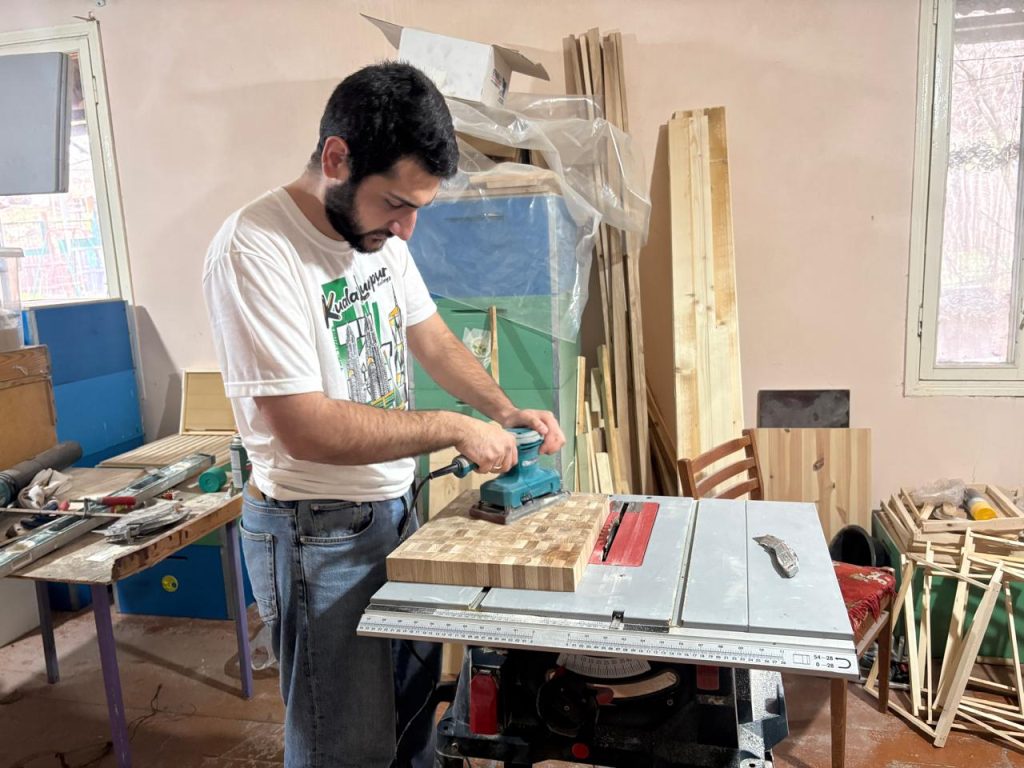
“When you take wood, it is not just a material. It has a story-layers formation. And when you work with it, you don’t erase that – you highlight it,” he explains.
He adds that the same approach applies to working with old objects: the goal is not to completely transform them, but to preserve their original value.
“People often want to ‘renew’ objects, but in reality, those objects carry a story that should be preserved. We try to maintain their original look and value as much as possible,” he says.
The workshop
Haykaram also places great importance on community engagement, making his work open and accessible to everyone. His goal is not to limit the process to the workshop, but to allow people to see, understand, and even participate in the creation process.
“We often have children and young people visiting us, many of whom are working with wood for the first time. At first, it’s just an interesting experience for them, but later they begin to understand the depth of it. We try to show them that craftsmanship is not only a skill, but also a way of thinking,” he says.
Haykaram’s story is not just about the success of one young individual. It is a story of how knowledge, support, and inner motivation can turn into real change within a community, in people’s mindset, and in preserving culture.
The SKYE NET project became for him not only an opportunity to gain new skills, but also a turning point in his way of thinking. It helped him approach his work more systematically, understand market demands, and see his craft not just as a trade, but as a growing business and a community-driven initiative.
Today, his workshop is more than just a workspace – it is a place where the past meets the present, and where craftsmanship becomes a story that continues through new generations.
MOST READ






SEE ALSO

Armavir citizens mobilise for safe drinking water

‘Europe became real faces and real stories’: Young European Ambassadors look back on ten years of friendships and community projects
Small ideas, real impact: how students built a natural food brand
Crafted by youth, inspired by tradition: the Hinunik story, a school where new ideas are born within old walls
From waste to high-value products: circular economy in action in Lukashin


The information on this site is subject to a Disclaimer and Protection of personal data. © European Union,
