

Small ideas, real impact: how students built a natural food brand
During the hottest days of the summer harvest, four students from the secondary school of Ddmashen community in the Gegharkunik region of Armenia – Taguhi Safaryan, Anna Badalyan, Zhanna Ghevondyan, and Sona Voskanyan – wake up early and hurry to the orchards of their fellow villagers. Although each of the girls has her own interests and future professional aspirations, this does not prevent them from uniting around a common goal and developing their own initiative. Here, they do not simply help with harvesting; they also discuss with farmers the possibilities of sourcing fresh, natural fruits and turning them into dried products. They named their social company ‘Arevahunts’.
Arevahunts is a student social company initiative, launched with the support of a sub-grant from the European Union’s EU4Youth programme, within the framework of the project ‘Fostering Youth Social Entrepreneurship and Practical Career Management Skills through the innovative Social Student Companies Approach’. The programme provided students with the essential knowledge and skills needed to shape, plan, and implement their ideas. Throughout this process, they were supported and guided by CODE-SE HUB NGO.
They learned about the programme thanks to their teacher, Gayane Karapetyan, whose initiative led to the formation of a student group. The group began participating in training sessions, acquiring new knowledge, and developing business ideas. “We discussed several ideas, but decided to focus specifically on fruit, because a lot of fruit grows in our village, yet it often remains under the trees and spoils. It was a real problem. We thought we could make dried fruit from it,” says Anna Badalyan.
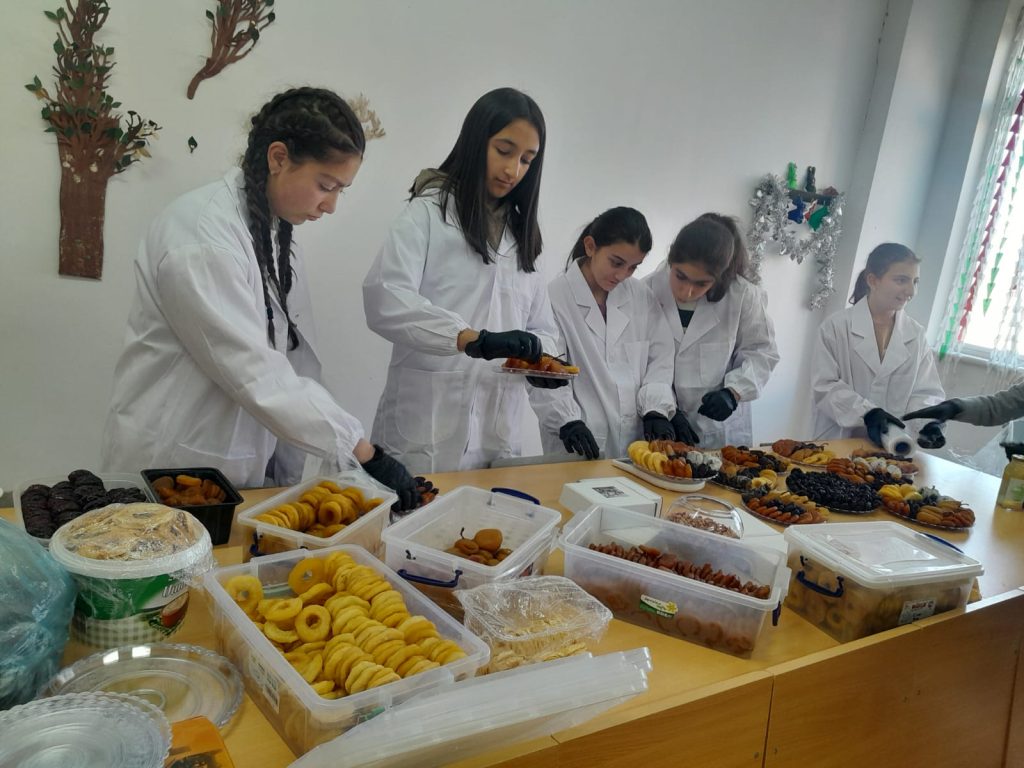
The school administration played a crucial role in establishing the social student company, supporting the students from the stage of idea development to organising the production process by creating the necessary conditions for work. Thanks to this support, it became possible to use one of the previously unused spaces of the school, transforming it into a small production unit and drying facility.
From learning to real business practice
After joining the EU4Youth project, the team not only participated in training but also began to develop real business thinking – from identifying a problem to creating a product and studying the market.
During the training sessions, the students acquired a number of essential skills, including the fundamentals of business management, financial planning, marketing thinking, target audience analysis, and effective customer communication. Importantly, they immediately applied this knowledge to their own project, testing it in a real business environment. After completing the programme, they received a grant of €1,000 and obtained some of the equipment and tools needed to organise the production process more efficiently, including fruit drying equipment.
A clear team structure was also formed, where each member has their own responsibilities. Zhanna coordinates the organisation and supervision of production processes, ensuring workflow and quality. Anna is responsible for marketing and managing social platforms, presenting the brand in the online environment, and developing connections with the audience.
Taguhi and Sona are mainly responsible for product packaging and design, shaping the visual identity of the brand and ensuring that Arevahunts has a recognisable and appealing image. Other team members are involved in sales and online communication processes, ensuring the continuous functioning of the entire chain-from production to the consumer.
Sona notes that the programme helped her develop business thinking and a sense of responsibility, especially toward the community and farmers’ work. “This programme was very important to me because I not only acquired new skills but also developed the ones I already had. We learned how to work as a team, how to turn an idea into a real business, and how important responsibility is at every step. For me, the most important realisation was that any small idea can become real if you approach it seriously.”
The business also has a strong social component, formed around a real community problem. By studying the situation in their village, the students observed that during the harvest season, a large amount of fruit remains unused and often spoils, leading to both economic and social losses.
“We saw that farmers work very hard, but the harvest often just remains under the trees and is lost. Our goal was to ensure that this work does not go to waste but instead becomes a source of income,” says Anna Badalyan.
At the core of the idea is the belief that farmers’ work should create lasting value. To support this, a model was developed that enables farmers to sell their produce to Arevahunts, helping them to earn additional income.
“The most important thing for us was realising that our work also carries responsibility toward the farmer. When a farmer provides us with their harvest, we are obliged to use it properly and turn it into value, not waste it,” adds Sona.
100% natural product
The students source fruit directly from farmers in their community, selecting completely natural and organic raw materials. “It is important for us that the product is fully natural. We do not use sugar or sulphur because we want people to trust what they consume,” the team members note. The business formed in Ddmashen was named Arevahunts, which means “kneaded by the sun”, emphasising the natural origin of the product.
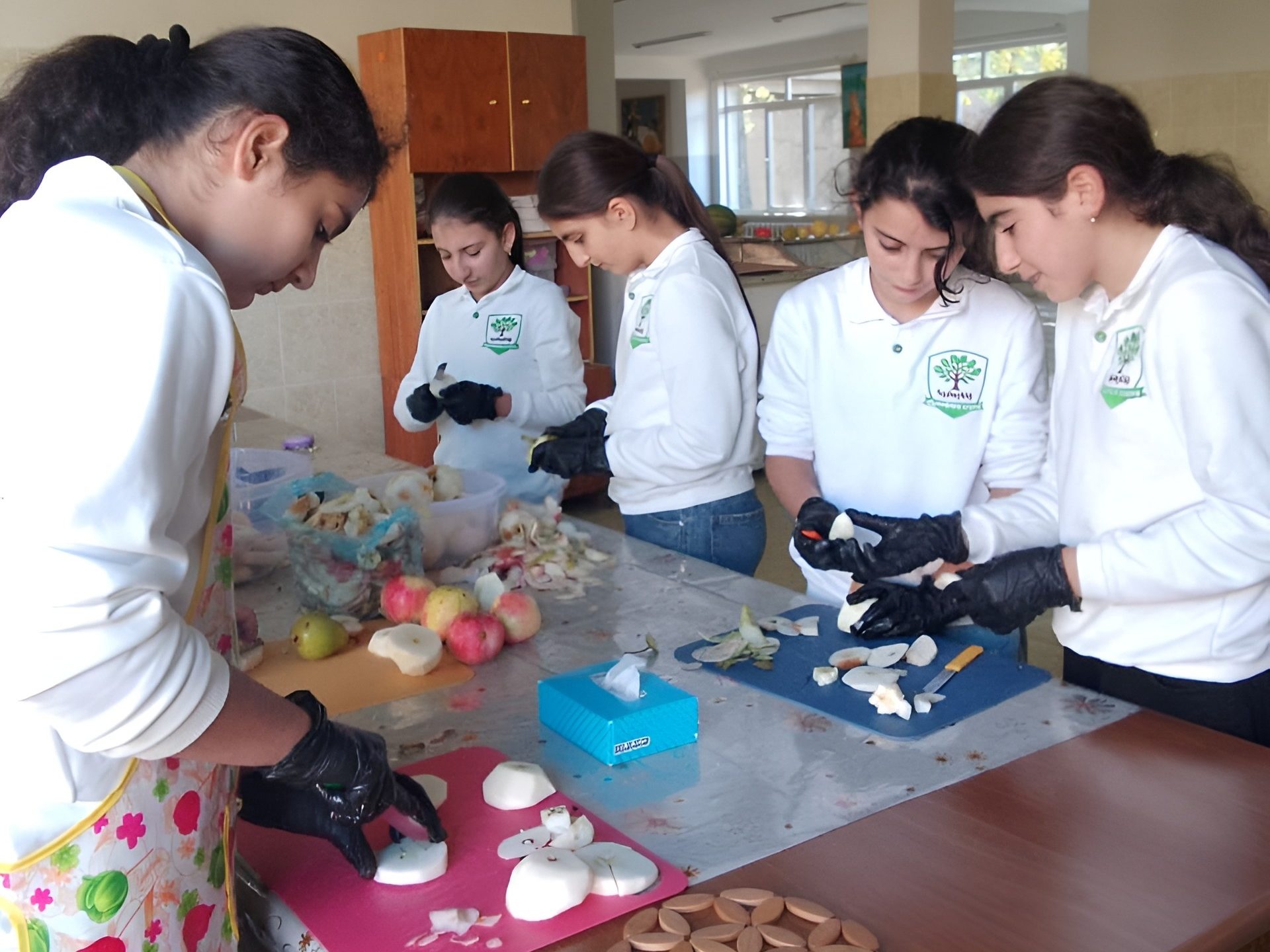
They have also taken specialised training in dried fruit production to ensure compliance with production standards.
The entire production process is carried out as a team: they collect the fruit and then work together, washing, cleaning, removing pits, and preparing them for drying. Younger students also assist them in these tasks.
Today, the students are actively developing their brand, maintaining social media pages on Facebook and Instagram and having their own logo and packaging design. They have already participated in various events, presenting their products and expanding their audience.
They have also conducted in-depth market research to understand who their potential buyers are. “This programme changed a lot in my life. Before joining, I knew almost nothing about marketing, but during the process, I started exploring, trying, and understanding. Now I already have some foundations that can be useful in any field, regardless of what profession I choose,” says Anna.
Taguhi, in turn, notes that thanks to the programme, they now have a comprehensive understanding of business management. “For me, the most important achievement was that we learned not only how to produce a product but also how to understand its real value, from cost price to sales. We also studied markets, different price points, and demand, and understood how to think like a producer, not just a consumer.”
From small steps to real results
The team members reflect on the work they have accomplished, emphasising that it has not only produced results but has also become an important experience for them. As Zhanna Ghevondyan notes, “even participating in small initiatives provides an opportunity to gain experience, develop, and learn how to assess and manage risks.”
Anna Badalyan continues this idea, emphasising that “it is precisely through trying and engaging in different programmes that skills are formed and new opportunities open up, regardless of future professional choices.”
The idea of persistence also holds a special place in the team’s reflections. As Sona Voskanyan puts it, “the most important thing is not to give up”, since even small ideas can be developed if you start with small steps and continue working on them consistently.
At the same time, Taguhi Safaryan notes that “initial fear is natural”, but in the process, it becomes clear that many things are actually possible if there is desire and readiness to achieve the goal.
MOST READ


SEE ALSO
Armavir citizens mobilise for safe drinking water
‘Europe became real faces and real stories’: Young European Ambassadors look back on ten years of friendships and community projects
Stories hidden in wood
Crafted by youth, inspired by tradition: the Hinunik story, a school where new ideas are born within old walls
From waste to high-value products: circular economy in action in Lukashin


The information on this site is subject to a Disclaimer and Protection of personal data. © European Union,
