

Crafted by youth, inspired by tradition: the Hinunik story, a school where new ideas are born within old walls
Secondary School No.107 is located on the outskirts of Yerevan – an old yet well-kept building whose walls are filled with students’ voices, ideas, and dreams. Although the school was last renovated back in the twentieth century, today it lives and breathes the spirit of the twenty-first century, shaped by modern thinking, creative young minds, and proactive educators.
The school employs young professionals who do not limit students’ development to classroom hours alone. They encourage children not to miss any opportunity to discover their abilities, interests, and vision for the future. It is precisely in this inspiring environment that the Hinunik student social enterprise was born.
The Hinunik student social enterprise initiative was launched with the support of a sub-grant from the European Union’s EU4Youth programme, within the framework of the project ‘Fostering Youth Social Entrepreneurship and Practical Career Management Skills through the innovative Social Student Companies Approach’. The programme provided students with the essential knowledge and skills needed to shape, plan, and implement their ideas. Throughout this process, they were supported and guided by CODE-SE HUB NGO.
A small room, a big idea
On the first floor of the school, in a small room, there are two sewing machines, while fabrics and various sewing accessories are laid out on a table. This space serves as the main creative and working area for Hinunik. According to the school’s Deputy Principal, Hasmik Asiryan, the room is small and in need of renovation, but there are already plans to move to a larger and more comfortable space in the near future, where the team will be able to work under better conditions.
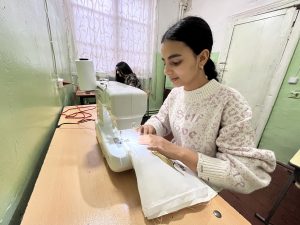
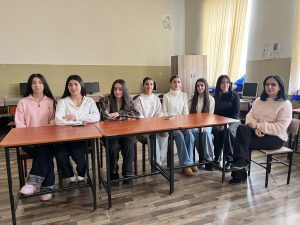
Inside the sewing room, students enthusiastically present their work and share the sewing techniques they have learned through hands-on experience. Currently, the team consists only of girls. They note that involving boys in the sewing process has been quite challenging; however, they emphasise that this business is not limited to sewing alone. Organisational, marketing, and accounting tasks are equally essential for moving the initiative forward.
Team formation and first steps
Team leader Mane Akhtskhetsyan recalls how, after learning about the programme, they decided to form a team. They discussed various ideas, tried to understand which direction interested them the most, and eventually chose eco-bag production as their focus.
At first, according to Mane, the team was rather sceptical. They assumed that preference would be given to older students or to teams that included boys. However, their hard work, mutual trust, and persistence paid off.
“At first, we didn’t believe we would be selected, but we started working hard, trusting and supporting each other. Thanks to that dedication, we were chosen and given the opportunity to start our small business,” says Mane.
Seven girls, seven roles, one goal
Today, the Hinunik team consists of seven girls. Although each of them has chosen a different career path for the future, they are all confident that this experience has left a meaningful mark on their lives. Through the programme, they gained not only theoretical knowledge but also the support of professional mentors and valuable hands-on skills.
The girls firmly believe that having a good idea alone is not enough to build a successful business. Continuous effort, experimentation, learning from mistakes, and constant progress are essential. According to Mane, one of the greatest advantages of the programme was the opportunity to build strong connections with mentors. These connections have already extended beyond the programme itself: today, she is working on her own business idea, with a clear understanding of where to start and whom to turn to for guidance and advice.
From idea to implementation
As in any well-established business, each member of Hinunik has a clearly defined role. The idea of producing eco-bags belongs to Anna Nahapetyan. After the initial team formation, it seemed that everything was in place – the team was formed, the idea was clear, and the work could begin. However, one important challenge soon emerged: there were no tailors in the team.
The students began searching among their peers for classmates with sewing skills, and this is how Gohar Martirosyan and Khana Usoyan joined the team. Today, they are the main tailors of Hinunik, responsible for sewing the bags.
Khana recalls hearing that the team was looking for tailors. Although she knew how to sew, she had never enjoyed it and never imagined that sewing could one day bring her joy. However, after joining the team, her attitude changed, and soon after, Gohar also became part of the initiative.
Marketing, calculations, and self-discovery
Lilith Hovhannisyan is responsible for the team’s marketing activities. She frequently documents the team’s work through photos and videos, prepares content, and soon Hinunik will launch its presence on social media platforms.
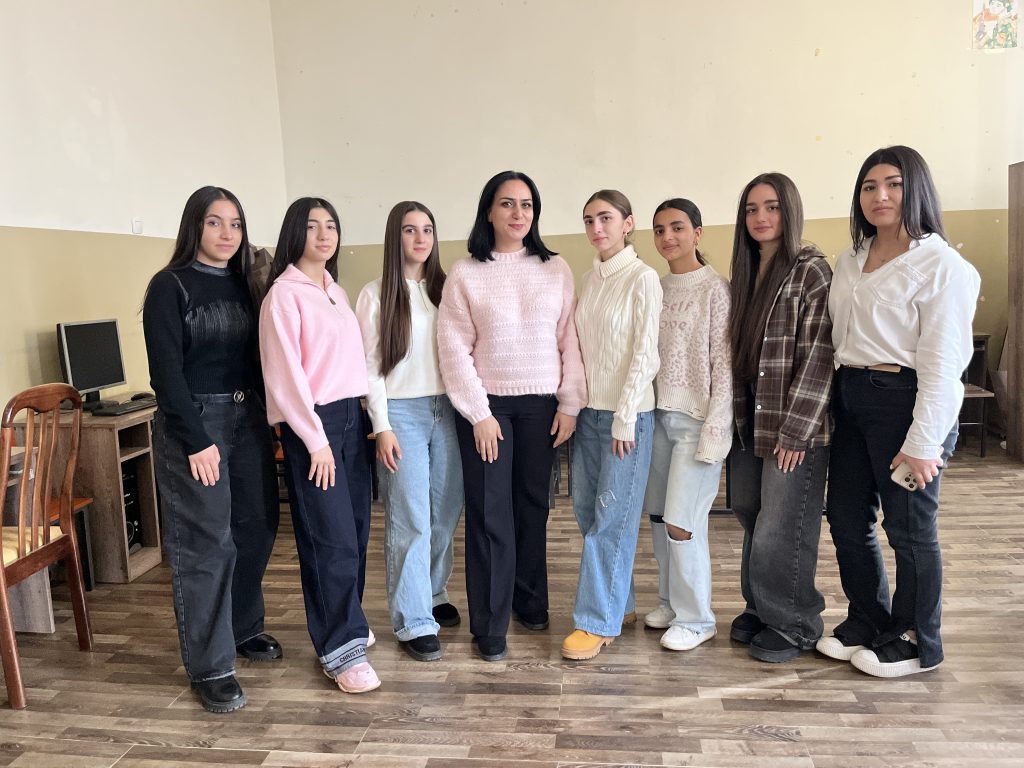
Suzan Hayrapetyan supports the team with calculations, organisational tasks, and documentation. For her, this experience has been particularly important from a personal development perspective. If in the past she avoided communicating with strangers and felt uncomfortable speaking about her interests, today those barriers have been overcome.
Anna Nahapetyan, who aspires to become a professional dancer in the future, is confident that the business knowledge she has gained will help her establish her own dance groups one day and better understand how a business operates.
The story behind the name
The name Hinunik was born from the fusion of two languages. It combines the Armenian root “hin” (meaning old), which symbolises respect for Armenian culture and traditions, with the English word “unique,” reflecting the distinctive and one-of-a-kind nature of the products.
Hin + unique = Hinunik. A name that is as unique as each bag they create.
At the core of Hinunik lies the belief that traditional Armenian ornaments and motifs can be harmoniously blended with modern design to create something that both honours the past and looks toward the future. As young entrepreneurs, the team believes that even the oldest traditions can be revived in fresh, contemporary forms, and that their generation has a unique opportunity to become a bridge between the past and the future.
First products and future plans
Today, the eco-bags produced by Hinunik are still made in limited quantities. The team collaborates with several nearby bookstores where their products are sold. While mass production has not yet begun, the girls are confident that their eco-bags stand out among the many similar products available on the market.
“First of all, we paid close attention to the size – our bags are more spacious. Second, we made the handles longer so they can be comfortably worn over the shoulder. And third, quality is key: the bags are very durable. We use them ourselves, our teachers use them as well, because they are truly practical and long-lasting,” says Gohar Martirosyan.
School support and the power of trust
According to the school’s Deputy Principal, Hasmik Asiryan, this initiative has been a valuable learning experience for everyone involved. Teachers and the school administration have developed new skills alongside the students, while for the young participants, the most important lesson was learning to believe in their own abilities.
Throughout the entire process, the school stood firmly by their side – trusting, supporting, and encouraging them. Hinunik is not just a student team producing eco-bags; it is a powerful example of how trust, collaboration, and dedication can create new value and real change within school walls.
MOST READ



SEE ALSO

Armavir citizens mobilise for safe drinking water
‘Europe became real faces and real stories’: Young European Ambassadors look back on ten years of friendships and community projects
Stories hidden in wood
Small ideas, real impact: how students built a natural food brand
From waste to high-value products: circular economy in action in Lukashin


The information on this site is subject to a Disclaimer and Protection of personal data. © European Union,
