

Our home is not made of walls. How Ukrainians have transformed their perception of home
Home. A single word with many meanings, unique to each of us. For most, home is a place of comfort, a sanctuary where family waits and where we find peace and protection, no matter what happens in the world.
Tragically, since 2014, Ukrainians have faced a different reality: one where you must defend your home to one day have the right to a quiet morning or a holiday dinner with loved ones. After 24 February, 2022, it became clear that the struggle for this right had only intensified. We had to become the walls themselves to protect everything we hold dear.
In my opinion, the idea of home is deeply sacred to Ukrainians. Beyond the long struggle for our borders – finally recognised by the world in 1991, the Ukrainian attitude toward the home has always been special. Every element, inside and out, had deep meaning.
The traditional Ukrainian house, or ‘khata’, was a true ‘place of power’. Within its walls, ancestors raised children, worked the land, and honoured the memory of relatives. The philosophy of the home began with the foundation. It was very important to choose a clean site, free from negative influence. Plots where cattle grazed were considered lucky and fertile. On the other hand, it was strictly forbidden to build where lightning had struck or where a life had been lost.
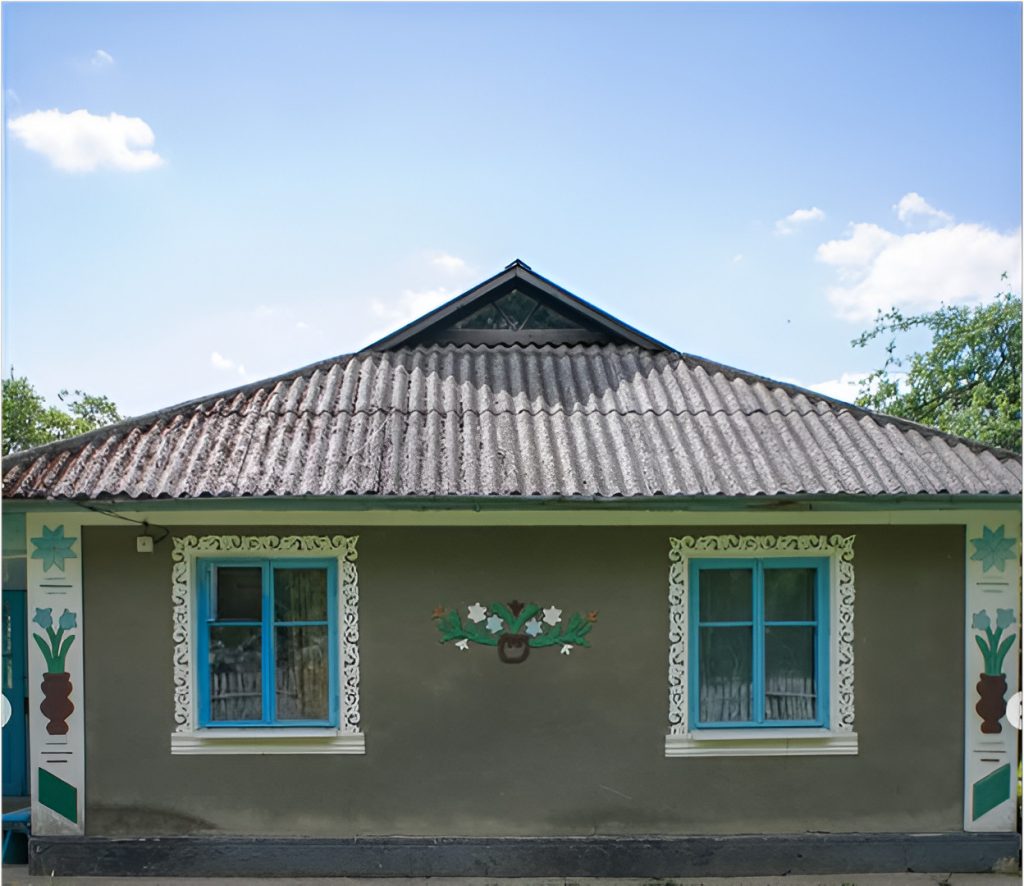
In that era, taking care of a house’s appearance was not just about style; it was a form of spiritual protection. People believed that only a house with floral murals was fit for living. They even drew a black line at the base of the walls to separate the world of the living from the ‘otherworld’.
The ‘pich’ (traditional stove) was the heart of the home, bringing the family together, providing warmth in winter, and allowing them to cook. This was the most important part of the house, because without heat, daily life was just survival. There was also the ‘pokuttia’ – the ‘holy corner’ for icons and candles – and the ‘skrynia’ (chest), where a daughter’s dowry was kept. When a girl married, she took this chest to her new home to show her role as the new mistress of the house.
We can see that while Ukrainians valued the physical home, every object was also a link to spiritual protection. Being rooted to a specific place, living within walls built by your own hands, was a core part of our culture.
Because of the constant struggle for housing after Ukraine’s independence, a specific goal appeared in the 1990s – buying and furnishing real estate to ensure a stable future. This era was defined by a demand for modern appliances and furniture, as the home became the centre of everyone’s life and dreams.
The philosophy of home for Ukrainians changed in February 2014. The events on the Maidan served as a reminder that home is not a structure and its contents, but rather the person who meets you in the evening after a difficult day of work or study. Our home is our loved ones. For many families, their heroes who defended Ukrainian values during the Revolution of Dignity against the pro-Russian regime of the time, never returned to that home. During that same month, the occupation of the Autonomous Republic of Crimea reminded us that home means freedom from territorial encroachment and hostile propaganda. The Ukrainian April of 2014 (when the first settlements in the Donetsk and Luhansk regions were occupied) became an irreversible turning point for a fundamental transformation in the perception of home. Thousands of residents realised that home is the absence of the forced seizure of Ukrainian lands and the absence of an installed Russian government. February 2022 added to this thesis the fact that home is our safety and the ability to live through every stage of life without enemy missiles overhead, turning this vision into one of the core meanings of our continued struggle.
The period since the start of the full-scale Russian invasion has shifted the meanings associated with home by another 90 degrees. This is due to the intensification and spread of the aggressor’s actions, including ballistic attacks on civilian targets, which made the issue of safety in every Ukrainian city more vulnerable. In the first days and months after February 2022, the primary task for Ukrainians was ensuring the protection of health and life for themselves and their families; consequently, our citizens left the country en masse. However, over time, most realised a simple truth: despite comfortable living conditions and, most importantly, the absence of unpredictable missile strikes on residential areas, they could not be far from their native land. They could not live without the sense of belonging to the spirit of the cities, apartments, and houses that are truly ‘theirs’; they could not overcome the longing for the familiar walls and objects that surrounded them. It is phenomenal, but for many Ukrainians, home is where the deep sense of the ‘native’ prevails over the fear of the daily risk of death. Ukrainians themselves, through their presence, become the living armour and unbreakable walls of their own homes. To support these reflections, I want to cite the words of an eight-year-old boy who, according to his mother, constantly repeated: “I know they will shell us there. I know there will be no light in winter and we will be cold. But we can put a tent in the apartment and sleep in sleeping bags to stay warm. It’s always better at home.” Anna, who moved from Kyiv to Olsztyn in Poland in March 2022, shared this story specifically for the Polish-Ukrainian media platform SESTRY in January 2024. She also noted that her 14-year-old daughter actively supported her brother’s position, saying “Kyiv is safer than at the beginning of the war, and besides, they’ve installed air defence systems”. The children convinced Anna, and they eventually returned to their native Kyiv.
For many Ukrainians, the concept of home began to evoke feelings of uncertainty and confusion. For example, I (the author) personally lost my home as a specific place and a point on the map, one I could refer to when telling stories to others, in October 2014. That was when I finally left the city of Chystiakovo in the Donetsk region, which has been occupied by Russia since the summer of 2014. During my summer holidays, I stayed with my grandmother in Kyiv and even started school there in September, but my parents decided to try and return to our normal life in our hometown. However, enduring the pressure exerted on those who showed even the slightest resistance to the ‘DPR’ regime was impossible. I was deliberately given failing grades for my school diary because I kept it in Ukrainian. Classmates threatened to ‘report’ me to their parents because I had spent the holidays in Ukrainian-controlled territory. Any movement through the city was accompanied by the sight of enemy hardware, specifically tanks, whose tracks destroyed the asphalt on the streets. Taking all these factors into account, we left to build our lives from scratch in Vinnytsia. Since then, I have had no ‘settled’ place to call home, as my residence in Chystiakovo is merely a childhood memory that I want to keep as warm as it was back then. My home’s walls cannot exist surrounded by occupiers and under the Russian tricolour. My home is where Ukraine is free, even with all the trials it faces.
The problem of losing one’s home is relevant to a vast number of Ukrainians. According to data from the Ministry of Social Policy, as of November 2025, there were 4.6 million registered internally displaced persons (IDPs) in Ukraine. The largest number of IDPs is in the Dnipropetrovsk region (557,000), followed by the capital, Kyiv (433,000). Significantly, not all migration movements are between regions. More than a quarter of displaced people (27% of IDPs) were forced to move within the same region they originated from. According to this criterion, the ranking is as follows: Kharkiv, Zaporizhzhia, and Dnipropetrovsk regions. This trend can be explained by a desire for financial savings and a wish to remain close to the location of their home. The latter also stems from the need to keep the housing situation under control and to be able to return home at any time, even if under shelling or occupation. Why is this so? Primarily, not everyone retains the ability to rent housing in another city due to a lack of funds. Secondly, unfortunately, abandoned homes are often broken into and occupied by Russian forces, after which they are resold to other owners. In such cases, those who moved even to the nearest Ukrainian-controlled settlements would have nowhere to return to. Consequently, the housing issue often dictates the fate of our people and forces them to live under a hostile flag to avoid losing the rights to their own apartments or houses. It is even harder for those citizens whose cities, and thus their homes, have been completely destroyed by Russian missiles. For example, according to the Mariupol City Mayor, during the blockade of the city, Russians destroyed 52,000 apartments. As of December, the Ministry of Community and Territorial Development, in a comment to the Ukrainian media outlet 24 Channel, reported that 13% of the housing stock in Ukraine has been destroyed or damaged. This involves approximately 60 million square meters, and the cost of restoring the destroyed housing is at least $86 billion.
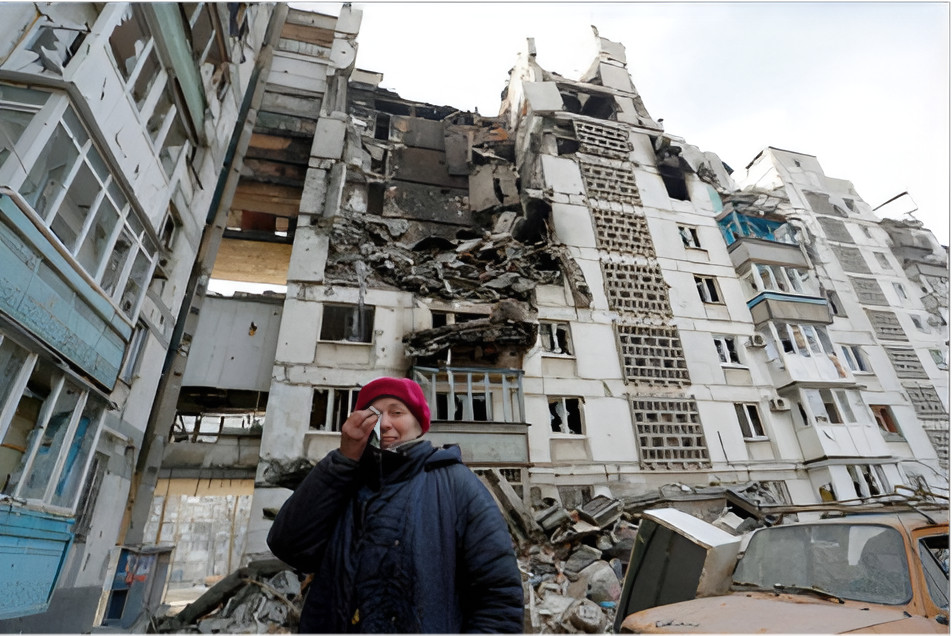
I want to emphasise most strongly that throughout the years of the War for Independence (from 2014 to the present), a fundamental transformation has occurred: home has ceased to be merely a material object and has become a synonym for community and resilience. This transformation has found its continuation in the modern process of community-building. The ‘geometry’ of the home itself has changed radically; when physical walls are destroyed or left behind the front lines, Ukrainians begin to build a new home – one that stands on the foundation of collective action and the sense of belonging to the defence of the state in the place where you are most useful.
Today, being home means, above all, feeling a living connection with those who share your path. Research by the Cedos think tank indicates that within the first year of the full-scale invasion alone, a tectonic shift occurred in the consciousness of the youth. The proportion of young people involved in volunteering rose from 20% to 42%, while the goal of ‘being useful to the country’ as a primary life aim surged from 6% to an impressive 37%. This patriotic shift became the new ‘foundation’ holding the country together: 66% of youth consciously choose to stay in Ukraine, and 76% of those abroad plan to return. Their home is no longer where it is safest, but where they feel their own agency and the strength of the community.
This new type of home is built not only of bricks but of memory and action. An example of this continuity is the ‘Crane Workshop’ (‘Maysternia Zhuravlia’), founded in Lviv in memory of the fallen defender, Scout, and restaurateur Dmytro Pashchuk (‘Harmash’). His ideas and dreams have been transformed into a volunteer workshop where dozens of people assemble drones in their spare time. Here, a friend’s work continues in every detail; this is a modern ‘pokuttia’ (holy corner), a sacred space where the memory of those we have lost provides light for those holding the line.
The concept of home for the youth community in 2025 has scaled to the level of entire cities. In 2025, when Lviv became the European Youth Capital, the ‘TVORY!’ network succeeded in uniting over 42,000 young people from all over Ukraine. Flagship events of the year – Molodvizh, Desarium, Youth Day, and OL Fest – attracted over 37,000 participants, proving that youth are the primary architects of social change. Through the ‘Molofond’, 39 projects worth 5.6 million UAH were implemented, and the collective efforts of the youth raised over 4.5 million UAH for the Armed Forces.
A similar spirit of solidarity fuels the BUR (Building Ukraine Together) initiative, where collective labour, from outfitting military hangars to creating educational spaces at the UNBROKEN rehabilitation centre, becomes a ritual of creating new spaces that will one day be affectionately called “home”.
The reimagining of home manifests even in the darkest moments of the energy terror, which became particularly acute in the winter of 2025-2026. If the stove (‘pich’) was once the symbol of family warmth, today it is the shared generator or the extension cord provided to a neighbour. The common darkness has not divided us; it has ‘stitched’ us together, and there are many proofs of this: Kyivans hosting raves in blacked-out Troieshchyna, or women sharing ‘pampukhy’ (Ukrainian donuts) in freezing high-rises. We are witnessing how home expands far beyond the front door.
It is in this ability to rally around shared values that the highest form of home has been forged: the ‘Community of the Resilient’. Today, for a Ukrainian, home is not just an address or property; it is an unbreakable bond between people. This is the home that cannot be destroyed by missiles, for in this time of great war, we have become the walls for one another.
LATEST
The green transition and enlargement: is climate policy the EU’s strongest bridge?
Living Europe: from Erasmus dreams to building Moldova’s European future
Young voices of Moldova: why youth and EU integration should shape Moldova’s future today
Young voices, Europe’s future
Georgian filmmakers on the front line of European values


The information on this site is subject to a Disclaimer and Protection of personal data. © European Union,
