

Georgian filmmakers on the front line of European values
My country, Georgia, holds EU candidate status, seeking full membership alongside other candidate countries. This path, which had already been facing political hurdles, reached a critical turning point on 28 November 2024, when Georgia’s Prime Minister announced the suspension of EU accession talks. The decision ignited a massive wave of protests in front of Georgia’s parliament, which has now persisted without interruption for over 500 days.
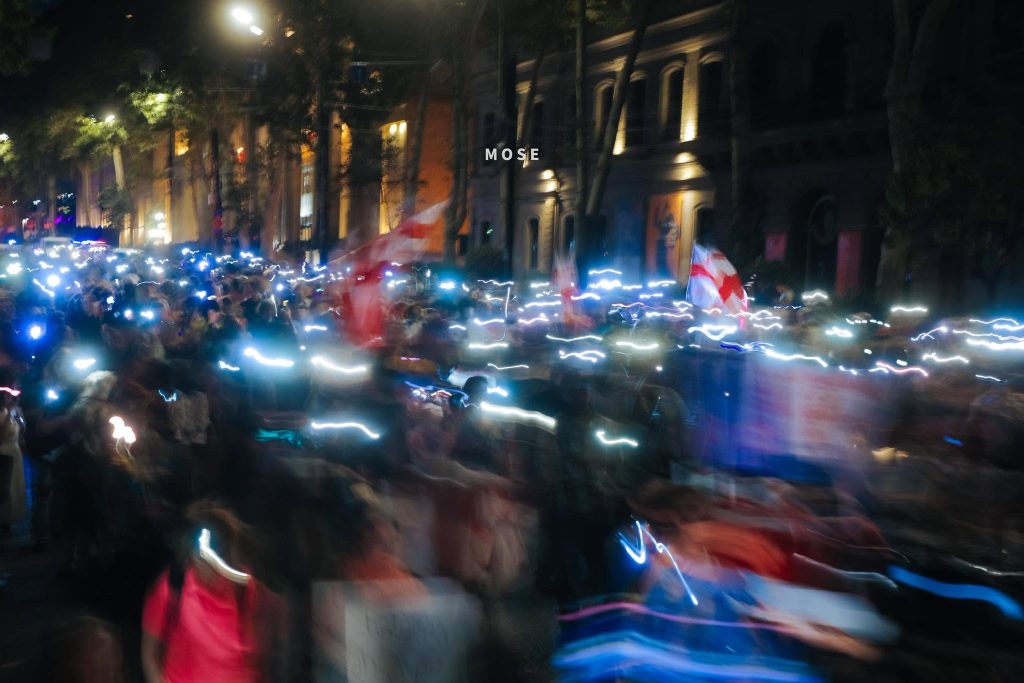
Every evening on Rustaveli Avenue in Tbilisi, you will find a true cross-section of society – people of all ages, backgrounds, and professions standing together. One of their primary demands is crucial: Georgia must return to its European path and secure a future built on real democracy, human rights, and freedom of expression.
Among these citizens are Georgian filmmakers, who began their resistance a year earlier. In 2023, the government initiated a restructuring of the Georgian National Film Centre (GNFC) allegedly in an attempt to purge critical voices. In response, over 450 professionals united to form the “Georgian Cinema is Under Threat” movement and boycotted the GNFC. Despite it being the country’s only funding body for cinema, Georgian filmmakers’ stance remains uncompromising: Georgian cinema will survive.
As the political crisis deepened, these filmmakers realised they could contribute more than just their physical presence to the demonstrations. They picked up their cameras to capture the human stories behind the protests.
I interviewed ten filmmakers to understand their creative resistance – we discussed European values, the unique voice that Georgian cinema offers Europe, and how the broader prospect of EU enlargement, with Georgia as part of it, could transform the film industry in our country.
Tekla Machavariani (Producer)
Tekla co-initiated the project documenting detained “prisoners of conscience“. To fight state propaganda and spark empathy, eleven short documentary films were created to show that arrested pro-European protesters are simply ordinary citizens. “They are not political activists; they are regular people just like us who simply worried about the fate of their country and stepped outside,” she explains.
When discussing what European integration means for her, Tekla points to a fair, functioning court system. “When you lose it, and justice completely disappears around you, then you realise that it is the air that keeps you alive,” she says. She believes that joining the EU would provide the free environment essential for art to thrive, gradually bringing international co-productions and financial investment, while sharing Georgian culture globally.
Giorgi Varsimashvili (Director)
Giorgi documented Insaf Aliev, an ethnic Azerbaijani citizen of Georgia. Despite not speaking Georgian, Insaf went from his rural village to the capital to join the pro-European protest, where he was arrested.
“If there are two fields on earth that cannot be separated, they are art and politics. It is impossible to live in an unjust country and expect your profession to flourish. When everything around you is on fire, you cannot be a single blooming garden.”
Giorgi emphasises that the EU’s core is its respect for human dignity. He sees it as the world’s most culturally diverse union because it protects each member’s unique heritage – a diversity to which Georgia has a distinct artistic voice to add.
Keti Machavariani (Director)
Keti directed a short film about Giorgi Mindadze, a protester sentenced to a year and a half in prison for allegedly setting off a firework. The film was built around Giorgi’s old school notebooks, and highlighted his childhood essays on morality, nature, and his country.
Keti sees the fight for European integration as a direct stand against Soviet-style censorship. For her, European values are grounded in freedom of expression and the acceptance of diversity. As a university lecturer, she emphasises the practical benefits that EU membership brings to the next generation, including exchange programmes, better technical resources and major European film funds. Culturally, she views film as an essential export. “Georgian cinema is part of our identity, just like Georgian wine,” she explains.
Anna Dziapshipa (Director)
Anna directed a short film about Temur Katamadze, the “Flagbearer from Batumi”, who has since been forced to leave Georgia.
“For me, these European values have come down to very simple things,” Anna told me. “It should probably mean living the way you want to live without anyone standing in your way – doing the work you love and somehow contributing to society through it.” She believes EU membership would open new doors for Georgian filmmakers to access professional networks, collaboration, and funding.
Beyond the films focused directly on political prisoners, directors also turned their lenses toward the broader, personal impacts of the ongoing civic resistance.
Levan Tskhovrebadze (Director), Ani Kiladze (Director), Liza Alpaidze (Producer)
Levan and Ani co-created the short documentary “Fragments on Resistance” (Chai Khana, 2026) Following two friends – one in Georgia and one in Serbia – the film documents their changing worlds amidst political unrest.
“Ultimately, we showed the psychological process from hope to uncertainty, rather than just the direct state of the protests,” the producer, Liza, explains. “How a person going through such prolonged, multi-year protests experiences something like the stages of grief. There are many films about the protests, but what I love about ours is that it focuses on a very personal experience – one that is, more or less, shared by everyone.”
Mari Gulbiani (Director)
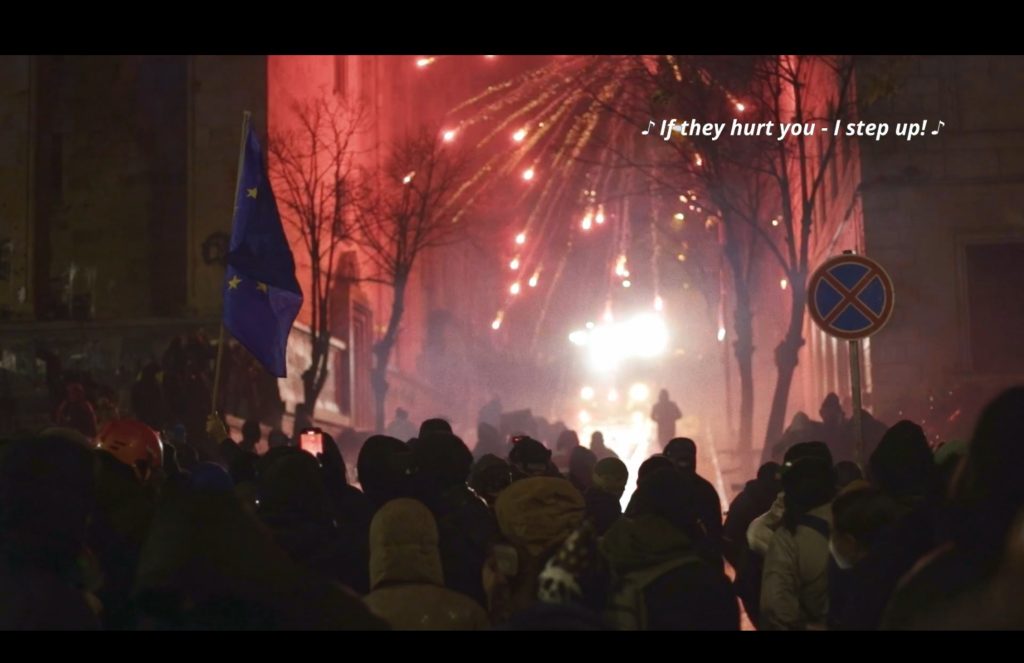
Mari’s documentary is a story of friendship and solidarity. When Dato Simonia’s friend was arrested at a pro-European demonstration and sentenced to ten days in prison, Dato went to the Zahesi detention cell to protest. He was soon joined by his sister, Salome, and together they waited outside for the release of their friend. After seeing their social media post, Mari felt an immediate need to capture it.
To Mari, European values mean the ability to co-exist with those who hold different opinions in a democratic, free society.
Niniko Lekishvili (Director)
Niniko Lekishvili directed “Chase”, a short film following Georgian actor Kakha Kintsurashvili during the protests of early 2025. Feeling a sense of powerlessness at the time, she picked up her camera to document his journey. For her, filming was a way to process the overwhelming reality.
When discussing European values, Niniko emphasises justice and human freedom. “Justice was taken from us, but I think freedom hasn’t been taken yet, at least not from those who fight,” she notes.
Tiku Kobiashvili (Director)
Tiku’s first short film was initially a coming-of-age story about her two best friends. However, when the “foreign agent” law was reintroduced, the street protests inevitably took over their daily reality. After that film, she directed another short documentary about Zviad Tsetskhladze, a prisoner who started a handmade newspaper from his cell.
When I asked what her message would be for international readers, Tiku’s answer was a direct call to action: support independent Georgian journalism through Sinatle Media. “Financially backing uncensored outlets is the most effective way to ensure the true voice of the Georgian people continues to be heard,” she says.
As Georgia fights to secure its place within the EU’s next enlargement package, the contribution of Georgian filmmakers remains an essential part.
Sources:
Davalou L. & Naughtie A. (2024, 28 November). Georgian Prime Minister suspends EU membership talks until end of 2028. Euronews.
JAMnews (2026, 11 December). Georgia protests: 500 days of continuous demonstrations.
Kapanadze T. A. (2025, 22 October). Review | Prisoners of Conscience — Georgian filmmakers tell the stories of detained protesters.
Indigo (2025, 7 March) Newspaper from Prison | Zviad Tsetskhladze Case.
Radio Free Europe (2023, 11 August). Over 200 Cinematographers Boycott GNFC.
LATEST
From displacement to enterprise: rebuilding my community through entrepreneurship
A message from the YED Coordinators
My personal experience as a Young European Diplomat viewing the EU for the first time
A blueprint for enlargement: what we can learn from Moldova, Ukraine, and Montenegro
Young European Diplomats Club


The information on this site is subject to a Disclaimer and Protection of personal data. © European Union,
