

Why doesn’t Ukraine just give up Donbas and end the war?
One of the recurring questions I’m occasionally asked in various European countries is: why doesn’t Ukraine just give up Donbas, as Putin wants, and simply end the war? Thank God, I haven’t been asked this in Croatia or the Baltic countries – perhaps because Croats, like Lithuanians, Estonians, and Latvians, still remember quite well what it means to be under occupation. And what it means to lose your own nationality, or what it’s like when a country with a different religion, language, and history swallows you up.
In response to a reporter’s question about the American position on Donbas, Secretary of State Marco Rubio replied that the US had never told Ukraine that it “must accept or leave”. As he said, the decision is entirely up to the Ukrainians: “They don’t want to make certain decisions or concessions, so the war continues,” Rubio said.
The surrender of Donbas is a key Russian demand
You can play with words all you want about what “decisions” are meant, but the answer is clear: one of Russia’s key demands is that Ukraine hand over Donbas.
Meanwhile, Zelensky is absolutely right when he responds to such demands by saying: “Donbas is not just territories, it’s people.” People who are forcibly living under occupation. Among them, many children. One of the stories documented by The Reckoning Project shows very clearly how Ukrainian children try at all costs to escape the occupation and return home, to Ukraine.
The heartbreaking story of Marina from Mariupol
For more than three years, Marina (the names of abducted girls in the article have been changed for security reasons) was forced to live in Russia. Her family – Marina, who was 14 at the time, her parents, and younger brother – left Mariupol in April 2022. Going to Russia then seemed like the only way to evacuate from the besieged city.
In Russia, Marina attended school where teachers told her that Russia is a powerful country protecting Russian-speaking populations, but she could not bear the hostile environment she found herself in. Hiding her plans from her parents, Marina contacted volunteers and returned to Ukraine on her own.
“In many situations, I was walking on the edge of a knife. And everything could have ended badly,” Marina says.
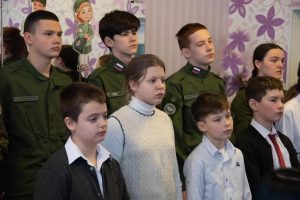
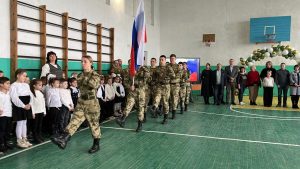
When she left Mariupol in April 2022, Marina initially completed the 9th grade of Ukrainian school online, but in September 2022 she started attending a Russian school. She recounts seeing children marching in military uniforms with flags during a school performance.
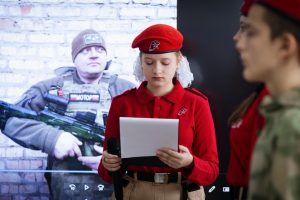
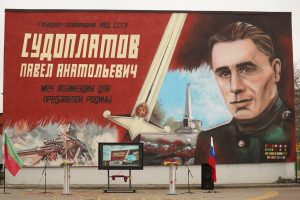
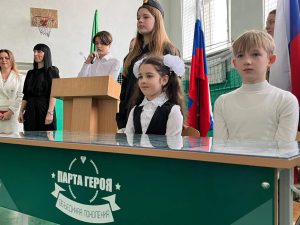
In 10th grade, a teacher asked her to prepare a presentation about military actions in Mariupol for ‘Lessons on Important Matters’. In these lessons, students are taught about their duty to the homeland and are presented with justifications for the ‘Special Military Operation’, as the Kremlin calls the war that has now entered its fifth year.
Portraying the people who destroyed her hometown as heroes
Marina recalls that in class they were shown videos of the people who had destroyed her city, portraying them as heroes. The teacher encouraged students to collect aid for Russian soldiers.
Marina prepared her speech, describing everything as it really happened. That day began as usual: the anthem played, students carried out the flag. It was time for her presentation.
“I simply told them that it was difficult there, what the conditions were like, how we were trying to survive… And I also mentioned that there had already been many cases of sexual assault by soldiers. I didn’t say they were Russian. One of my classmates asked: ‘Whose?’ I said: ‘Well, of course, Russian’,” the girl recalls.
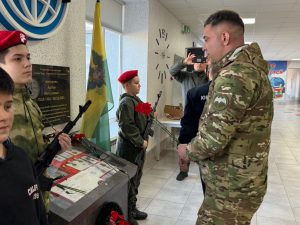
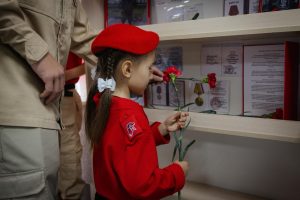
After her presentation, the teacher remained silent for a long time, then said: “Thank you for your presentation, sit down.” Marina was surprised by her restrained reaction. The classmates were hardly interested in politics or anything outside school. In addition, students were taught to assemble automatic rifles and encouraged to join the ‘Yunarmiya’, a Russian organisation focused on indoctrination and militarisation of children. In 10th grade, Marina realised it was hard to force herself to go to school, and later she enrolled in college.
Longing for home
Marina often recalls her happy life in Mariupol: drawing in the parks or spending days at the beach. At the end of February 2022, the city lost electricity and signal, and shops ran out of food.
The family stayed in their apartment, all in one room where the windows remained intact. They ate old supplies: jams, preserved food, cookies. One day a shell hit a neighbouring building. “And then everything caught fire. The fire gradually spread to our apartment,” Marina remembers.
Her parents grabbed belongings and ran to the basement. There they learned about the possibility of evacuation to Russia via Novoazovsk. They walked over 60km on foot. Along the way, other people joined their group, forming a column of refugees. From Novoazovsk, they took a bus to the border.
There, the family went through “filtration” – interrogations, document checks, and biometric data collection. The checks lasted several hours. Marina saw a family whose children cried because they had been delayed while their mother was interrogated for a long time. “There were so many people. I just sat on one of the bags and dozed off. Night, everyone was hungry, tired.” The family managed to pass the filtration and find shelter in Russia.
Secretly ordered Ukrainian jewellery
In Russia, Marina survived, but she couldn’t live as herself. At college, she pretended to be Russian. She avoided interacting with others. She was anguished by the indifference toward events in Ukraine: “They burned your city, destroyed it, killed people. And there, people don’t even have a basic understanding of what that means.”
At one point, Marina bought Ukrainian jewellery from an online store, but afterwards she feared the risk for a long time. Any careless word could lead to punishment. She was shocked by the news of a woman imprisoned for positively mentioning Ukraine on a Telegram channel.
A smile for freedom
One day, Marina came across an article about teenagers who had managed to leave Russia. She connected with volunteers through a Telegram channel. She didn’t tell her parents because she feared obstacles. “They said it was dangerous in Ukraine, that it was better not to return.”
She told her parents she was going to another city, and alone she travelled through Belarus toward Ukraine. At that moment, she turned 18. During the journey, she kept in touch with the volunteers. In Ukraine, relatives welcomed her. Marina now continues her education in a technical school. A smile often appears on her face because in Ukraine she feels free.
Children under occupation
According to the Ukrainian government, the number of deported children reaches nearly 20,000. About 1.6 million Ukrainian children are in temporarily occupied territories. One of them was Samira from the Kherson region.
Samira stopped attending her school, where Russian standards, Putin’s portraits, and the Russian anthem had been introduced. She secretly studied online according to the Ukrainian curriculum. Life under occupation reminded her of the Soviet Union: “The radio plays old songs, the city has become very grey.”
When she turned 18, Samira crossed three borders. During interrogations, she was sometimes held simultaneously by five security officers. Today, she feels free: “I like that I can communicate in Ukrainian, listen to Ukrainian songs.”
The complex process of reclaiming oneself
Natalia Sosnovenko, a psychologist at the ‘Voices of Children’ Foundation, emphasises: “Children who are returning experience a strong state of anxiety. While there, they had to hide their emotions. This is a complex process of reclaiming oneself – not physically, but psychologically. It is important to create a safe environment, providing support and understanding.”
The Office of the Prosecutor General, in cooperation with the Ukrainian Security Service (SBU), continues to investigate the facts of deportation and forced relocation of Ukrainian children. In all of this, Russia’s intent is clear: the destruction of Ukrainian identity.
This story was written in collaboration with The Reckoning Project, an initiative that brings together journalists, researchers, data scientists and legal experts to document war crimes, build legal cases, and combat disinformation by using reliable media outlets. The European Union last year reinforced its support for The Reckoning Project.
Author: Eugene Stepanenko
The original article was published in Croatian by Index.hr
MOST READ
SEE ALSO
From passion to mission: how Sofiia Nazarenko became a voice of Ukrainian journalism through EU4Youth
A partnership that builds resilience
Packaging from mushrooms: how a Ukrainian start-up is contributing to Europe’s green economy
From idea to energy: how Kyiv youth are developing the ‘energy willow’ project
A space where science comes to life: how an interactive museum in Ternopil is inspiring the community


The information on this site is subject to a Disclaimer and Protection of personal data. © European Union,
