

From passion to mission: how Sofiia Nazarenko became a voice of Ukrainian journalism through EU4Youth
In a world where the information war is as intense as the one on the battlefield, Sofiia Nazarenko from Ukraine chose to fight through quality journalism. From reporting on historic events at just 18 to becoming a TV presenter in Kyiv, her journey is defined by a strong determination to deliver the truth. Through the EU4Youth Scholarship Programme, Sofiia transformed this passion into European-level analytical expertise at the College of Europe in Natolin.
A first encounter with global politics
Originally from Zaporizhzhia, Sofiia began her career early, at just 17. However, 2019 became the defining year in her path: at 18, she was in Paris reporting from the Normandy Format – a diplomatic platform established in 2014, bringing together Ukraine, Russia, France, and Germany to negotiate solutions to the conflict in eastern Ukraine – where Vladimir Putin and Volodymyr Zelenskyy met for the first high-level talks in years. That experience sparked her interest in international politics.
After the start of the full-scale invasion, Sofiia moved to Brussels, where she pursued a Master’s degree in Political Science and worked as a special correspondent for Channel 24 (Ukraine) and Radio France Internationale. Her ambition to build a future in Ukraine while maintaining a strong European perspective led her to the College of Europe in Natolin, Warsaw, through the EU4Youth programme.
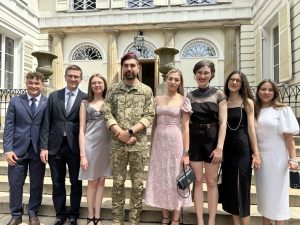
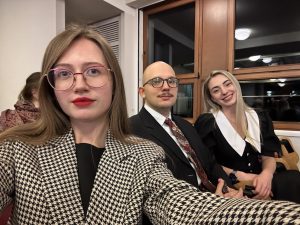
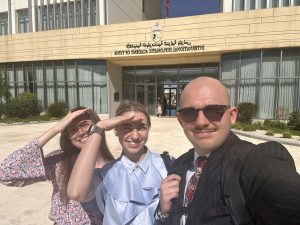
“I felt that the environment and knowledge at Natolin would strengthen my profile – and that’s exactly what happened. The EU4Youth programme essentially helped me turn this dream into reality and gave me the opportunity to receive one of the best educations in Europe,” Sofiia says.
Wider Europe and Ukraine’s European integration
At Natolin, Sofiia chose the specialisation “The EU in the Wider Europe and its Neighbours”, a strategic decision for her future. It provided her not only with a deep understanding of accession processes, but also with the tools needed to counter manipulation narratives.
“From a career perspective, I aim to be involved in Ukraine’s European integration. That’s why I wanted to better understand this field and learn from leading experts and professors – which I successfully did. At the same time, as a journalist, I closely follow Ukraine’s path toward EU membership. The knowledge I gained allows me to approach this topic with confidence and depth. After completing the Programme, I can describe myself as a journalist with strong analytical expertise in European affairs,” Sofiia explains.
Being familiar with EU processes, including procedures and legislation, she actively applies this knowledge in her work as a journalist. Moreover, Sofiia is able to explain complex topics related to European integration in a clear and accessible way for the wider public. The experience she has gained allows her to identify disinformation and counter it with well-grounded analysis. Looking ahead, she aims not only to inform citizens accurately but also to contribute to strengthening Ukraine’s European path.
The Natolin experience: ‘People, Knowledge, Emotions’
Beyond academic life, Sofiia’s experience was shaped by solidarity. She was actively involved in organising events supporting Ukraine on campus, from charity fairs to commemorations of the invasion. She also built strong friendships with remarkable individuals, many of whom later became trusted sources for her programmes.
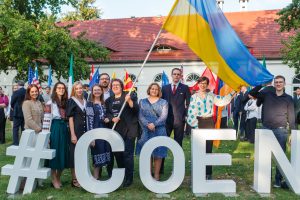
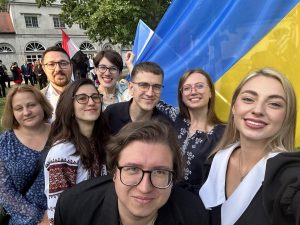
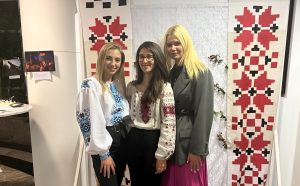
“I realised that in a world full of disinformation, even a small ray of truth can increase global support for my country. I now have a solid academic foundation, and my materials are much more professional. Natolin also provided me with a very valuable professional network. Many alumni work in embassies in Ukraine, which enables them to build collaborations much easier across borders,” the young journalist emphasises.
At the same time, these connections strengthen her ability to report with accuracy and depth.
Journalism as a weapon against propaganda
Being a responsible journalist in Ukraine, especially during wartime, is critically important. Today, Sofiia covers international news with a focus on Ukraine, while the European Union and NATO remain central topics in her work. One of her key motivations is to help her country win the information war.
“Currently, I host a programme where I analyse Russian propaganda in English – explaining how Russia justifies the war, what narratives it promotes, and what its real intentions are. I believe that today, when Russia operates hundreds of bot farms and invests millions in anti-Ukrainian content, clear and fact-based reporting can help counter propaganda and improve how Ukraine is understood internationally,” Sofiia says.
Programmes such as EU4Youth have also played an important role in empowering young professionals like Sofiia to develop critical skills and resilience. Through its support, participants gain access to education, networks, and opportunities that strengthen their ability to respond to disinformation. This kind of initiative helps amplify credible voices in the media landscape. In turn, it contributes to building a more informed and resilient society.
Advice for young journalists
For those aspiring to a career in political journalism, Sofiia has a clear message: “Start as early as possible. Journalism is learned through practice. Don’t be afraid to ask tough questions and knock on every door.”
Today, Sofiia Nazarenko is a TV presenter at Channel 24 (Ukraine), continuing to promote her country’s European integration with the professionalism and rigour that she developed at the College of Europe in Natolin.
MOST READ
RELATED PROJECTS
SEE ALSO
A partnership that builds resilience
Packaging from mushrooms: how a Ukrainian start-up is contributing to Europe’s green economy
From idea to energy: how Kyiv youth are developing the ‘energy willow’ project
A space where science comes to life: how an interactive museum in Ternopil is inspiring the community
‘Europe became real faces and real stories’: Young European Ambassadors look back on ten years of friendships and community projects

The information on this site is subject to a Disclaimer and Protection of personal data. © European Union,
