

High-tech rehab services to face the pressure of war
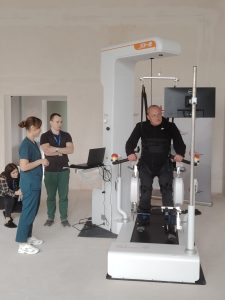
“My arm has recovered by about 90%, and my leg is still behind, but I am doing much better. When I arrived here, I couldn’t walk without a stroller. Now I can.” Ihor Popovic is a serviceman in the Ukrainian army. A few months ago, after suffering a stroke while on duty, he was first treated at a front-line infirmary, then transferred to a medical facility in Lutsk, and finally admitted to Volodymyr Hospital in northwestern Ukraine. Here, he began the long and demanding rehabilitation journey needed to regain control of his body. At the hospital, Ihor found not only specialised medical care, but also AI powered rehabilitation equipment recently acquired through the RehabHelpPL-UA project, funded by the European Union. “I am not functioning at 100% yet,” he says, “but I keep working, and I hope everything will be OK soon.”
A growing demand due to war injuries and displacement
Despite operating within different public healthcare systems, municipal medical institutions on both sides of the Polish – Ukrainian border are confronting similar pressures. Chronic shortages of equipment and medical staff, combined with a steady rise in patient numbers, are stretching local capacities, making it harder to access specialised care. These challenges have been amplified by the war: Polish border regions are responding to the influx of Ukrainian refugees, while Ukrainian facilities face a growing demand for rehabilitation and long-term treatment linked to war-related injuries.

To tackle these issues, the RehabHelpPL-UA project – implemented in the framework of the Interreg NEXT Poland-Ukraine Programme – has set out to improve access to high-quality medical services through investments in infrastructure, equipment and staff training. In the Municipal Hospital in Białystok, in Poland, the wards of internal medicine and the rehabilitation clinic are being renovated. Meanwhile, the Volodymyr Hospital in Ukraine is enhancing its rehabilitation services thanks to modern, high-tech equipment, including AI-powered rehab services. Both institutions are also expanding psychological support for people facing depression and trauma. In addition, the project plans to soon establish teleconsultation systems, to enable the exchange of medical and tele-imaging records from devices like ultrasounds, scans and magnetic resonance.
Quick results thanks to advanced technology
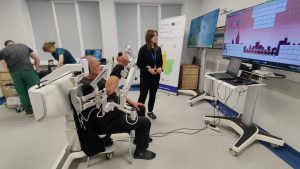
Advanced medical technology can be a breakthrough for health systems under pressure. It helps widen access to care, it supports earlier and more accurate diagnoses, and improves the overall quality of treatment and patient outcomes. Ganna Nesteryak, the project manager, is very proud of the hospital’s new technological equipment. “Among other tools, we have received a robotic system for upper limbs rehabilitation, and a table verticaliser for lower limbs: in one year, more than 700 patients were able to use them, both civilian patients and military personnel injured in conflict zones. The results are impressive.” In countries where health resources are limited, the impact of high-tech care can be especially strong. Modern tools allow hospitals and clinics to make better use of scarce staff and equipment, treat more patients, and reduce the risk of medical errors. At the same time, they help narrow regional gaps by bringing specialised services closer to remote and underserved communities that would otherwise have little, or no access to advanced care.
At Volodymyr hospital, physical therapists involved in the project say the new equipment speeds up the recovery also by helping them to better understand patients’ movement problems. The table verticaliser clearly shows when a leg is too stiff to continue an exercise. If this happens, the system signals it, and the therapist knows it is time to stop, let the patient rest, or continue later. The robotic system used for arm rehabilitation also measures how the joints move, and how strong they are. This information helps therapists to prepare a rehabilitation plan that is adapted to each patient. Kristina Savyuk, the rehabilitation coordinator, is enthusiastic about the results obtained. “The new equipment really makes a difference for us, we can see progress from one day to the next, for example, how much stronger a limb has become from Monday to Friday, or how the movement in the elbow has improved. Patients love this too. They move forward faster and with a much more positive attitude than during traditional, passive therapy. The games on the screen keep them focused on what’s happening there instead of on the effort itself, which makes the whole process not only quicker and more effective, but also simply more enjoyable.”
A strong experience to be shared with European partners
Another key part of the project is the training of medical staff. Ukrainian physicians have already taken part in courses on pain management in Bialystok, Poland. A new specialised course is now being planned to bring together all partners to evaluate the use and outcomes of the robotic rehabilitation system. “When the project was first designed, a few years ago, we were counting on the transfer of expertise from our Polish partners, and we have certainly gained it,” continues Nesteryak. “But since the start of the war, our hospital has also accumulated extensive experience, particularly in rehabilitation. Now, our medical specialists can share their knowledge with their Polish colleagues as well.”
As a matter of fact, advanced medical technology – when combined with proper training – can also build local capacity, helping to retain skilled professionals, and supporting the long-term development of border regions. “At the beginning of the war, many European countries helped us with equipment, training, medicines and consumables that we still use to this day,” concludes the medical director, Serhiy Yarmolin, “but the continuous partnership brought by instruments like the cross-border cooperation, has become vital for our hospital, and our city.”
Author: Daniela Cavini
MOST READ



SEE ALSO
From passion to mission: how Sofiia Nazarenko became a voice of Ukrainian journalism through EU4Youth
A partnership that builds resilience
Packaging from mushrooms: how a Ukrainian start-up is contributing to Europe’s green economy
From idea to energy: how Kyiv youth are developing the ‘energy willow’ project
A space where science comes to life: how an interactive museum in Ternopil is inspiring the community


The information on this site is subject to a Disclaimer and Protection of personal data. © European Union,
