

Why the free movement of workers matters for Ukraine’s EU future
The principle of free movement of people is often called one of the cornerstones of the European Union. It is the right that allows EU citizens to live, work, and study freely across member states. For many, it is the most tangible expression of belonging to the European family. For Ukraine, preparing to join this system is not simply a legal obligation. It is about giving people opportunities – and about anchoring our future inside the EU.
My interest in this topic is not new. As an expert in employment policy and labour migration, I have spent years analysing how labour mobility shapes economies and societies. During my participation in the Natolin4CapacityBuilding programme at the College of Europe in Natolin, I had the chance to study the EU acquis on free movement and to compare it with Ukraine’s current framework. This experience gave me valuable insights into how other countries managed accession, and how technical rules on labour mobility are in fact deeply connected to broader questions of social policy, education, and equal opportunities.
Also, I explored these issues more systematically in my PhD research, where I focused on practical aspects of labour migration and employment. That academic work turned out to be directly relevant during the screening process, as I contributed to preparing Ukraine’s negotiation positions for Chapter 2 (Freedom of Movement for Workers). But what struck me most is how interconnected this chapter is with many others: the recognition of professional qualifications (Chapter 3), the rights of workers and anti-discrimination standards (Chapter 19), the functioning of social security systems, etc. In practice, these are not separate boxes – they form a network of rules that protect people and create real opportunities across borders.
Why does this matter so much for citizens? Because without transparent systems for recognising skills and qualifications, people cannot fully access opportunities abroad; without strong equality and anti-discrimination protections, workers risk facing unequal treatment in new labour markets; without coordinated social security systems, individuals may lose hard-earned rights when moving across borders. Free movement is therefore not only about crossing borders – it is about fairness, dignity, and security for every individual.
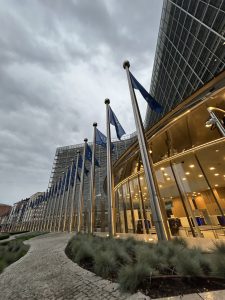
For Ukraine, moving toward negotiations on this chapter will mean substantive reforms in several areas. The 2024 Enlargement Report stressed that Ukraine was still at an early stage of preparation here, with limited progress during wartime, and highlighted three urgent priorities:
- To bring its legal framework into line with the EU acquis on access to the labour market, and in particular with rules on non-discrimination on grounds of nationality against EU workers.
- Work on concluding agreements on social security coordination and healthcare insurance with EU Member States.
- Carry out preparatory work towards joining the European Network of Employment Services (EURES) upon accession.
The 2025 Enlargement Report also stressed that Ukraine was in the early stage of preparation. At the same time, the priorities outlined earlier remain practically unchanged.
These recommendations are not abstract – in practice, they mean at least the following steps for Ukraine. First, adapting employment services to EU standards by digitalising matching systems, introducing personalised counselling, and preparing to join EURES. Second, modernising the recognition of diplomas and regulated professions, and developing comprehensive legislation on regulated professions in Ukraine. Third, ensuring non-discrimination and equal treatment by adopting the EU acquis on equal opportunities in employment, while also strengthening equality bodies and labour inspectorates. Fourth, cooperating with the European Labour Authority (ELA), which will be key to protecting mobile workers. Finally, coordinating social security systems will be essential, so that pensions and benefits can be transferred without loss.
Yet even these reforms represent only the tip of the iceberg. Behind them lies a much larger body of work: aligning entire policy frameworks, building new administrative capacities, and changing practices across institutions and the labour market. The examples above are the most visible and immediate steps, but the real challenge will be embedding EU principles deeply into Ukraine’s governance structures, and ensuring that citizens feel the benefits in their everyday lives.
These reforms may sound technical, but they are the very foundations of European integration – because they determine whether membership in the EU translates into real opportunities for people.
From my professional perspective, I see three lessons for Ukraine as it prepares for this stage:
- Think beyond one chapter – mobility connects to education, social policy, non-discrimination, and many other targeted aspects. Reforms must be coordinated across sectors.
- Invest in recognition systems – building transparent and efficient procedures for diplomas and qualifications is key to avoiding frustration and inequality. A comprehensive approach to regulated professions is also critically important.
- Protect domestic resilience – while opening opportunities abroad, Ukraine must also strengthen its own labour market, especially for youth, IDPs, and veterans.
The free movement of people is therefore both a technical and a symbolic chapter. It is technical because it requires detailed alignment of laws and institutions. But it is symbolic because it shows whether Ukraine is truly ready to become part of a Europe without barriers. For me, it is one of the clearest examples of how European integration starts with people – and why this chapter is at the heart of our EU future.
This is also why the next article in this series will look at the lessons from previous EU enlargements – from Central and Eastern Europe to Croatia and the Western Balkans – and reflect on what makes Ukraine’s accession process unique. Understanding these differences will help to explain why our country’s integration is not only urgent, but also unprecedented in the history of the European Union.
This blog is the second in a series of three articles by Dariia Andriunina around the theme ‘Ukraine and the EU: Lessons and Perspectives’. You can read the first article here:
From screening to negotiations – how Ukraine is aligning with the EU acquis
LATEST
A message from the YED Coordinators

My personal experience as a Young European Diplomat viewing the EU for the first time
A blueprint for enlargement: what we can learn from Moldova, Ukraine, and Montenegro
Young European Diplomats Club
Europe is more than the EU – it’s a practice. On Europe, belonging, and the quiet power of those who refuse to wait

The information on this site is subject to a Disclaimer and Protection of personal data. © European Union,
