

Europe is more than the EU – it’s a practice. On Europe, belonging, and the quiet power of those who refuse to wait
Nobody handed Armenia a map to Europe.
For a long time, that absence felt like a disadvantage – as if we were navigating without a clear direction, moving closer without knowing exactly where we were meant to arrive. But over time, something shifted. When there is no map, you stop asking where you are supposed to go and start drawing your own future worth building.
In Armenia, that question is no longer theoretical. It is being answered – not in ministries or declarations, but in small rooms filled with young people who are beginning to understand that belonging is not something granted from the outside. It is something practised from within.
I write this as someone who has moved between those two worlds. I grew up in Gyumri, where opportunities often felt distant, almost abstract – something you heard about more than experiencing it yourself. And later, I lived and worked in Germany, inside European programmes such as Erasmus+ where those same opportunities are structured, visible, and available for many more people.
Somewhere between those spaces, a realisation settled in – uncomfortable at first, then impossible to ignore: Europe is not as stable as it appears, and Armenia is not as peripheral as it is often treated.
If Europe is defined by its values – freedom, democracy, participation, accountability, dignity – then its boundaries are not always fully reflected in its institutions, and its future remains more open than its language might suggest.
I saw this most clearly not in a policy discussion, but in a youth house in Vagharshapat, Armenia. In 2024, through the EU4Youth Alumni Network, we implemented a project called Next Wave. For six months, we worked with around thirty young people – teenagers who, in many cases, had never been seriously asked what they think. We taught them about local governance, community engagement, how to apply for grants, how to write and speak to decisionmakers, and how to stand in a room full of people and not shrink.
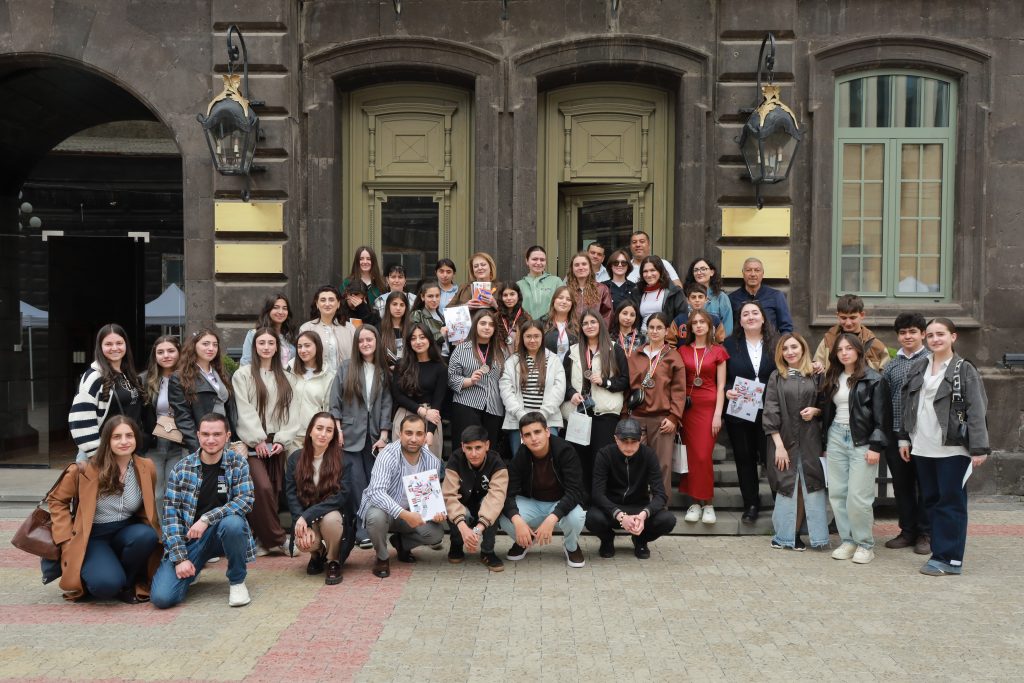
On paper, it looks like civic education. In reality, it felt more like teaching someone how to exist differently in this space.
What mattered most, however, was not what we had originally planned. We introduced voluntary discussions, open conversations, literature, anything that created a space where people could explore ideas openly, without fear of judgment or the need to give the ‘right’ answer. What followed was not a return to structure, but a shift in how people engaged. They began to speak more openly, without waiting to be called on or guided, bringing their own thoughts into the space. The conversations carried themselves. And they kept coming. Not occasionally, not selectively, but consistently. That consistency tells you something important: people do not need to be convinced to participate. They need to be given a reason to believe it matters.
Once you see that, your perspective shifts. You stop asking why young people are not engaging with opportunities, and start asking instead why opportunities are not reaching them. The focus moves away from individual effort and toward the structures that shape access in the first place.
That realisation led me to become involved in organising initiatives like EduFest Armenia. Not as just another event or a symbolic gesture, but as a response to something I had experienced myself. For many young people, the issue is not a lack of ambition, but a lack of access to information, networks, and guidance.
EduFest Armenia was designed with that gap in mind. The idea was to create a space where opportunities are not distant or abstract, but visible, accessible, and easier to navigate. By bringing together institutions, programmes, and young people in one place, the initiative aimed to make access more direct and less dependent on chance.
In that sense, the project was not only about organising an event. It was about rethinking how opportunities are shared and who they are truly reaching.
Living in Germany, I saw what access looks like when it is embedded into everyday life – when information is visible, when pathways are clear, when opportunities feel like something you can step into rather than chase. And I knew what it felt like to grow up without that clarity, relying on fragments of information, on chance encounters, on persistence without guarantees.
EduFest was, in its own way, an attempt to close that gap – to make opportunities tangible, to create direct encounters, to extend a hand to those who are already trying but too often are left navigating alone. Because effort is not what is missing – access is.
Armenia understands that space. We have lived in it – between aspiration and constraint, between possibility and limitation. This complexity is reflected in the country’s relationship with the European Union, particularly through the Comprehensive and Enhanced Partnership Agreement (CEPA) signed in 2017, which enables cooperation in governance, rule of law, and democratic reform, while remaining a limited framework shaped by Armenia’s geopolitical realities.
But what is changing is the response.
What I witnessed in Vagharshapat, and what initiatives like EduFest continue to make possible, is not passive aspiration. It is practice.
A young person facilitating a discussion for the first time. Someone applying for an opportunity they do not fully believe they deserve – and discovering that they do. A participant choosing not to disappear in a room, but to take space within it.
These are small acts, but they accumulate. They reshape expectations – of self, of community, of what participation actually means.
If Europe is to mean anything beyond its institutions, it must recognise this: it is not defined in parliaments alone. It is produced in places like these – in youth centres, in informal initiatives, in moments where someone chooses to act before certainty exists.
And that refusal changes things – not instantly, but irreversibly.
So perhaps the question is no longer whether Armenia is moving toward Europe. Perhaps the more urgent question is whether Europe is willing to recognise where its values are still being built – often without the support it assumes is necessary.
Because what is happening in Armenia is not imitation. It is a contribution.
And if Europe is serious about itself – as a project, not a label – then it must learn to see that contribution clearly. Not as something distant, but as something shared.
The future of Europe will not be decided only in the places where it is already secure. It will be shaped in the places where it is still being tested – in cities like Gyumri, in rooms like those in Vagharshapat, and in streets like those of Budapest.
It will depend on the choices of young people who are still deciding whether they believe they belong to something larger than themselves – and whether that belief is met with reality.
Because once people begin to act as if they belong, they stop waiting. And they start building.
Sources:
European Commission. (2017). EU-Armenia comprehensive and enhanced partnership agreement.
EduFest. (n.d.). EduFest Armenia.
Freedom House. (2024). Freedom in the world 2024: Hungary.
Mediamax. (n.d.). EU programme alumni pass on their experience to community youth through EU4Youth Alumni Network.
OECD (2022). Recommendation on Creating Better Opportunities for Young People. https://www.oecd.org/en/topics/youth-employment-and-social-policies.html
LATEST
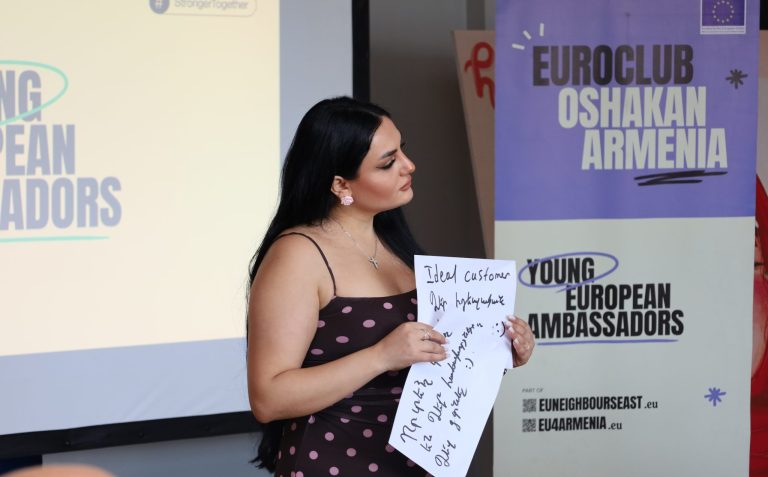
From displacement to enterprise: rebuilding my community through entrepreneurship
A message from the YED Coordinators
My personal experience as a Young European Diplomat viewing the EU for the first time
A blueprint for enlargement: what we can learn from Moldova, Ukraine, and Montenegro
Young European Diplomats Club


The information on this site is subject to a Disclaimer and Protection of personal data. © European Union,
