

Where the lights are always on: how a solar-powered Point of Invincibility is helping Shostka endure
Shostka, a city of around 70,000 people in Ukraine’s northeastern Sumy region, lies just a few dozen kilometres from the Russian border. Since Russia’s full-scale invasion, its residents have learned to live with daily air raid sirens, repeated attacks on energy infrastructure and prolonged power outages. Electricity can disappear without warning, taking with it heating, water, mobile communications and Internet access. For people, every blackout is another test of endurance. Yet there is one place where the lights are always on. Thanks to EU support, the local NGO ‘Charm Future’ has transformed a community facility into an energy-independent hub – a place where residents can find light, warmth, connectivity, but also reassurance that they are not facing the crisis alone.
“Missile strikes, bombs and drone attacks occur almost every day, and nearly every week an energy facility is destroyed,” says Mykola Noha, the Mayor of Shostka. “In such conditions, the local authorities cannot provide services in full.” Water is supplied on a two-hour schedule, hospitals rely on backup generators, and restoring damaged energy infrastructure has become a daily race against time. For the people of Shostka, every blackout has a human cost. “During the blackout in October 2025, we remained without electricity for almost a month,” recalls Maryna Hulenok, a local activist and entrepreneur. “The darkness was depressing. Climbing eight flights of stairs to get to my flat and living without Internet was very hard.”


More than a shelter
In a city where power can disappear for weeks, a place where “the light is always on” is a real lifeline. “Our community was one of the first in Ukraine to create ‘warming points’, which later became Points of Invincibility – essential for people’s survival in wartime,” explains the Mayor. Today, a network of 30 Points of Invincibility across Shostka provides residents with a critical safety net during blackouts, ensuring access to essential services, information and communication.
The point established by Charm Future with EU support through People in Need offers something different. Instead of relying on diesel generators – noisy, polluting and reliant on fuel that may run short – the facility runs on a hybrid solar power plant and battery storage system. “During daylight hours, the solar panels power lighting, Internet equipment, charging stations, laptops, a boiler and a sewage pump, while simultaneously recharging the batteries,” explains project manager Oleksii Lifyrenko.
In the sunnier months, the facility can run independently for unlimited periods. Even on cloudy winter days, its battery storage provides enough power to keep essential services running for up to 24 hours.
But the facility is more than just an emergency support centre. It has become a welcoming community space where children can study online, remote workers can keep earning a living, older residents can stay connected with their families and recharge essential medical equipment, and neighbours can simply sit together over a cup of hot tea. “We’ve created not just a ‘recharging point’,” explains Oleksii. “We created a comfortable space for socialisation, psychological support and distance learning.”
For local residents, this Point of Invincibility is now part of their everyday life. Nataliia Zaiets (42) visits the place almost every day. “Here, there is always internet and electricity,” she says. “This is a place of protection and safety for people of all ages.” For 65-year-old Lina Suprunenko, staying connected with family became one of the biggest concerns during prolonged outages. “The lack of communication was the hardest thing,” she stresses. Today she regularly visits the centre to charge her phone.
Since its opening in 2023, the Point of Invincibility has become a lifeline for around 3,000 residents. More than 1,000 people used the facility in 2025 alone, when the installation of the solar power system enabled uninterrupted electricity, communication and essential services during emergencies. As Oleksii notes: “In the frontline region, energy security equals survival. The enemy can damage a large power plant, but it cannot switch off the sun.”


Looking beyond survival
The success of the initiative demonstrates why cooperation between local authorities, civil society organisations and international partners matters so much. “If local authorities are the trunk of a tree, then civil society organisations are its branches that reach ordinary people, providing them with their daily basic needs,” says Mayor Mykola Noha. While municipal authorities focus on restoring city-wide infrastructure, organisations like Charm Future can respond quickly to immediate community needs.
“Without the EU’s financial and expert support, communities in the frontline zone simply would not have the resources for such capital investments,” says Oleksii Lifyrenko. “Local budgets are almost entirely directed towards defence and repairing damage.” The example of the Point of Invincibility has already inspired other NGOs in Shostka to explore similar solar-powered solutions for offices or shelters. For Charm Future, the work is far from being over too. The organisation now plans to scale its experience to another community facility, advancing the transition towards energy-sustainable and green communities across the Sumy region.
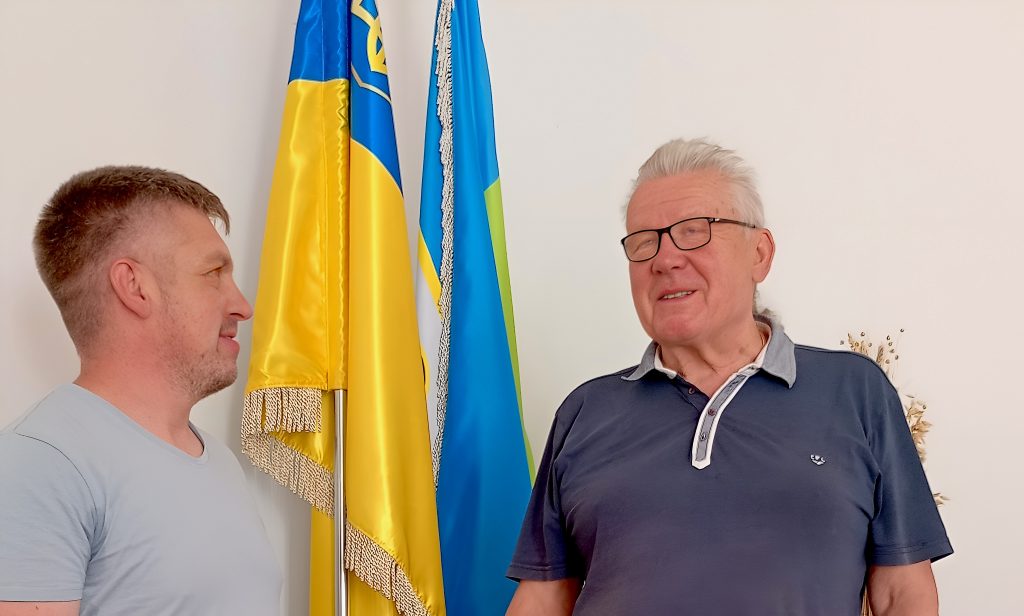
In a city where blackouts have become part of everyday life, the Point of Invincibility stands as proof that resilience can be built one community at a time. It shows how renewable energy, local action and international solidarity can help a community withstand the daily consequences of war. “Ukraine is facing a challenge unlike any other, learning how to survive and adapt without electricity, sewage and other centralised services,” says Mykola Noha. “If our city survives, then the Sumy region will survive; if the Sumy region survives, Ukraine will survive − and an independent Ukraine means a stronger Europe.”
Authors: Volha Prokharava, Kateryna Pyrozhenko
MOST READ

SEE ALSO
Freedom, trust and the future of science: Nobel laureates reflect on the ideas shaping tomorrow
Agricultural panic or opportunity in the EU? Ukraine’s next battle is going to be grain
Children are not the only ones to be deported: parents are also taken hostage in occupied Ukrainian territories
Occupation through education: how Russia took over Ukrainian schools
She baked bread at home and did not let her children leave the yard for three years: how a Ukrainian mother escaped occupation to prevent the Russians from taking her children


The information on this site is subject to a Disclaimer and Protection of personal data. © European Union,
