

Children are not the only ones to be deported: parents are also taken hostage in occupied Ukrainian territories
In the autumn of 2024, masked soldiers took Mariia away from her family in an occupied city in southern Ukraine. A few hours later, the soldiers called Mariia’s daughter and, during a video call, showed her mother tied up while threatening that unless she cooperated with Russian forces, they would transfer her mother to an undisclosed prison. According to a UN report, this is not an isolated case: the Russian state is committing war crimes against civilians abducted from the occupied territories.
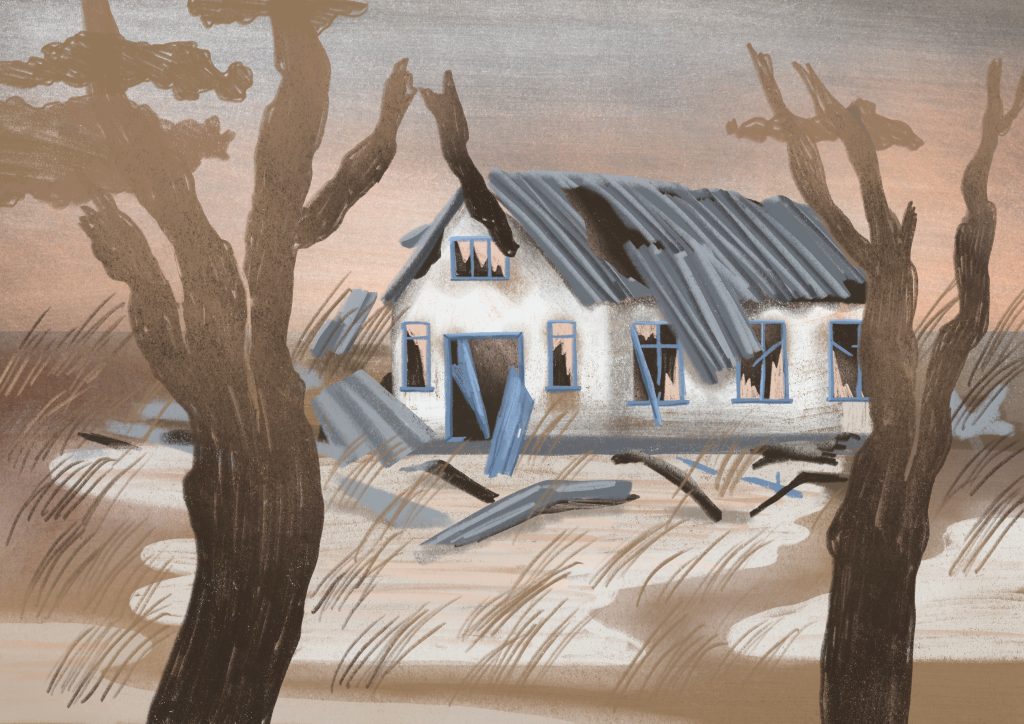
The Ukrainian city on the left bank of the Dnipro River, where 15-year-old Artem lived with his family, has been under Russian occupation since 2022. In the autumn of 2024, unidentified masked men abducted Artem’s mother, Mariia. A week later, the family was shown a statement purportedly written on her behalf.
“The handwritten letter said that she was renouncing her family and her former life. She had chosen something better,” says Sofia (the names of those involved have been changed to protect their identities), Artem’s older sister, who had already managed to leave the occupied territory. After their mother was abducted, the family decided to evacuate Artem as well.
The case described above is not unique, according to volunteers who help children leave the Russian-occupied territories of southern and eastern Ukraine. Volunteers have documented several cases in which both parents were taken into Russian custody at the same time, creating the risk that the children could be registered by the Russian authorities as orphans. They could then be adopted by Russian families and, as a result of indoctrination, lose their Ukrainian identity.
This article was produced in cooperation with The Reckoning Project, an international initiative dedicated to documenting war crimes committed during Russia’s war against Ukraine and ensuring accountability for those responsible. The project was founded in March 2022 by war correspondent Janine di Giovanni and Peter Pomerantsev, a researcher at the London School of Economics.
The Reckoning Project documents war crimes in accordance with international legal standards so that the evidence it gathers can be used in legal proceedings before courts, including the International Criminal Court. Its team of around 30 lawyers, human rights researchers, investigators and data analysts works in close cooperation with the Ukrainian Prosecutor’s Office.
Members of the project’s board include Kenneth Roth, former Executive Director of Human Rights Watch, and Andrew Gilmour, former UN Assistant Secretary-General for Human Rights. Its advisory board includes, among others, Nobel Peace Prize laureate and human rights defender Oleksandra Matviichuk and historian Timothy Snyder. The organisation has collected numerous witness testimonies from Ukraine’s occupied regions, many of which have also been presented at the United Nations.
At the beginning of 2026, a Russian court sentenced Artem and Sofia’s mother to 10 years in prison for ‘espionage’. According to verified data collected by the Media Initiative for Human Rights, at least 2,500 Ukrainian civilians have been held in Russian prisons since February 2022. Based on data from July 2025, Russian courts have convicted nearly 200 of them on charges of ‘treason’, ‘espionage’ and ‘confidential cooperation with a foreign state’. Those convicted include teenagers, women and entire families.
80% of abducted children have still not returned home
According to estimates by Ukraine’s ‘Children of War’ database, Russian authorities have deported or forcibly transferred more than 20,000 children from the occupied territories of Ukraine. The UN Human Rights Council Commission has so far confirmed the deportation or transfer of 1,205 children by Russian authorities. Four years after the start of the full-scale war, and in the cases examined by the Commission, 80% of these children have still not returned home, according to a UN report published on 9 March 2026.
“Children who were left without parental care, deported from institutions, or who had no parent or legal guardian have, in most cases, not been returned,” the report states. The deportations and transfers affected children who had lost their parents or had been separated from their families due to the hostilities, as well as children living in institutional care.
“Over the course of four years, the Russian authorities have not created the conditions necessary for the children’s return. Instead, they have focused on arranging their long-term placement with families or in institutions in the Russian Federation,” the UN stressed.
Due to these deportations, the International Criminal Court issued arrest warrants in March 2023 for Vladimir Putin and Mariia Lvova-Belova. Russian authorities deny that adoptions have taken place; however, practical examples confirm the UN’s findings.
‘There will be trouble’– blackmail for a Russian passport
Sofia recalls that on the morning of 24 February, 2022, the first day of the invasion, their mother woke them up and told them the war had begun. “Half-asleep, we didn’t understand anything. (…) We just heard military convoys passing by us toward Kherson,” the girl says. Russian soldiers immediately replaced the Ukrainian flags at city hall with Russian ones and destroyed the monument to the 2013-14 revolution. Armed soldiers flooded the city streets. Six months into the occupation, more and more bombs fell on the city. “The peaceful city instantly became a war zone,”Sofia said.
According to her, the Russians targeted civilian objects to intimidate them. Many were arrested and taken for interrogation, but most were later released. Residents gradually began to move away, but Sofia’s family did not want to leave their home, so they stayed. However, after the destruction of the Kakhovka Dam, the family was forced to move to another city. There, during a walk, Sofia and her friend were stopped by Russian soldiers who asked for their documents.
“They immediately threatened us, saying that if we didn’t want trouble in the future, we should get a (Russian) passport, and then we could stay here peacefully,” Sofia says. Later, when the situation happened again, Sofia left the occupied territory out of fear. Her parents and Artem, however, stayed.
Collaboration or prison
One morning in the autumn of 2024, unidentified men in ski masks detained Mariia . They broke down the door, ordered Mariia, her husband, and their underage son into separate rooms, and after interrogating everyone, put the woman in a car and drove off in an unknown direction. They told the family they would bring her back by evening, but that did not happen.
Instead, late that night, one of the masked men involved in Mariia’s abduction called Sofia –who was already in Ukrainian-controlled territory at the time – from her mother’s phone. In a video call, he showed Mariia tied to a chair. “They told me I had two options: either I cooperate with them as an informant, or they take my mother away and put her in prison immediately, in an unknown location,” her daughter says.
Sofia does not know who the man was that took her mother, but he appeared to be around 26-27 years old. About two weeks later, representatives of the Russian special services showed the family a photograph. In the photo, Sofia’s mother was holding a piece of paper with a handwritten note stating that she was allegedly ‘renouncing her family and her past life’ and had decided to stay in Russia.
Sofia said that her younger brother, Artem, did not attend the Russian school where the Russian occupying administration forces children to go. “We didn’t let him go because we were very worried,” she explains. Concerned relatives tried every possible way to get Artem out of the occupied territory. They contacted a charity organisation called Save Ukraine, which has been helping Ukrainian children return home since the beginning of the full-scale invasion. Ultimately, volunteers evacuated the boy, and Sofia became his guardian.
“It was very important for us to save the boy because we understood that he could be abused or interrogated for information,” Save Ukraine explained.
A representative of the organisation recalled a case where they helped return children whose parents were both in captivity. The children’s grandmother contacted Save Ukraine, saying that the Russian social services were threatening to take the children away unless she took Russian citizenship and began adoption procedures according to Russian standards. The family then turned to the volunteers for help.
Trials against civilians are war crimes
According to a March 2026 report by the UN Commission, the trials initiated against civilians and prisoners of war detained in Russia and the occupied territories are unlawful, fail to ensure fair trial conditions for the defendants, and therefore constitute war crimes.
In the cases reviewed by the Commission, courts in the occupied territories of Ukraine issued rulings ‘in the name of the Russian Federation’, extending Russian jurisdiction to the occupied territories and applying Russian criminal law to acts committed in the occupied territories of Ukraine, which contradicts international humanitarian law.
The children want to secure their mother’s release
For nearly a year, the family knew nothing about where Mariia was being held or what had happened to her. According to Sofia, the family learned through a lawyer in the autumn of 2025 that their mother was in a detention camp in the occupied Crimea. They have been able to correspond with her since then.
In early 2026, a Russian court sentenced Mariia to 10 years in prison for ‘espionage’. According to Sofia, a year and a half was deducted from the sentence – the amount of time she was held unofficially. The girl says that since May 2026, their mother has been held in a detention camp in Russia. Sofia notes that the facility holds people in pre-trial detention, meaning it is only a temporary stop, and the woman will later be transferred to a penal colony.
“And she might have already been transferred, but we cannot reach her,” Sofia says.
It is not easy for Mariia’s children to cope with everything that is happening. Sofia says that while she feels much calmer now, “the memories are still there, they don’t just disappear, you think about it every day.” After leaving the occupied territory, Artem saw a psychologist for a while and took medication to help him sleep. “The situation has improved, but his emotional state has still not fully recovered,” says his guardian.
The family are now doing everything they can to free Mariia from the Russian prison. For instance, they want to secure their mother’s release through a prisoner exchange.
Author: Lesya Pinyak
The original story was published in Hungarian by Atlaszo.hu
MOST READ
SEE ALSO
Occupation through education: how Russia took over Ukrainian schools
From passion to mission: how Sofiia Nazarenko became a voice of Ukrainian journalism through EU4Youth
A partnership that builds resilience
Packaging from mushrooms: how a Ukrainian start-up is contributing to Europe’s green economy
From idea to energy: how Kyiv youth are developing the ‘energy willow’ project


The information on this site is subject to a Disclaimer and Protection of personal data. © European Union,
