

War is reshaping medicine in Ukraine
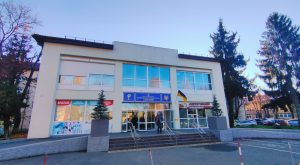
“A few years ago, we would have had to amputate this patient. Today, we can save his foot and restore its function.” We meet Andrii Buchok just outside the operating room, in a corridor, with blood still on his trousers. He is a young surgeon at the Multidisciplinary Clinical Hospital of Uzhhorod, a Ukrainian city near the borders with Slovakia and Hungary. A health facility strained by war pressure, but able to improve its response also thanks to the cooperation with partner hospitals supported by the Interreg NEXT Hungary-Slovakia-Romania-Ukraine Programme.
War stress on health services
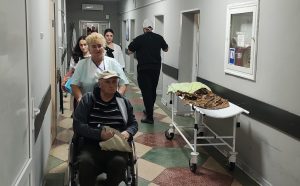
Before the war, this regional capital of Zakarpattia had around 120,000 residents. Today, its population has swollen with refugees, displaced people and wounded patients, who have travelled west in search of safer houses or treatment. The burden on local infrastructure is heavy. In just four years, the number of people served by the hospital has nearly doubled. “The war has had an enormous impact on health services and doctors’ workload, especially in the trauma department,” says Nataliia Hema-Bahyna, the hospital’s medical director. “Last year alone, we carried out 1,600 surgeries. We perform between 10 and 15 trauma operations a day: for us, it’s a real strain.”
In the orthopaedic and trauma department in Uzhhorod, surgeons are redefining what is possible in war medicine. The unit is split between civilian care and complex trauma, where doctors meticulously document each case, from pre-operative images to long-term recovery. One example is a soldier with a devastating heel bone fracture, involving severe bone and tissue loss. Doctors have first stabilised the injury, then repaired the damaged tissue. Once healed, they have planned a titanium implant to reconstruct the bone. Just three weeks after his final surgery, the patient was walking again.
Infections are one of the biggest challenges. Many patients arrive after being treated in multiple hospitals, often carrying multi-drug-resistant bacteria. “We find all kinds of microbiology in these wounds,” explains Andrii Buchok. As a result, he relies less on antibiotics and more on surgery. “The best antibiotic is aggressive debridement,” he says, “the removal of infected tissue.” Antibiotics are used only in specific cases, such as after internal fixation with plates or nails. But often, he adds, patients have already undergone multiple courses of antibiotics with little effect. “By the time they reach us, they’ve had four or five different treatments, and it hasn’t worked.”
Boosting surgical capacity to handle trauma
Since 2022, strengthening healthcare along the EU-Ukraine border has become a priority. Among the key initiatives are two EU-funded projects under the Interreg NEXT Hungary-Slovakia-Romania-Ukraine Programme, aimed at reinforcing the capacity of surgical wards while equipping hospitals with essential ultrasound technology. The projects – TRAUMAHUA and HUSKUARADIO – connect three facilities located less than 50 kilometres apart: the Clinical Hospital in Uzhhorod (Ukraine), the St. Damján Görögkatolikus Kórház in Kisvárda (Hungary) and the Polyclinic Hospital in Kráľovský Chlmec (Slovakia). Together, they are building a more coordinated, resilient cross-border system of care, in a region under a growing burden.
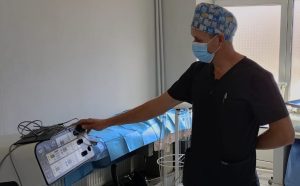
Under the TRAUMAHUA project, the Uzhhorod Clinical Hospital is strengthening its capacity to respond to both war-related injuries and the growing number of road trauma cases along the busy E573 corridor. The initiative is improving the trauma wards and the surgery department with new equipment, while supporting the renovation of key spaces. At the same time, doctors are working with cross-border partners to introduce shared treatment protocols, to ensure patients receive the same care on all sides of the border. The aim is to reduce complications, to shorten recovery times and, ultimately, to save more lives. “In Uzhhorod Clinical Hospital we already had skilled staff,” says project manager Yulia Berlianuk, “but we needed to modernise the department with renovations and new equipment. We’ve now purchased two devices our doctors greatly value, as they help stop bleeding faster and improve surgical outcomes.”
Top-notch ultrasound systems
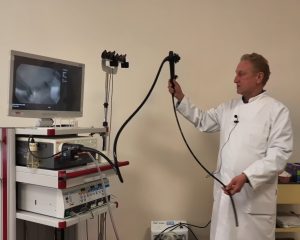
There is something else that up-to-date, highly technical equipment can do: lead to earlier diagnosis, and therefore to more effective treatment. Detecting conditions sooner allows for less invasive surgery and faster recovery. This reduces pressure on both the patients and the health system. The HUSKUARADIO project strengthens diagnostics with advanced ultrasound technology, which is fast, safe, non-invasive, and can be repeated as often as needed. In endoscopy, these devices are essential for rapidly identifying internal bleeding and organ damage. They are used for a wide range of screenings, including abdominal, carotid and gynaecological exams. Ultrasound specialist Marina Frint confirms the quality of the new technology: “The system now allows to examine both superficial and deep tissues, and to detect even very small lesions. It offers high-resolution imaging, from cardiac and abdominal scans to gynaecological and prostate exams. It’s a great way to improve diagnostic precision.”
Sharing knowledge to improve decisions
Beyond upgraded facilities, and next to new tools and harmonised protocols, both projects place strong emphasis on professional exchange. Through joint trainings and workshops, doctors from partner hospitals regularly share knowledge, compare practices and learn from each other’s experience. This continuous exchange is crucial in daily work, where rapid decisions and up-to-date skills can improve patient outcomes. “Good, intelligent doctors are important,” concludes Nataliia Hema-Bahyna, “but they truly become the best when they can use the right equipment and have the necessary technical support.” Ukraine’s experience of war medicine is – unfortunately – reaching new heights.
Author: Daniela Cavini
MOST READ

RELATED PROJECTS

SEE ALSO
Packaging from mushrooms: how a Ukrainian start-up is contributing to Europe’s green economy
From idea to energy: how Kyiv youth are developing the ‘energy willow’ project
A space where science comes to life: how an interactive museum in Ternopil is inspiring the community

‘Europe became real faces and real stories’: Young European Ambassadors look back on ten years of friendships and community projects
When dreams return from war: how veteran Andrij Kaspshyshak is developing a publishing house


The information on this site is subject to a Disclaimer and Protection of personal data. © European Union,
