

The world of mushrooms: a school-based social initiative supported by EU4Youth
The basement floor of Yeghegnadzor School in southern Armenia is no longer just a storage space. It has been transformed into a learning and production environment, where the social initiative ‘The World of Mushrooms’ was born and continues to develop. Here, students Lusine Harutyunyan, Arman Grigoryan, Angelina Khachatryan, and Khachik Davtyan can regularly be seen, forming a proactive student team that unites their interests around a single shared idea. Their goal is not only to cultivate mushrooms but also to develop social entrepreneurship skills, gain practical work experience, and implement initiatives that benefit the school community.
Learning through practical experience
Team members have diverse interests and professional orientations, making the initiative multifaceted. Angelina and Khachik have already clearly decided to pursue careers as doctors. Arman emphasises determination and responsibility as key components of success, while Lusine envisions her future in the fields of management and marketing.
The students participated in the European Union’s EU4Youth programme, through the project ‘Fostering Youth Social Entrepreneurship and Practical Career Management Skills through the innovative Social Student Companies Approach’, which enabled them to acquire the necessary knowledge and skills to conceptualise, plan, and implement their idea. They received support and guidance from the CODE-SE HUB NGO (www.codesehub.com), acting as their mentor organisation.
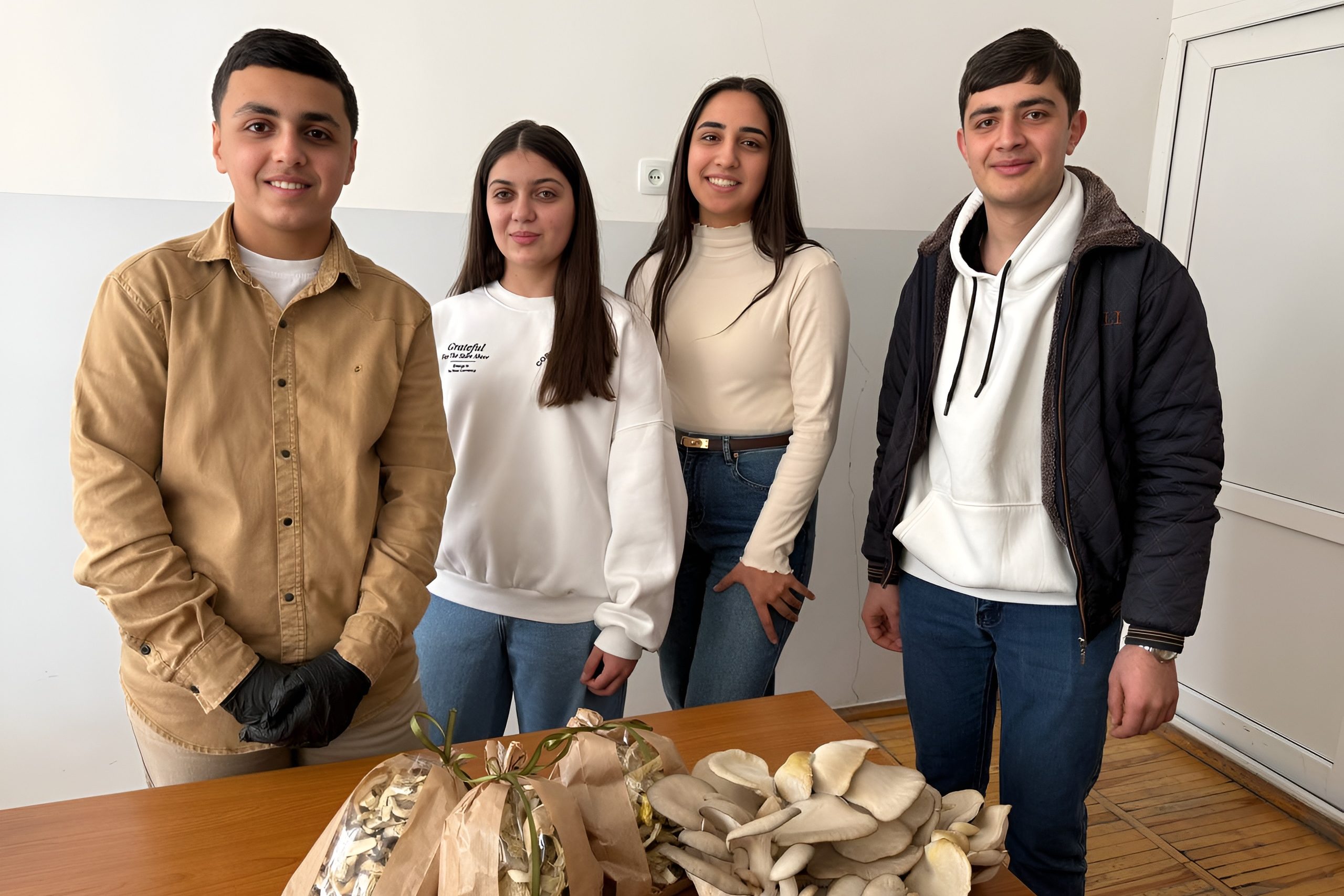
During the programme, they learned the principles of social entrepreneurship, financial and business literacy, the process of developing a business plan, studied existing examples, conducted team-based projects, and received mentoring support.
“The programme helped us to understand our roles within the team. Each of us had our responsibilities, and everything was done with enthusiasm,” says Angelina Khachatryan.
The world of mushrooms in Vayots Dzor
With the knowledge and experience they gained, the team launched a mushroom cultivation social initiative at their school, naming it ‘The World of Mushrooms’. The mushrooms were brought in special bags, already prepared and ready for cultivation. They were placed in the basement, where the necessary conditions for growth were established.
“When we hung the bags in the basement, we realised that the project had truly begun. At the moment, we have about 75 bags, each requiring care and attention,” explains Khachik Davtyan.
The entire process is carried out with the support of the biology teacher, the school accountant, the staff, and the principal, who are constantly by the students’ side.
“Every three days, we harvest the mushrooms, and each time we see the results of our work. Since we are still in the experimental phase, we mainly calculate and record how much yield each bag produces, so we can plan the next steps accurately,” says Lusine. She adds that sometimes the most interesting moments occur during observation, when one can notice in a single day how the mushroom changes and emerges from its casing.
The team is not limited to fresh mushroom production. They have also begun the process of drying mushrooms to produce long-term consumable products. As they do not yet have a specialised dryer, the first attempts are carried out using a small home dehydrator.
At this stage, the entire process is experimental. Students explore different conditions to understand how to maintain the quality of the mushrooms, what results can be achieved with the available resources, and what improvements can be made in the future.
The first harvest
“Until now, we did not realise that cultivating mushrooms requires as much precision and attention as maintaining a delicate mechanism,” Lusine notes with a smile.
She says that, although she is not a great fan of mushrooms, the entire process has been highly engaging and educational. Every day, twice a day, they monitor humidity and temperature, and observe even the smallest changes. This process has taught the team consistency, patience, and responsibility.
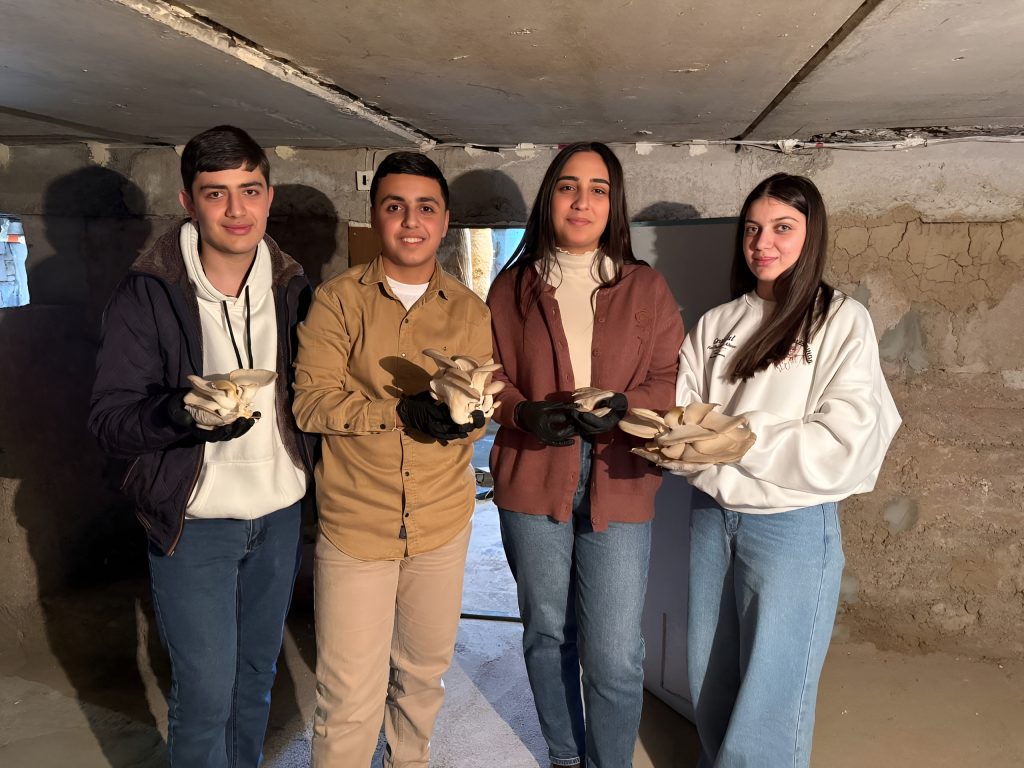
At this stage, the team has already harvested approximately 5-6kg, some of which has been donated to friends. The first harvest was not merely a material outcome; it became an important confirmation that the chosen path is correct and that the project holds promising potential.
Khachik adds that the initiative has inspired him so much that he decided to grow mushrooms at home as well. Even though the project is still in its initial phase, the interest and desire to experiment remain strong.
A school-based initiative with real impact
The team envisions that in the future, as production scales increase, the revenue generated will be directed towards addressing a school need. Since the members of this social entrepreneurship team are graduating students, they also emphasise the continuity of the initiative. They are already passing on their experience to younger students, sharing not only successes but also the challenges faced and lessons learned.
According to Angelina, the project has had a significant impact on her professional orientation, as it provided an opportunity to practically observe all stages of work. While she is confident in pursuing a career in medicine, she also recognises the importance of developing business skills. Khachik notes that, alongside pursuing medicine, ‘The World of Mushrooms’ has become an important area of his interests, which he intends to focus on further in the future. This experience has taught the team consistency, patience, and responsibility.
For Lusine, this social entrepreneurship experience was decisive in choosing a career in management and marketing. She has practically learned how to conduct market research, organise work, and manage a small initiative. Arman also advises his peers to seize every opportunity, not to fear experimentation, and always to move forward.
The students unanimously note that the initiative’s greatest supporter has been the school principal, who believed in the team’s potential, trusted their idea, and assisted with all arising matters.
“Supporting initiatives like this within the framework of social entrepreneurship at Yeghegnadzor School is very important, because they give children practical knowledge and help them connect theory with real life. Through cultivating mushrooms, students learn diligence, responsibility and teamwork. These programmes simultaneously have educational, social and economic benefits, as they develop children’s entrepreneurial thinking, encourage independence and initiative, help them understand the importance of local production and create small but real examples of success that motivate students. Such initiatives teach children not only how to grow mushrooms, but also help them to believe in their own abilities and see that even small ideas can grow into useful and sustainable projects,” said Hasmik Margaryan, School Director.
The work completed by the team demonstrates that even a small initiative can have a significant impact, teaching responsibility, teamwork, and the importance of believing in one’s own ideas.
MOST READ



RELATED PROJECTS

SEE ALSO

‘Europe became real faces and real stories’: Young European Ambassadors look back on ten years of friendships and community projects
Stories hidden in wood
Small ideas, real impact: how students built a natural food brand
Crafted by youth, inspired by tradition: the Hinunik story, a school where new ideas are born within old walls
From waste to high-value products: circular economy in action in Lukashin


The information on this site is subject to a Disclaimer and Protection of personal data. © European Union,
