

The postal code of independence
In Cherkasy, Elena Shchepak’s ‘18000’ is redefining what local journalism can do – and who it belongs to.
Elena Shchepak was still early in her career, working at a local newsroom in Cherkasy, when she first noticed the cracks showing. A story was softened and another was quietly dropped. Then came the familiar conversation – subtle at first, then less so – about what should and shouldn’t be pursued. The owner had views, and the newsroom, it turned out, was expected to reflect them.
For a while, Elena and her colleagues tried to work around it as most journalists do. They told themselves it was temporary, or manageable, or just the way things were done. But the gap between what they wanted to report and what they were allowed to publish kept widening.
Eventually, there wasn’t much left to negotiate, and three principled journalists left to start their own outlet – independent, small, and answerable only to its editorial team. They called it ‘18000’, after the postal code of Cherkasy. This was their way of saying: this is ours, and it belongs here.
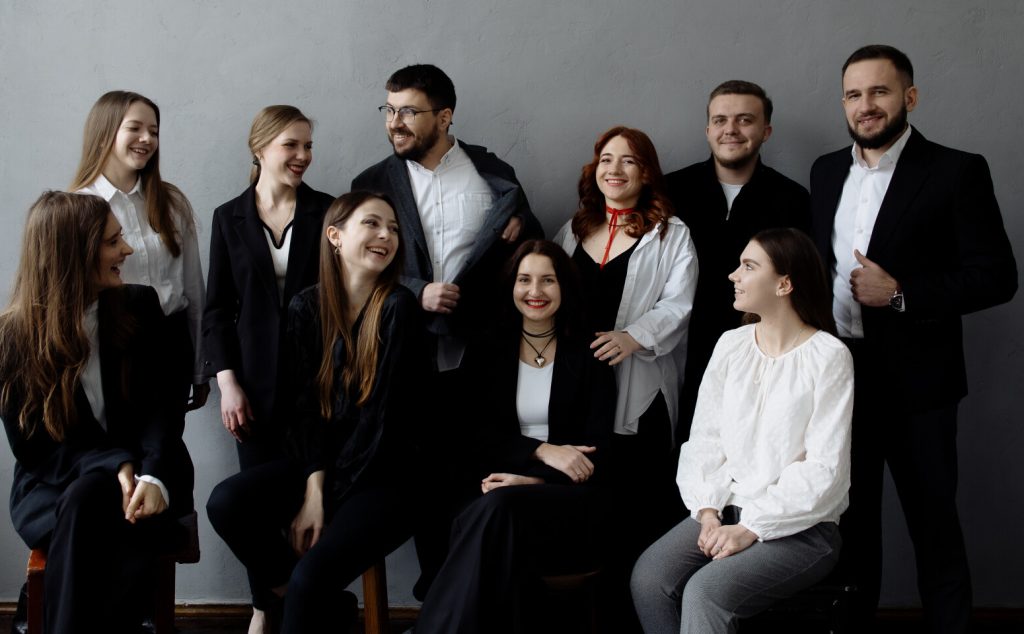
What followed was a success story. Founded in 2019, 18000 has grown into a team of 14. Its website attracts around 300,000 monthly visitors – roughly the population of the city itself. It produces investigative reporting alongside high-quality video content, building a reputation not just for uncovering wrongdoing, but for making it visible and shareable.
A bond between journalism and civic action
But the more interesting story is not the growth. It is the bond between journalism and civic action.
At one point, readers took to the streets carrying posters emblazoned with headlines from 18000’s investigations. Petitions followed and local officials were forced to respond. The line between audience and actor began to blur.
“Our work has a real impact,” Elena says.
Unfortunately, impact does not pay salaries. Independent media, particularly investigative outlets, operate in a kind of permanent financial precarity. They are expensive to run, and structurally disadvantaged in markets where advertising is either insufficient or compromised. Skilled journalists, time-intensive reporting, production costs don’t come cheap.
For 18000,” like many Ukrainian outlets, international donor funding became the backbone. Until, suddenly, it didn’t, when at the beginning of 2025, US funding – previously a core source of support – was paused. The effect was immediate and existential, as newsrooms like Elena’s do not have large reserves. They have payrolls, rent, and deadlines.
“Without donor funding, it is highly likely that media outlets where the owner dictates editorial policy will remain, while independent media may disappear,” she explains. “Thanks to the emergency support from the European Endowment for Democracy (EED) in 2025, we managed to survive the pause without compromising on quality, losing our team and office.”
The newsroom stayed intact and their investigations continued. The office lights, when there was electricity, stayed on. But things did change.
“We began to look differently at what we could do for our future,” Elena says.

A strategy for income generation
The team expanded its commercial activities, experimenting with new advertising formats while maintaining strict ethical boundaries. There would be no microloans, no gambling or dubious financial schemes. This is a decision that costs money in the short term and builds credibility in the long term – a trade-off many outlets claim to make, and few consistently uphold.
After the funding shock, 18000’s strong relationship with its readers deepened further. Fundraising campaigns became more frequent, events were organised, and branded merchandise appeared. A membership base – now more than 200 people – began to take shape.
In a country at war, where economic pressures limit people’s ability to donate, the decision to support a local investigative outlet becomes an act of participation in democratic life.
They also have more institutional forms of support. The Cherkasy IT Cluster – a group of local technology companies – has backed 18000 financially since its inception, without interfering editorially. Each year, the newsroom presents its results to the cluster, effectively making its case not just for funding, but for relevance. It is, in its own way, a model of public-private alignment that works precisely because it respects boundaries.
Not all such relationships are so straightforward. Attempts to partner with local businesses have sometimes triggered backlash from authorities. In one case, a café that collaborated with 18000 found itself facing administrative pressure, such as restrictions on its outdoor terrace, subtle signals about “choosing partners more carefully”. This is how power operates when it cannot directly control the message: it targets the ecosystem around it.
Adaptation to war and to AI
And then, of course, there is the war. Cherkasy is not on the frontline, but the war is everywhere. Russian attacks on energy infrastructure have led to prolonged power outages – up to 16 hours a day. For a newsroom that relies heavily on video production, electricity is a prerequisite.
In the meantime, they have adapted their daily practice. They repurpose long-form investigations into short, mobile-friendly videos for social media, as these platforms remain accessible when websites are not. They have expanded their presence across nearly all major social media channels, following their audience wherever they can reach them.

The outlet is also having to deal with a different kind of disruption: artificial intelligence. “We realise that AI is taking away some of our audience,” Elena notes. The team has taken the decision to work with experts to ensure their content surfaces within AI-driven recommendation systems. The distribution layer of journalism is changing, and survival depends on understanding those changes early.
And then there is the future. For Elena, that future includes something almost counterintuitive in a time of scarcity: a school for investigative journalists. The reasoning is simple. There are not enough trained investigators, and without them, the entire model weakens. It is a long-term investment in capacity, at a moment when short-term survival still demands attention.
Seven years on, it’s clear the decision that started 18000, that quiet act of walking away by three principled journalists, wasn’t just about leaving something behind. It was about building something new and durable, closely linked to its community.
18000 received support from the European Endowment for Democracy (EED), an independent, grant-making organisation, established in 2013 by the European Union and EU member states as an autonomous International Trust Fund to foster democracy in the European Neighbourhood, the Western Balkans, Turkey and beyond.
EED supports civil society organisations, pro-democracy movements, civic and political activists, and independent media platforms and journalists working towards a pluralistic, democratic political system.
The EED was established by the EU as an independent, complementary mechanism to provide fast and flexible technical and financial support to democratisation and human rights promotion in the European Neighbourhood.
MOST READ






RELATED PROJECTS

SEE ALSO

Children are not the only ones to be deported: parents are also taken hostage in occupied Ukrainian territories
Occupation through education: how Russia took over Ukrainian schools

From passion to mission: how Sofiia Nazarenko became a voice of Ukrainian journalism through EU4Youth

A partnership that builds resilience

Packaging from mushrooms: how a Ukrainian start-up is contributing to Europe’s green economy


The information on this site is subject to a Disclaimer and Protection of personal data. © European Union,
