

Skateboards, sirens, strength
On a weekday in Okhtyrka, a small city just thirty kilometres from Ukraine’s frontline, you might hear the rattle of a skateboard, a burst of electronic music, or a cheer from a group of teenagers learning to scratch vinyl records. And then, cutting through it all, the air-raid siren.
No one panics.
The young people glance up, exchange looks, and check their phones. A volunteer at the entrance nods toward the nearby shelter. The activity pauses, but the energy in the room doesn’t fade. In Okhtyrka, the rhythm of war and the rhythm of youth have learned, somehow, to coexist.
This is the Street Cultures Development Centre, an unassuming NGO that has turned survival into an act of creativity. Its founder, Pavlo Ihnatchenko, describes the mission simply: “We want to give youth access to normal social life, even in such challenging circumstances.”
But what Pavlo means by “normal” has taken on new meaning since 2022, when Okhtyrka was under heavy bombardment and the city’s future seemed to hang by a thread.
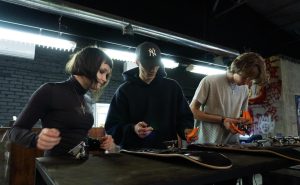
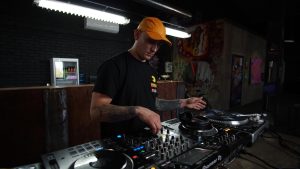
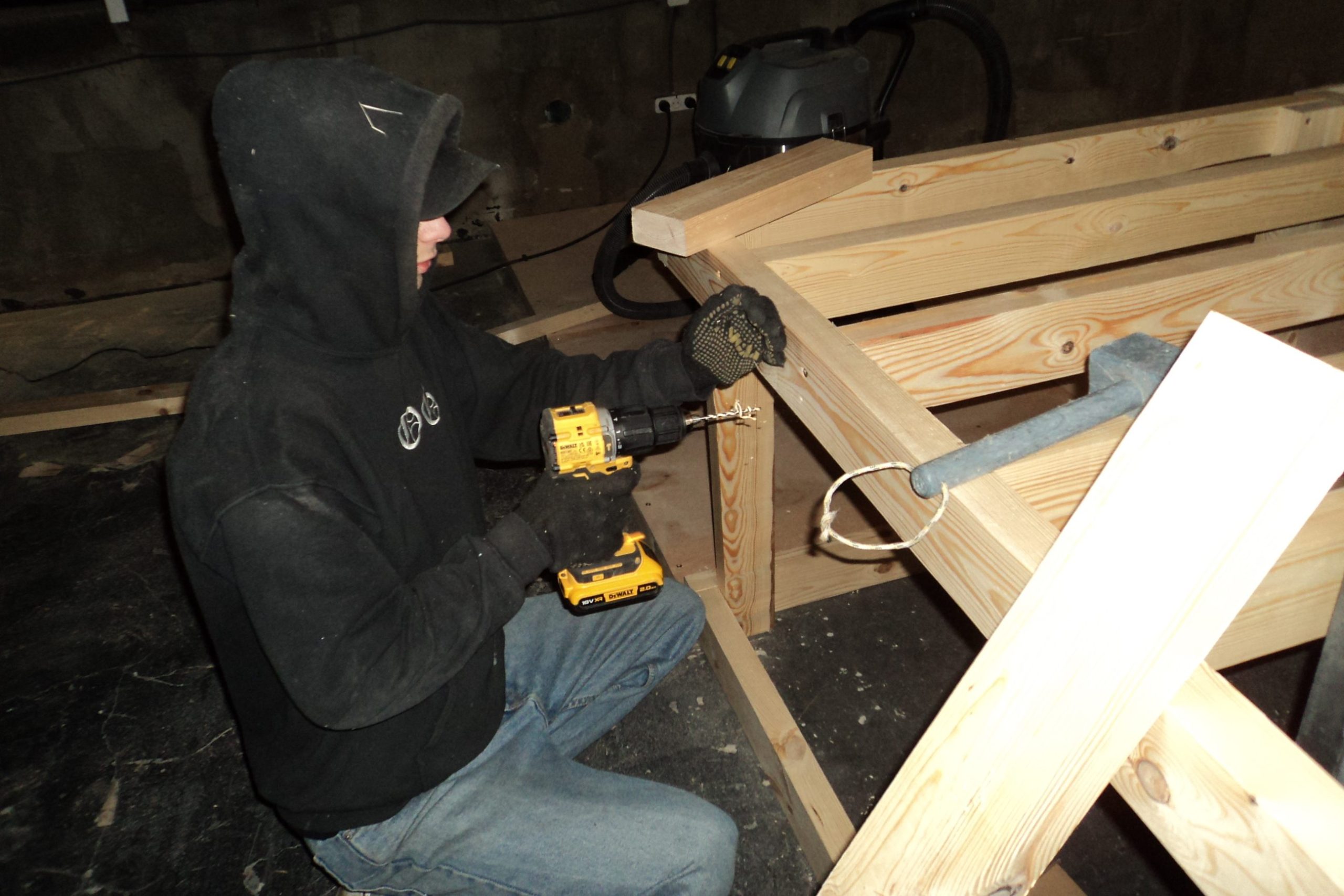
In the early days of the invasion, Pavlo’s team helped the local army. Their cultural projects – skate ramps, graffiti workshops, and DJ nights – went silent. When residents began returning a year later, he saw something remarkable: the same young people who had fled were coming back, looking for connection, identity, and hope. “I realised that bringing back cultural life was just as important as rebuilding houses,” Pavlo says. “If there’s nothing that makes you want to stay, the city dies slowly.”
That casual observation captures a pattern visible across Ukraine’s war-torn regions. Where rebuilding begins not with infrastructure, but with meaning.
The space for staying
The Street Cultures Development Centre is not merely a youth club; it’s a stabilising system in miniature. It offers books and magazines from contemporary Ukrainian and European publishers, table tennis and skateboards, DJ equipment and master classes in upcycling. It hosts lectures, art events, and graffiti sessions that, in Pavlo’s words, “keep the spirits up and allow youth to feel engaged in the life of their hometown”.
More than 500 people visit the Centre every month, in a city where every air raid could be the last. This number alone suggests something counterintuitive: in times of danger, people seek not just safety, but belonging.
“Okhtyrka lives under constant risk,” Pavlo says. “You can’t work if you react to every alert. We monitor real threats, but otherwise we go on.” Behind this calm practicality lies a psychological truth familiar to anyone who studies communities under stress: resilience doesn’t come from ignoring danger, but from refusing to let it dictate meaning.
The European Endowment for Democracy’s (EED) support came at a decisive time. After losing part of his team (some joined the army, others never returned) Pavlo faced an impossible choice: scale down or reinvent. Through institutional funding and capacity support, the Centre strengthened its structure, trained new staff, and refined its focus. “We became more confident in what we do,” Pavlo says. “More united as a team. More visible to the community.”
Today, six permanent staff members manage everything from events to communications to safety protocols. They know each siren drill by heart. They’ve learned to pause DJ sets mid-beat and resume them after the all-clear. A choreography of caution and defiance.
Culture as infrastructure
What Pavlo has built might not look like traditional humanitarian work. There are no food rations or medical kits here. But the Centre performs a quieter kind of emergency response: emotional infrastructure.
Every skater, reader, or graffiti artist who walks through its doors is participating in an act of civic resilience. They’re saying: I am still here.
When Pavlo introduced a small entrance fee – 50 hryvnia on weekdays, 100 on weekends – he wasn’t sure how people would react. “And people were willing to pay,” he says, smiling. “That was the best feedback we could get, that what we do has real value.”
The fees cover only a fraction of costs. The rest comes from local businesses, branded merchandise, and donors. Most grants are project-based and short-term, but the EED’s institutional support allowed something rarer: breathing space to think, reorganise, and grow.
This distinction matters. In donor work, impact is often measured in numbers: participants, outputs, deliverables. But what the EED’s model recognises – and what Pavlo’s story demonstrates – is that long-term change starts with organisations that can survive uncertainty. Resilience is not a project. It’s a habit.
The limits of normal
Still, there are days when optimism feels like a luxury. Mass public events remain restricted by security rules. Many of Okhtyrka’s brightest young people have left — some to larger cities, some abroad. And a new law allowing men aged 18 to 25 to leave Ukraine has only deepened the outflow.
“We already lost one colleague after this law came into force,” Pavlo says quietly. “Now we have to invest time and resources again to train someone new.”
He speaks without bitterness. Instead, there’s a kind of quiet pragmatism: learn, adapt, repeat. The team has started documenting processes, sharing skills internally so that the work can continue even if someone leaves. “We exchange knowledge so that the Centre can smoothly continue in any case,” Pavlo says. It’s a strategy borrowed from start-ups and emergency responders alike.
A son, a space, a sense of future
If there is one image that captures what Pavlo is trying to build, it’s this: his young son, skateboard under his arm, standing at the edge of the Centre’s courtyard, waiting for his turn on the ramp.
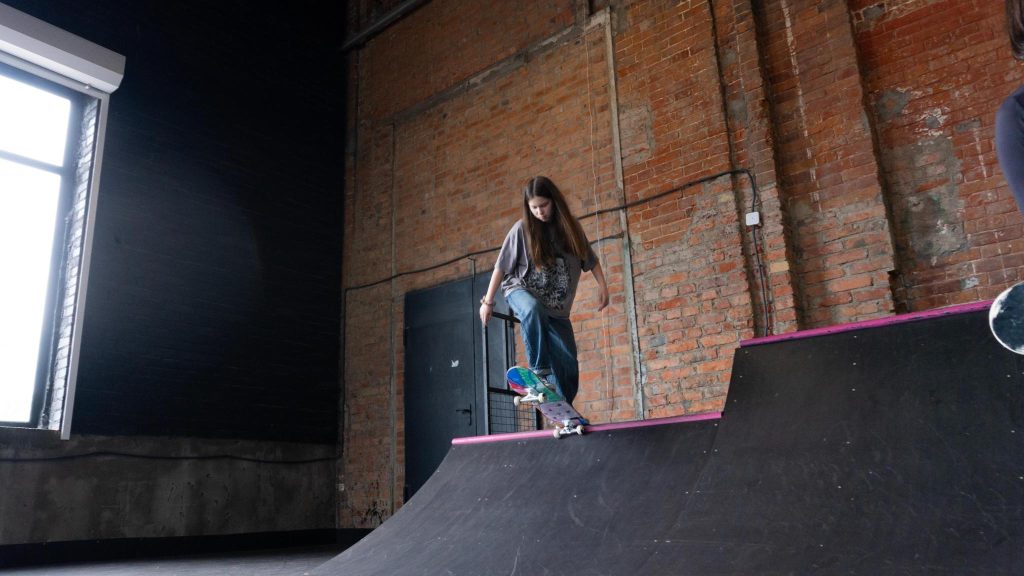
“My son attends many of the Centre’s activities,” Pavlo says. “For me, that’s the best success indicator.”
It’s not a grand statement about nation-building or post-war reconstruction and revitalisation. It’s a simple gesture, a father making a small space for his child’s joy. Yet in that gesture lies a vision of renewal that numbers can’t capture: continuity of ordinary life, even when nothing about life is ordinary.
In Okhtyrka, that’s what Pavlo and his team are doing every day. They’re behaving as if peace, creativity, and civic life are not distant goals, but realities to be rehearsed now. A DJ practice in a half-lit room. A new graffiti mural against a battered wall.
A girl laughing on a skateboard, while sirens wail overhead.
The European Endowment for Democracy
The Street Cultures Development Centre was supported thanks to the contribution of the European Commission to the European Endowment for Democracy (EED), an independent, grant-making organisation, established in 2013 by the European Union and EU member states as an autonomous International Trust Fund to foster democracy in the European Neighbourhood, the Western Balkans, Turkey and beyond.
EED supports civil society organisations, pro-democracy movements, civic and political activists, and independent media platforms and journalists working towards a pluralistic, democratic political system.
The EED was established by the EU as an independent, complementary mechanism to provide fast and flexible technical and financial support to democratisation and human rights promotion in the European Neighbourhood.
This story was first published by the European Endowment for Democracy (EED)
MOST READ

RELATED PROJECTS
SEE ALSO
From passion to mission: how Sofiia Nazarenko became a voice of Ukrainian journalism through EU4Youth
A partnership that builds resilience
Packaging from mushrooms: how a Ukrainian start-up is contributing to Europe’s green economy
From idea to energy: how Kyiv youth are developing the ‘energy willow’ project
A space where science comes to life: how an interactive museum in Ternopil is inspiring the community


The information on this site is subject to a Disclaimer and Protection of personal data. © European Union,
