

‘I strive to do my best for myself, my family, and my community’– how EU4Youth helped Tatev spread digital skills in Tavush
Tatev Harutyunyan’s journey as a community leader began with a significant life decision: moving from Yerevan to the border town of Noyemberyan in Armenia’s Tavush region. Settling there gave her a deep understanding of local needs, challenges, and untapped potential, fuelling her desire to create meaningful opportunities for her community. Tatev is also engaged in beekeeping and has combined this with her work in community tourism, developing apitourism – a branch of tourism that integrates beekeeping into the experience. For years, she has promoted the area’s rich potential in a responsible and purposeful way to benefit local development.
In 2023, Tatev founded the NGO Sustainable Progress, which aims to protect community interests by identifying local issues and finding solutions, with a particular focus on women and young people. She then won a sub-grant through the EU4Youth programme, awarded by the ‘Agate’ Rights Defence Centre for Women with Disabilities NGO, within the framework of the ‘Upskilling digital competences and career management skills of disadvantaged youth in Georgia, Armenia and Moldova’ project.
With the financial support of the European Union, ‘Agate’ awarded six sub-grants to five NGOs in the Shirak, Lori, and Tavush regions, for projects designed to empower disadvantaged youth by providing them with the digital skills and career guidance to thrive in today’s competitive job market. By fostering the potential of youth, the project not only invested in individual futures, but also contributed to building stronger communities.
“My goal has always been to do work that benefits not only me and my family, but also the environment I live in. The quality of life I envision is only possible when I live in a healthy, developed environment. Even if I am financially secure, if I open my door and see lots of unsolved problems, I can’t say I’m living the life I want. That’s why I strive to do my best – for myself, my family, and my community,” said Tatev.
EU4Youth: supporting a strategic approach
The EU4Youth grant was the very first for Tatev’s Sustainable Progress NGO. Its project on ‘Enhancing the Digital Skills and Career Management Competencies of Youth from Vulnerable Groups’ aimed to equip young people with the practical tools to navigate the modern job market. Before receiving the grant, Tatev had taken part in a series of trainings – on entrepreneurship, digital literacy, and training-of-trainers.
Tatev Harutyunyan received the EU4Youth sub-grant not only because of her professional skills and potential, but because she had the ability to actively seek, filter, and use information and opportunities in her field. “We live in a time when information is abundant, but the challenge is to find it, identify what is relevant, and apply it effectively,” she noted. The sub-grant taught Tatev that success requires you to be constantly refining skills, taking initiative, and being proactive, because no one will come to your door and just hand you the opportunities to unlock your potential.
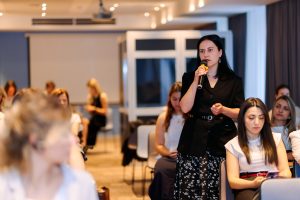
At the same time, the grant helped position her NGO in the CSO sector, showing that even as newcomers, they were ready to lead projects, gain the trust of partners and become key actors. “The NGO field is highly competitive, and for us it was important not only to receive funding but also to earn the trust that others would want to collaborate with us. We managed to achieve that,” she said.
The project: educating youth in digital skills in border communities of Tavush
The project was implemented in Tavush, reaching 50 young people aged 15-29, including those from disadvantaged families, persons with disabilities, residents of border communities, and displaced youth from Nagorno-Karabakh. The main goal was to provide personal consultations on digital professions and show that even in remote border regions, it is possible to have a successful career in the digital field.
Tatev’s team began by working with community partners – approaching the Fund for Armenian Relief, Bridge of Hope, and the Dilijan Youth Cooperation Centre. With their support, they identified beneficiaries, conducted surveys to assess their digital literacy, technical readiness, and professional interests.
Each participant received individual career consultations tailored to their chosen digital field, based on the guidelines developed within the framework of the EU4Youth project. “We explained how they could grow in that field, what skills were needed, and how to find work opportunities,” said Tatev. “The overall goal of all these activities was to raise awareness about digital professions and the opportunities of the modern era.”
The project also featured two webinars: one on opportunities in digital professions and another on business communication skills. “Many participants initially feared that AI would replace them in the job market. We worked to explain that AI is a tool – it won’t replace you if you know how to integrate it into your work,” she noted.
Tatev said the EU4Youth sub-grant played a huge role in strengthening the NGO. It provided experience in financial and project management, improved fundraising skills, and opened the door to new partnerships – including international ones. “It was a serious starting point that allowed us to secure our place among community and regional organisations,” she said.
Tatev’s work and its impact on youth
Tatev’s message to young people is to be proactive: “We need to understand that the people who bring change are those who create their own opportunities; we are the ones who can truly change our lives. We cannot wait for opportunities to be created, we should be creating them. Secondly, we shouldn’t fear mistakes and failures – this is a major challenge that comes from the older generations, because we want to be perfect: ‘Do this, do that, make sure it succeeds.’ But failure should be approached as a learning process – understand what the problem was, fix it, and move forward. And finally, lifelong learning – we live in a time when everything is constantly changing, and you can’t just study somewhere once and say, ‘I’ve done my duty.’ To be dynamic and understand what’s happening around you, you need that energy – and for that, you need to keep learning all the time,” Tatev emphasised.
Digital literacy for all professions
Tatev believes that such programmes are especially vital for NGOs in the regions, where opportunities to stand out are greater compared to Yerevan. “In the regions, you are present on the ground, you know the people, you hear their concerns, and you can communicate them to larger organisations that distribute resources. This is a connecting link that communities often lack,” she said.
When it comes to choosing a profession, parents play a significant role. Many of them have a set of traditional professions in mind, such as doctor, teacher, or economist, and there is very little information among them about modern professions. Another important message is that it does not matter what your profession is – in today’s digital age, you must have digital literacy. Whether you are a doctor, a teacher, or a graphic designer, digital skills are essential for everyone.
The EU4Youth Phase III: Youth Employment and Entrepreneurship programme, funded by the European Union and the Ministry of Foreign Affairs of Lithuania, is implemented by the Central Project Management Agency (CPVA) in the Eastern Partnership countries, Armenia, Azerbaijan, Belarus, Georgia, Moldova, and Ukraine. The programme aims to provide technical assistance to governmental and non-governmental organisations to tackle youth unemployment and improve employability.
MOST READ
SEE ALSO
‘Europe became real faces and real stories’: Young European Ambassadors look back on ten years of friendships and community projects
Stories hidden in wood
Small ideas, real impact: how students built a natural food brand
Crafted by youth, inspired by tradition: the Hinunik story, a school where new ideas are born within old walls
From waste to high-value products: circular economy in action in Lukashin


The information on this site is subject to a Disclaimer and Protection of personal data. © European Union,
