

Start local, think European: Milena Galstyan, Armenian youth, and how to turn EU engagement into action
Comic character Ozzy is a hamster featured in a successful school campaign designed to encourage children to save water at home: for Milena Galstyan, seeing this kind of impact is the “most motivating part” of her work. As Community Manager of the Young European Ambassadors (YEAs) in Armenia under the EU NEIGHBOURS East Regional Communication Programme, Milena promotes awareness of the EU and EU-Armenia relations, amplifies youth voices, and ensures that community needs are reflected in decision-making.
From participation to impact
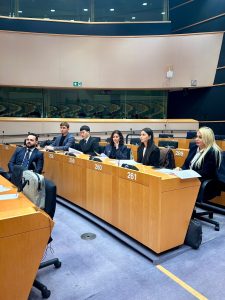
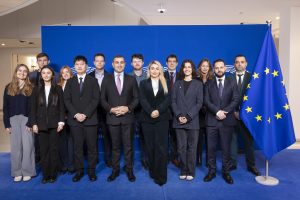
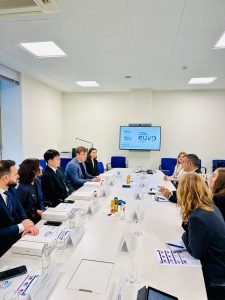
To make such initiatives effective, the YEAs in Armenia work closely with national institutions and the EU Delegation, with strong support from Vassilis Maragos, Head of the EU Delegation to Armenia. This has enabled high-level exchanges, including a meeting with Commissioner for Enlargement Marta Kos. For Milena, moments like these are when young people become changemakers, gaining space not only to ask questions but also to build meaningful relationships with decision-makers.
At the same time, she notes that follow-up is often missing, leading to “scepticism if youth voices are being heard and taken into account”. The creation of Armenia’s Youth Advisory Council last year has therefore been particularly encouraging, signalling that youth empowerment is moving beyond rhetoric.
A generation asking new questions
Asked about the most pressing issues for Armenian youth, Milena points to growing interest in engaging with the EU and understanding Armenia’s path towards closer ties. This is reflected in the increasing number of young people joining the YEAs each year. “Each generation brings fresh ideas, and you can see shifts in the way of thinking,” she says, noting that younger members are often particularly strong in social media communication, an essential asset in countering disinformation.
Identity, values, and difficult conversations
One key challenge, especially in remote areas, is fear that closer relations with the EU could threaten Armenia’s national identity. Milena points to resistance on certain social issues where EU values are perceived to contradict traditional beliefs, citing discussions around LGBTIQ+ as a particular point of contention. She explains that local representation within the YEAs helps to address these concerns, as people are more receptive when messages come from within their own communities.
Highlighting real-life examples is also crucial. Stories of students who studied abroad through programmes such as Erasmus and later returned home have helped shift attitudes among hesitant families. As Milena observes, “one person can lead the community to change perspective”.
Borders, barriers, and big ambitions
A related issue raised with EU officials concerns the difficulty that Armenian students face when applying for long-term visas to study in countries such as Belgium or Spain. Currently, applicants must travel to Moscow – a requirement made especially challenging by geopolitical tensions. As a result, many young people struggle to meet short application deadlines for EU-funded opportunities. Against this backdrop, Milena highlights the EU-Armenia Visa Liberalisation Dialogue, launched in 2024, as a positive step towards easier mobility and exchanges with the EU.
Momentum that matters
When asked about the granting of EU candidate status to Georgia, Moldova, and Ukraine, Milena says many young people saw it as proof that sustained engagement can pay off. For Armenian youth, it offered hope that closer alignment with the EU is not merely aspirational, but achievable. At the same time, she stresses that “the important aspect here is the people”, noting that reforms only succeed when the public understands and supports them.
Reflecting on her visit to Brussels through the EUVP programme, Milena highlights one lasting lesson: “Dialogue is important but also compromise – differences are not a threat; the goal is to find common ground.” Her advice to other young people who want to become more involved in politics is equally direct: “There is no ‘what if’ – you just need to try!” For her, meaningful engagement always starts at community level, by understanding what matters both to you and to the people you represent. As she puts it: “Start local – think European – go forward.”
This interview was conducted in collaboration with the European Parliament’s Directorate-General for Parliamentary Democracy and Partnerships, as part of the European Union Visitors Programme.
LATEST
From displacement to enterprise: rebuilding my community through entrepreneurship
A message from the YED Coordinators
My personal experience as a Young European Diplomat viewing the EU for the first time
A blueprint for enlargement: what we can learn from Moldova, Ukraine, and Montenegro
Young European Diplomats Club


The information on this site is subject to a Disclaimer and Protection of personal data. © European Union,
