

From the press room to the plenary: my Model European Union story
Have you ever paused to consider how your understanding of the world, from its power structures to moments of protest and progress, depends on the work of journalists? Maybe not just the ones in front of the camera, but also those scribbling notes in the back of a crowded press room, asking difficult questions, and giving voice to those on the margins. At its core, journalism is more than reporting facts: it questions authority, makes the invisible visible, and captures the very pulse of society.
This April, I had the privilege of stepping into the role of a journalist at the Model European Union Strasbourg (MEUS) 2025. While no simulation can fully mirror the pressures of real-time journalism or the gravity of global reporting, it offered a concentrated space to reflect on what it means to tell a story with integrity, curiosity, and care. For five intense days, inside the chambers of the European Parliament, we recreated a space for democratic debate. And we followed it all: the heated discussions, the behind-the-scenes compromises, the last-minute amendments, and the off-the-record hallway chats that sometimes said more than the official speeches.
Strasbourg, with its cobbled streets and imposing institutions, buzzed with the energy of over 200 participants from across the continent. For the largest simulation of its kind, they arrived as political group delegates, national ministers, lobbyists, bank governors, interpreters, and, in my case, as a journalist – each ready to engage with the complexities of EU decision-making in one of its most symbolic settings. And so, the story began…
Origins and evolution
Yet the origins of this story trace back not to a great committee room, but to a handful of students and an ambitious idea. In 2006, a group from AEGEE set out to make European politics more accessible, especially for young people whose futures would be shaped by distant institutions they scarcely understood. By March 2007, their efforts had borne fruit, when the first edition welcomed 150 participants to debate youth mobility and Balkan integration in the actual European Parliament.
Since then, MEUS has grown, but not without challenges. It has weathered funding constraints and even a global pandemic. A key turning point came in 2018, when BETA France, an independent, youth-led nonprofit, took over its organisation. Their commitment helped solidify MEUS’s structure and broaden its reach. Today, the event brings together over 50 volunteers from more than 25 countries each year, building an experience that reflects the diversity of the continent it seeks to represent.
At a time when disillusionment with politics is common, MEUS offers an alternative. It does not claim to be perfect, but it provides a space for genuine dialogue, peer learning, and active participation. It gives young people a platform, not just to observe, but to speak, to negotiate, to listen, and, above all, to care.
The professional journey
From the outset, the atmosphere was electric. Delegates representing EU member states and political groups took their seats in the hemicycle, ready to debate the Digital Euro and the Traineeship Directive, the topics featuring in this year’s edition. Meanwhile, lobbyists worked the halls, pushing for amendments and building unlikely alliances. In parallel, the Governors of the European Central Bank contributed sharp analyses, grounding the debate in the realities of monetary policy and institutional responsibility. Interpreters played a crucial role, I dare say one of the most impressive given the demand, ensuring linguistic diversity at all times. A special shoutout to the incredible team who brought nine languages – Romanian, Italian, French, Slovak, English, Spanish, Polish, German, and Greek – into one shared conversation, bridging voices and ideas across the hemicycle.
As journalists, we darted between committee rooms and press briefings, notebooks in hand, recording the moments that would define the week. Our last press conference was a moment where we truly felt the power of our role. It was an exercise in preparation, crafting incisive questions that not only ensured clarity but also helped bring out voices that hadn’t been fully represented in the debate. We made sure to cover every angle through the Strasbourg Press page, capturing both funny but also insightful content from participants. Personally, I had the chance to push my Gen Z editing skills to the limit; the world moves fast, but social media moves twice as fast, and I’m all about keeping pace.
In such a setting, the journalist’s role can feel paradoxical. On one hand, we strive for impartiality; on the other, we’re part of the same youthful, hopeful ecosystem. Reporting on a story we’re also living through adds a layer of complexity, but it also gives our role meaning. We didn’t just document, we made a story visible. Call it daily updates, interviews, or feature pieces – we genuinely aimed to capture the aspirations driving the participants. And you might ask, why? Because, just like in real life where narratives influence policies, we knew we had to listen carefully, fully aware that the stories we told could shape how MEUS 2025 might be remembered.
And at the heart of those stories were the individuals themselves, not only legislative victories or procedural hurdles. It was about the people who made the simulation come alive. To name a few, though far from an exhaustive list: the delegate of Slovenia who delivered a powerful speech on environmental awareness; the Romanian lobbyist who tirelessly rallied support for trainees’ rights; the Minister of Luxembourg who brokered a last-minute compromise when tensions were high. Each participant brought their own vision of Europe, sometimes at odds, but always compelling.
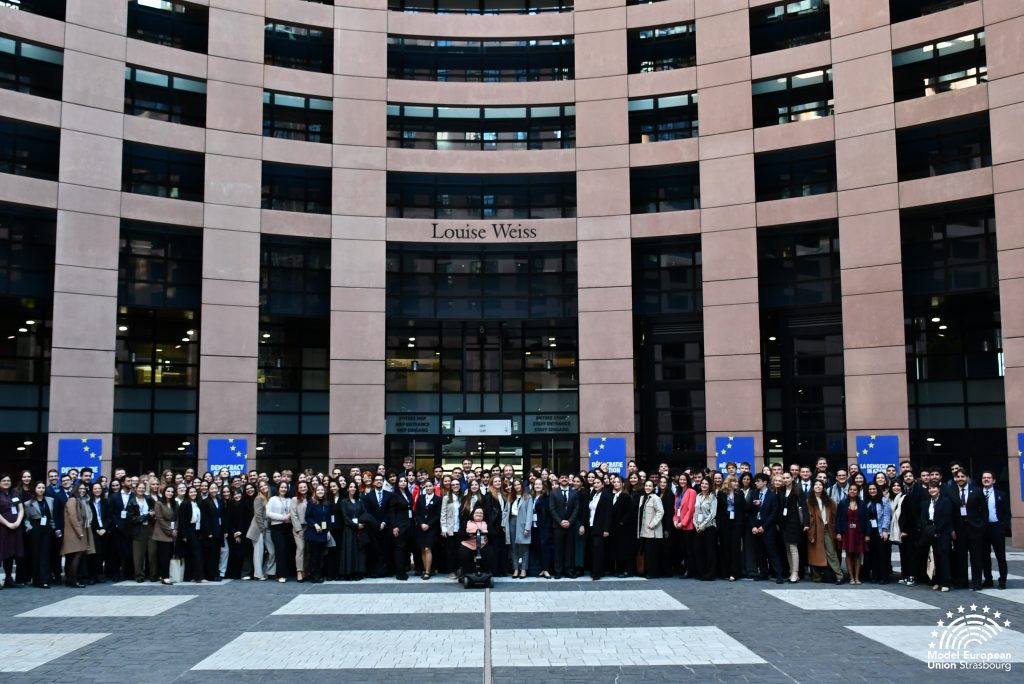
The personal journey
Within the structure of the simulation, it was our task as journalists to capture its heartbeat. I was honoured to be part of what our coordinator, Alexandra-Ioana Simon, fondly dubbed the “Dream Team”: Ludovica Privitera, Aurora La Rocca, Alexandra Brătulescu, and myself, Bianca Tudorache. Our role was to document the unfolding events, which translates to who did what, where, and when, and to shape the rhythm of the simulation into stories that could outlast its one-week lifespan.
We also had the privilege to publish the official MEUS newspaper, a fresh addition to this year’s simulation. From the very beginning, our team jumped into curating content, giving participants plenty of chances to stretch their thinking with tough crossword puzzles and games. And while this marked the start of our reporting journey, it won’t be the end: our final edition, soon to be published, will capture the essence of MEUS 2025, ensuring that the spirit of this experience endures even after we’ve all left Strasbourg.
Outside the chamber walls, there were moments that mattered just as much. I had the joy of reuniting with other Young European Ambassadors, including Loredana Avram from the Moldova Chapter. We quickly became a team within a team, sharing reflections, laughs, and the joy that international experiences like these can forge.
And I have to admit, beyond all the learning, the whirlwind of press briefings, policy language, and the rush to meet publishing deadlines, it’s the human moments that linger the most. My high school friend from Romania, Teodora, joined as an MEP, so seeing our journeys intersect years later made me quietly proud of how far we’ve come.
Then, there were new connections, too, with people whose open spirits and disarming warmth made it feel natural to connect, reminiscent of that kindergarten ease when friendships bloomed without hesitation. I found myself already missing them before we even said goodbye. Within this short burst of time, we built a shared world. I hope, some special day, we will get to share it again.
As novelist Haruki Murakami sums up quite well, “What happens when people open their hearts? They get better.” Storytelling in all its messy, inspiring, and vulnerable forms, is a way of opening hearts. It allows us to build futures in which we are seen and connected, to reflect on our very relatable human experience. MEUS reminded me that sometimes, the stories we carry home (the ones we smile back at later) are more powerful than the resolutions we pass.
Final reflections
As I packed up my press pass and folded my notes, I felt like I had witnessed a snapshot of something still unfolding, even after the event had ended. What makes a story important is not just its content, but the heartbeat behind it: the human pulse running through every word, every decision, every act of courage or compromise.
And perhaps that’s what journalism does, at its best: it finds the pulse of the world and, if we’re lucky, helps it beat a little longer.
I leave MEUS with a full heart, a buzzing mind, and a notebook that’s anything but neat. But it’s the kind of mess that proves something happened. Something real. Something that mattered. As a Young European Ambassador, I can say with conviction that MEUS does not just simulate the EU chambers, but it gives you the fleeting experience of a life simulation.
On a final, somewhat positive note, in the spirit of Hannah Arendt’s works, storytelling is an act of resistance against forgetting. I hope, in some small way, that I have helped the MEUS story be remembered.
Thank you, MEUS 2025!
References
AEGEE EUROPE. (2006). Take Control – Ways to democracy in Europe. Aegee.org. https://www.projects.aegee.org/takecontrol/index-8.html
Arendt, H. (1998). The Human Condition (2nd ed.). University Of Chicago Press. (Original work published 1958)
Model European Union Strasbourg. (2025, February 28). Wikipedia; Wikimedia Foundation. https://en.wikipedia.org/wiki/Model_European_Union_Strasbourg
Murakami, H. (2010). Norwegian Wood. Vintage.
LATEST
A message from the YED Coordinators
My personal experience as a Young European Diplomat viewing the EU for the first time
A blueprint for enlargement: what we can learn from Moldova, Ukraine, and Montenegro
Young European Diplomats Club
Europe is more than the EU – it’s a practice. On Europe, belonging, and the quiet power of those who refuse to wait

The information on this site is subject to a Disclaimer and Protection of personal data. © European Union,
