
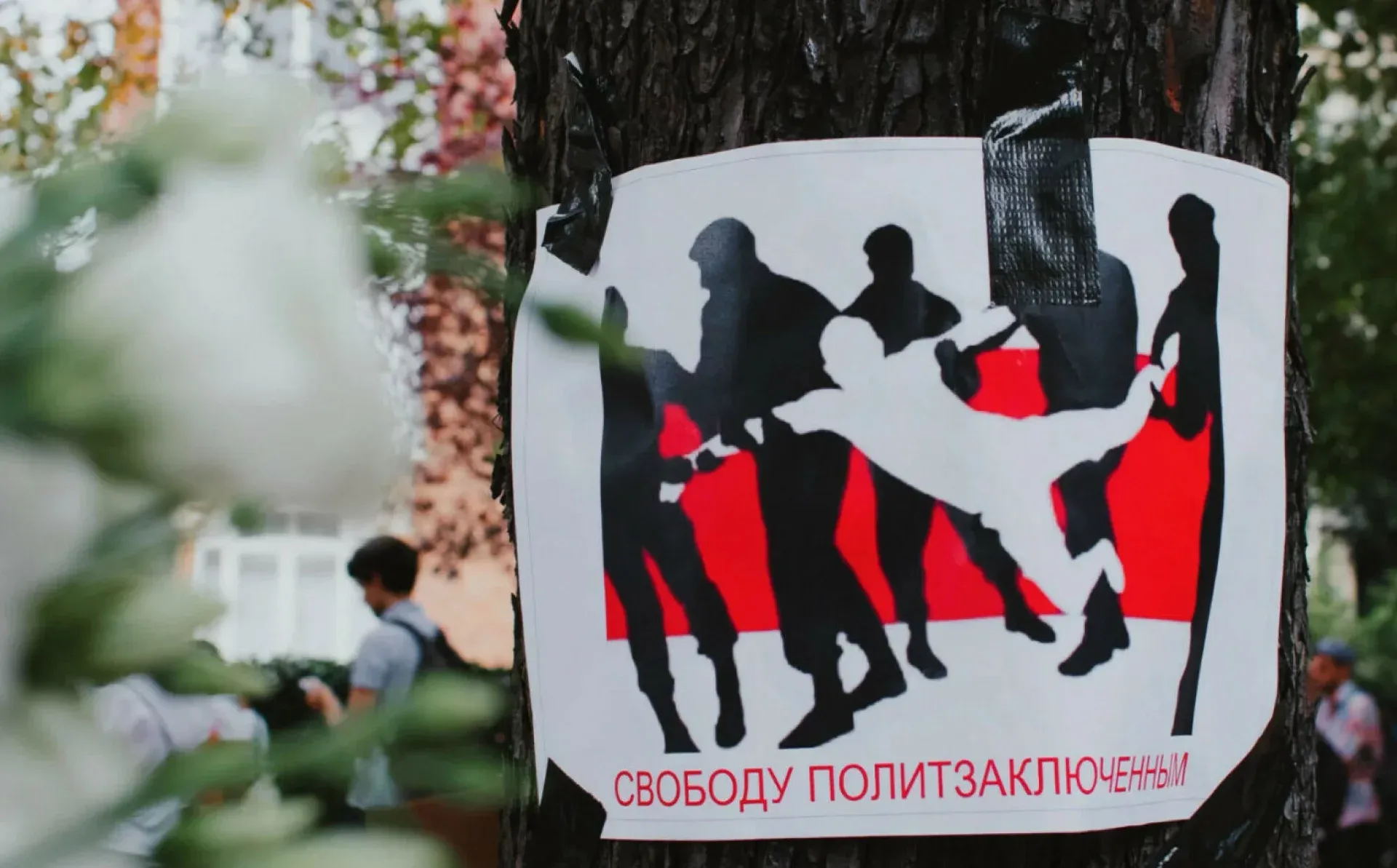
Democracy and Belarus in 2024: an insight from a Young European Ambassador
Human Rights are increasingly at the forefront of conversations across the European continent, particularly since the start of Russia’s full-scale invasion of Ukraine in 2022.
Many EU countries have stood in solidarity with Ukraine and condemned the invasion. On 17 June 2022, the European Commission recommended that Ukraine be granted EU candidate status, a move that was quickly confirmed by the European Council.
Throughout the war, the Belarusian government, headed by its illegitimate[1] president, Alexander Lukashenko, has remained a firm Russian ally, as demonstrated by his permission for Russian military forces to use Belarusian territory to launch attacks on Ukraine.
Furthermore, the Belarusian government has been complicit in aiding Russia’s systematic deportation of Ukrainian children. From February 2022 to late October 2023, more than 2,400 Ukrainian children between the ages of 6 and 17 were transported to at least 13 government-controlled facilities across Belarus, according to a December 2023 report by the Yale Humanitarian Research Lab. Officials initially denied their presence, but in 2023 the state broadcaster confirmed the presence of Ukrainian children in the country for “rehabilitation”.
Since the collapse of the USSR, The Belarusian government has demonstrated its political alignment with Russia by signing multiple treaties and economic agreements. In 1999, Alexander Lukashenko, and the then-Russian President, Boris Yelstin, signed the ‘Treaty on the Creation of a Union State’, which provides the foundation for the relationship between the two nations. It sought to deepen their relationship through economic integration and defence.
In Belarus, the treaty entered into effect in 2000, following its ratification by the Belarusian Parliament, which following a constitutional amendment in 1996 is under the control of the Head of State, the President. Although Lukashenko’s first term in office was scheduled to end in 1999, he was allowed to continue in office under new terms that he negotiated.
After his re-election in 2001, he oversaw the passage of a controversial constitutional amendment that enabled him to seek a third Presidential term. In the face of multiple allegations of electoral manipulation and fraud, he was declared the winner of the 2006 election. In response to these allegations, the European Union sanctioned Lukashenko and a number of his officials from entering any of the EU member countries. Only two years later, in 2008, the EU temporarily removed its travel ban against the President in an attempt to improve relations. In 2010 he was yet again declared the winner of another presidential term, this time with even more allegations of vote manipulating.
One of the ways that the Belarusian government has been accused of electoral fraud is by excluding certain individuals from running for election through various coercive tactics such as wrongful imprisonment. In October 2013, a guideline to define the notion of “political prisoner” was presented at the Third Human Rights Forum in Vilnius. It was developed by a working group of human rights activists from Azerbaijan, Belarus, Georgia, Lithuania, Poland, Russia and Ukraine. The guide was supported by the Human Rights Centre ‘Viasna’[2], as its purpose was to unify the various approaches of human rights organisations on the definition and use of the term “political prisoner”.
Ahead of the 2015 elections, the President tried to appear more democratic by releasing several political prisoners and welcoming international observers in Belarus. However, the election, which yet again declared him the winner, was noted by the OSCE (the Organisation for Security and Cooperation in Europe) as fraught with “significant problems” in the electoral process.
In August 2020, Lukashenko stood for yet another Presidential term. However, his poor handling of the COVID-19 pandemic and the overt nature of electoral interference – which included the imprisonment of opposition candidates such as Viktar Babaryka and famous vlogger Sergei Tikhanovsky – sparked an unprecedented mass mobilisation in the country’s recent history.
Viktar Babaryka attempted to run for President in 2020. After pledging to bring democracy, respect the separation of powers, and establish presidential term limits, he was proving to be popular in the polls. However, before the election he was arrested on trumped-up charges of tax violation and sentenced to 14 years in prison. It was reported that on April 27, 2023, he was hospitalised after suffering severe beatings in the Novopolotsk penal colony. His lawyers and family members have not heard from him since.
After the politically motivated imprisonment of her husband, Sergei Tikhanovsky, Svetlana Tikhanovskaya decided to run for election in his place. She became the leader of the opposition party and is believed to have won a significantly higher portion of the vote than is officially reported by the state channels.
In June 2021, the European Council introduced new sanctions against the Belarusian regime to respond to the escalation of serious human rights violations including the violent repression of civil society, democratic opposition, and journalists.
As of the end of November 2024, according to Viasna, there were 1,296 political prisoners in Belarus, including 172 women. In October 2024, the human rights community declared 62 people political prisoners. Since the summer of 2020, the human rights community has identified 3,638 individuals as political prisoners, 669 of whom are women.
Following the electoral manipulation and protests of August 2020, the leaders of the opposition and their supporters faced violence and imprisonment. Maria Kolesnikova, a prominent Belarusian opposition figure who was one of Tikhanovskaya’s main supporters led several street protests and is currently serving an 11-year prison sentence. Those who have managed to leave the country, like Tikhanovskaya, often continue to fight for a free, independent, and democratic Belarus as part of the European community.
To make the situation more difficult for political prisoners, the regime has also targeted their lawyers. In March 2020, according to Viasna, six lawyers were arrested after having represented well-known political prisoners. Among them is Ivan Chyzhyk, the last lawyer to represent Viktar Babaryka.
The Belarusian National Committee is responsible for investigating violations against human rights defenders and opposition leaders, yet they have only sided with the government, ruling its actions as ‘justifiable’. The Committee is also responsible for investigating all individuals and organisations that are placed on an ‘extremists list’ by the regime. Human rights defenders and human rights organisations form a large part of this list.
Political authorities and administrations including the National Assembly, Council of Ministers, and the Supreme Court are all centralised and controlled by a government in which all the officials are appointed by the President. The government strictly regulates the economy and restricts the freedom of civil society. They maintain nationalised economic policies, such as regulating prices and exchange rates, and authorising state intervention in the operations of any company. Following 1991, structural reforms have not been implemented and 75% of all the country’s companies are still state-owned.
Privatisation, the main economic policy associated with the transition from communism to capitalism, has been almost completely halted, there is little foreign direct investment, and a large portion of the national budget is wasted on maintaining factories from Soviet times.
There is a very limited number of independent media inside the country. Most of the information is spread through state channels and is subjected to state control, with severe consequences if state assumptions are not met. The use of wiretapping and other surveillance by state security agencies limits the right to free private discussion. Authorities threaten, harass, and arrest people who speak out against the regime, the post-election violence, and the war in Ukraine. Characteristically, reporters are subject to fines, detention, intimidation, and criminal prosecution, including under harsh anti-extremism legislation. Since 2020, the government has cracked down on independent media more forcefully, and several journalists received lengthy prison sentences in 2023. According to the Belarusian Association of Journalists (BAJ), at least 32 media workers were in prison in 2023. At least 33 media outlets were declared “extremist” during the year, while 12 outlets were declared “terrorist”, according to the BAJ. The government employs anti-extremism legislation against independent organisations and individuals to restrict public outreach and suppress dissent. In August 2023, the Viasna Human Rights Centre, one of the oldest human rights organisations in Belarus, was added to the list of “extremist organisations”. The designation also criminalises sharing information from Viasna channels.
Sanctions on the Belarusian regime are very important because it is a way for the international community to voice its support for Belarusian political prisoners and for the oppressed people of Belarus. As of right now the EU has sanctioned 261 entities and 36 people connected to the regime. On 26 February 2024, the Council decided to prolong the restrictive measures linked to internal repression in Belarus and the regime’s support for Russia’s war against Ukraine for another year, until 28 February 2025. In August 2024 the Council decided to impose sanctions on 28 individuals responsible for the internal oppression and human rights abuses within the country. Those sanctioned include members of the department for combating organised crime and corruption of the Ministry of Internal Affairs. They also include members of the judiciary, heads of correctional institutions and regime propagandists, as much of this arbitrary repression was made possible by the absence of an independent judiciary and the involvement of the judiciary in punitive practices.
Since August 2020, the EU has imposed several successive rounds of individual and sectoral sanctions, against those responsible for internal repression and human rights abuses in Belarus, and in the context of Belarus’ involvement in Russia’s war against Ukraine. With these measures, the EU is signalling to the political and economic actors responsible that their actions and support for the regime and to Russia come at a cost.
We as a Union must continue to support the people of Belarus in their fight for freedom and democracy and encourage them further to uphold the demand for respect of their human rights.
Resources
Interview with Viktoryia Andrukovič
Book: Cresciuta nell’ultima dittatura d’Europa. La lotta per la libertà in Bielorussia (Attualità e politica), Victoria Andrukovič, 2023
Links and Reports
The Economic Reconstruction of Belarus: Next Steps after a Democratic Transition, Policy Department for External Relations Directorate General for External Policies of the Union , March 2022
Viasna: Human rights Situation in Belarus, 2023
The Guardian: Belarus opposition candidate rejects election result after night of protests, August 2020
Aljazeera: Belarus blacklists 625 opposition figures as ‘extremists’, October 2022
Amnesty International: Belarus
Viasna: Referendum 2022: Analytical report on election campaigning
UN GA, 2023: Situation of human rights in Belarus in the run-up to the 2020 presidential election and in its aftermath
European Parliament resolution of 15 March 2023 on further repression against the people of Belarus, in particular the cases of Andrzej Poczobut and Ales Bialiatski
Viasna, March 2022: Referendum-2022: Findings and conclusions
Britannica: Government and society in Belarus
Council of Europe, Commissioner for Human Rights Statement, 2020: Human rights violations in Belarus must stop immediately
UN news article, March 2024: ‘Currently unsafe to return’ to Belarus, Human Rights Council hears
OMCT World Organisation Against Torture, July 2023: Belarus: How human rights defenders are being silenced – a new report
Human Rights Watch: Belarus events of 2023
European Council: EU imposes sanctions on Belarusian economy, 2021:
Viasna: Human Rights Situation in Belarus November 2024
Freedom House: Belarus: Freedom in the World 2024 Country Report | Freedom House
Restrictions on freedom of expression under the pretext of combating extremism and terrorism, Freedom House: *freedom_of_expression.pdf
EU sanctions against Belarus: https://www.consilium.europa.eu/en/policies/sanctions-against-belarus/
Viasna: restrictions_freedom_expression_2024.pdf
[1] The EU does not recognise the “falsified results” of the August 2020 presidential elections in Belarus – https://www.consilium.europa.eu/en/press/press-releases/2020/09/24/belarus-declaration-by-the-high-representative-on-behalf-of-the-european-union-on-the-so-called-inauguration-of-aleksandr-lukashenko/
[2] Viasna is the leading human rights organisation in Belarus. They engage in many activities including documenting human rights violations, informing the international community about the human rights situation in Belarus, defending those wrongfully imprisoned, and assisting political prisoners with medical care and other needs. As a result of her work, Marfa Rabkova, Viasna’s Coordinator of Volunteers, was wrongfully detained in Minsk on 17 September 2020 and accused of training people to participate in mass riots. In late November 2021, prosecutors also accused her of “property damage, “inciting hatred”, and “membership of a criminal organisation”. She was sentenced to 15 years in prison in 2022.
LATEST
A message from the YED Coordinators
My personal experience as a Young European Diplomat viewing the EU for the first time
A blueprint for enlargement: what we can learn from Moldova, Ukraine, and Montenegro
Young European Diplomats Club
Europe is more than the EU – it’s a practice. On Europe, belonging, and the quiet power of those who refuse to wait

The information on this site is subject to a Disclaimer and Protection of personal data. © European Union,
