

Beyond the ceasefire: how Ukrainian youth re-define peace
Sitting in the passenger seat, I watched Irpin pass by in segments: restored houses were interrupted by piles of rubble, facades still bore the scars of shelling, visible even months after de-occupation. I was there as a UNICEF youth adviser, evaluating the local humanitarian response. In the courtyard of a rebuilt school, I saw bullet holes circled with colourful flowers drawn by children. This dissonance stayed with me: the building had been restored, but what about the invisible wounds? The children had not erased the damage but turned it into petals of memory, and this image lingered in my mind.
War changes not only cities and villages but also our layered perceptions of peace. For Ukrainian youth, peace no longer means simply the absence of shelling; now it is linked to dignity, memory, justice, and trust. Our experience of loss, displacement, and survival forces us to ask difficult questions: how to heal the trauma of generations, how to remember without getting stuck in pain, how to build a future in which no one is excluded, and how different experiences of war are heard.
This story is important not only for Ukraine but also for Europe. How young people understand the world after the war will determine whether reconstruction will become the foundation for lasting peace.
How does the experience of war shape our vision of peace?
My interest in the redefining of peace is not abstract. As a Ukrainian student at the innovative, peace-oriented global institution, United World College, every day I see youth and friends from different war-torn countries. For instance, Syria, Sudan, Palestine, or Myanmar, which have experienced conflicts first-hand and are now seeking their own understanding of peace after its outdated interpretation is no longer effective.
Traditional peacemaking often boils down to ‘negative peace’, that is, the cessation of violence, and this is how we often perceive the idea of justice. Nevertheless, the experience of war has taught us to strive for positive peace through the restoration of relationships, centrality of trust, and a sense of inner security, both as individuals and a nation.
This understanding deepened during my studies at the UWC movement, a network of schools on all continents. Founded in post-WWII Europe, it carries the aim of educating a generation capable of rethinking peace not as a pause between wars, but as a state that comes after the restoration of justice and the creation of conditions for social healing. Here, peace is seen as a process where communities have a safe space for reflection, memory, and restoration of dignity before moving forward.
For my generation, peace means the ability to build a future without fear and the right to remember and be heard. It is about the collective derussification of our reality, the ability to take back our stolen identity, culture, language, and history. It is this perspective that helps us to understand why post-war recovery cannot be limited to rebuilding cities, because without community healing, without acknowledging trauma and preserving memory, society risks remaining in a state of truly unresolved conflict.
Restorative justice and memorialisation in action
The children’s drawings in Irpin became an example of living memorialisation for me. They do not hide trauma but gently acknowledge it, as if empathising pride and the crossing out of violence with this sign of celebration of survival.
Such practices are important because they create space for public memory without turning it into silence or oversimplified propaganda. Memorialisation practices such as cultural art, experiential literature, truth tribunals, and preservation initiatives help to acknowledge the experiences of victims, preserve historical truth, and form a public space where we can honestly and openly reflect on our past, present, and future.
But memory without justice can turn into lasting pain, so it is important to talk about restorative justice, an approach that focuses not only on punishment and reparations but also on restoring relationships and putting interpersonal trust at the centre of the process.
Reading The Moral Imagination by John Paul Lederach, which was introduced to me by a professor at the University of Notre Dame, I came across the idea of ‘paradoxical curiosity’, the ability to see unspoken perspectives, even in conflict. This gave me a language for what Irpin showed me: peace is built not only through infrastructure or diplomacy, but through the restoration of human connections, even when our experiences and memories of war are fragmented and differ.
Recognising societal trauma is the first step toward healing, while systematic silence and diplomatic compromises are its continuation. Trust in institutions comes when people feel they are treated fairly and with respect, and for Ukraine, this means that reconstruction must include not only infrastructure and other physical dimensions, but also transparency, citizen participation, and clear accountability, and we are steadily showing progress in these areas.
What does the memory of those years mean to us, both personally and collectively?
For Ukrainian youth, memories of the war are not only a source of pain, but clear evidence of our resilience and bravery. They are also an experience of solidarity, a reawakening of our own identity and a sense of pride in it, a strong realisation of responsibility for the future.
When I think about my wartime youth, I think about burned photos of a family under the rubble of a residential building, but also about warm summer evenings while volunteering with peers and sharing our dreams, so vulnerably human yet unshakably united. This duality is constant, a dichotomy of our lives that somehow coexist as we find the courage to love and live fully as our greatest way to resist.
On a personal level, the memory is stories of loss, evacuation, separation from home, loss of loved ones, and each story is different, each waiting for the world to hear it. Collectively, it is a rethinking of who we are as a Ukrainian society, what strengths and weaknesses we have and have developed, and where our strengths lie.
Inclusive and holistic approach for a sustainable future
Working with young people across Ukraine, I have seen that sustainable recovery is only possible when community voices are part of the process and when we have a safe space to understand each other, because everyone experiences war in a different way, making it important to soothe this internal polarisation. Besides, peacebuilding must include those who have survived the war, those who have been forced to leave their homes, and those who are returning to rebuild their lives.
The war has exposed inequalities and vulnerabilities, so peace cannot be sustainable without inclusion, patience, and a local community-oriented approach. While addressing external factors of violence, that is Russian genocidal invasion, may take several years and long diplomatic negotiations and pressure, true healing of a nation that finally gains security can take decades. Sounds a lot, but it is a promising way to regain confidence in our better tomorrow.
My experience working with war-affected communities has convinced me that infrastructure can be rebuilt quickly, but trust and a sense of dignity take time and conscious effort. A holistic approach to recovery involves integrating psychological support into reconstruction, encouraging youth participation in decision-making and understanding the intergenerational clashes of Ukrainianism that we all experience. Also, it’s about taking into account the experiences of internally displaced persons, implementing gender-sensitive policies, decolonising narratives, and restoring cultural agency, which is an epistemic element vital for the preservation of a Ukrainian identity that has been oppressed for centuries.
Today is another step of resilience
Often, when the voice in the carriage of the Kyiv-Ternopil night train announces my station, I close my book and notice the flowers drawn in its margins. Unconsciously, I repeat the gesture of the children from Irpin. In the morning air of the station, it gives a feeling of calmness: peace begins not with forgetting, but with attentiveness to memory.
For Ukrainian youth, peace is not just the end of war, but a complex process of restoring dignity, justice, and trust. It is the ability to remember without allowing trauma to determine the future. It is the creation of a society in which everyone has a voice and the right to memory in all its fragmentation.
As a student of a global peace-oriented movement and a citizen of one of the braviest countries in the world, currently experiencing the Russo-Ukrainian war, I am firmly convinced that peace is not an end point, but a joint process of creation. We, the Ukrainian youth, want to return our occupied territories, restore our lost cultural and national heritage, and receive justice and reparations for the suffering that Russia has caused us. However, it is worth starting to think about what will happen after these initial steps, how our fragmented society will be able to coexist and build a new, united, blooming Ukraine.
Today, our country is redefining what peace truly means as we search for our future direction as a nation. Amid shelling and air alerts, we all long for that forgotten peacefulness and safety, yet we continue to show up every day volunteering, working, studying, creating, and loving deeply. These small acts carry our greatest form of resistance.
We, the youth of Ukraine, will continue to make every effort to bring closer that long-awaited final station of victory. Acting locally, we carry within us an unbreakable hope for a stronger, independent, and free Homeland.
And if it means rewriting the very definition of peace to show the world that what we are fighting for truly matters, then we will live it, defend it, and win it.
Below are some of my recommendations to further dive into this topic.
Sources
- Ukrainer. Article “Defining Peace in Ukraine: Understanding the Russo-Ukrainian Wars of 1918-1921 and 2014-Present.” January 20, 2025. https://www.ukrainer.net/en/peace-in-ukraine-analysis/
- O’Flaherty, Michael. Memorandum on Human Rights Elements for Peace in Ukraine. Strasbourg: Council of Europe Commissioner for Human Rights, 2025. https://rm.coe.int/memorandum-on-human-rights-elements-for-peace-in-ukraine-by-michael-o-/1680b678ec
- Riabchuk, Mykola. “War in Ukraine: Peace-Talking versus Peace-Making.” CIDOB Notes Internacionals, no. 288 (2023). https://www.cidob.org/en/publications/war-ukraine-peace-talking-versus-peace-making
- Sections “Explaining Ukraine” and “War Crimes” of the Kyiv Independent media website with very diverse informative articles and latest news coverage: https://kyivindependent.com/tag/explaining-ukraine/
- Snyder, Timothy. On Freedom. New York: Crown, 2024.
- Lederach, John Paul. The Moral Imagination: The Art and Soul of Building Peace. Oxford: Oxford University Press, 2005. https://gruposhumanidades14.wordpress.com/wp-content/uploads/2014/10/john-paul-lederach-the-moral-imagination_the-art-and-soul-of-building-peace.pdf
- Leiner, Martin, and Christian Schliesser, eds. Alternative Approaches in Conflict Resolution. Cham: Springer, 2018. https://content.e-bookshelf.de/media/reading/L-10388898-360127af25.pdf
LATEST
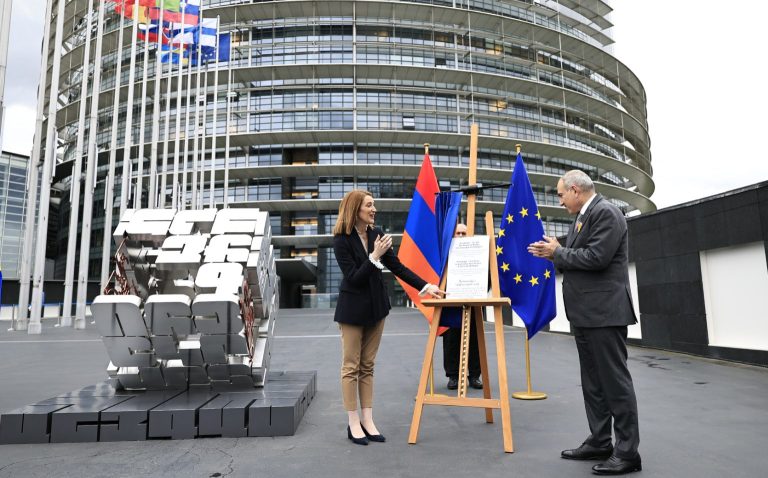
Where culture meets diplomacy: the Armenian alphabet in Strasbourg
From displacement to enterprise: rebuilding my community through entrepreneurship
A message from the YED Coordinators
My personal experience as a Young European Diplomat viewing the EU for the first time
A blueprint for enlargement: what we can learn from Moldova, Ukraine, and Montenegro


The information on this site is subject to a Disclaimer and Protection of personal data. © European Union,
