

Where culture meets diplomacy: the Armenian alphabet in Strasbourg
“To know wisdom and instruction, to perceive the words of understanding.”
These were among the first words translated into Armenian after Saint Mesrop Mashtots created the Armenian alphabet in 405AD. More than sixteen centuries later, those words continue to resonate, not only as the foundation of Armenian literacy but also as a reminder that language is a bridge to knowledge, dialogue, and understanding.
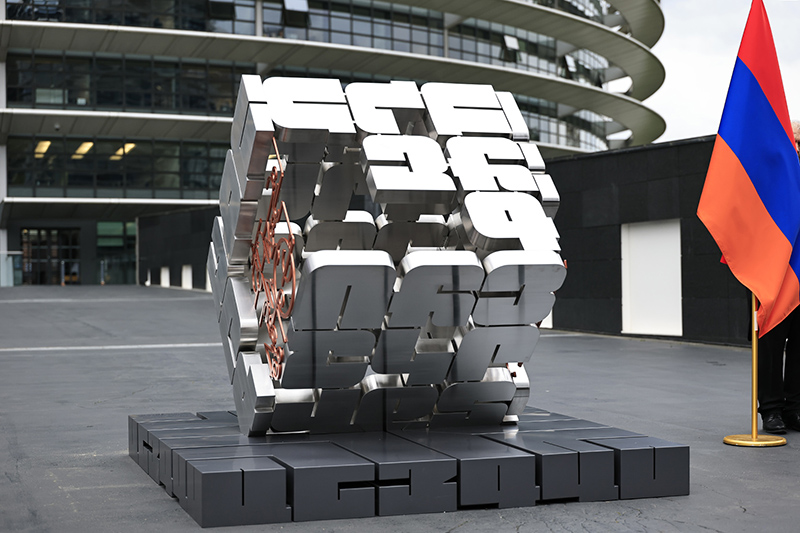
Standing in front of the European Parliament in Strasbourg, the Armenian alphabet monument embodies that very idea. It is more than a tribute to a unique writing system. It is a symbol of how culture can connect nations, foster mutual respect, and strengthen the relationship between Armenia and the European Union.
Why would the Armenian alphabet stand outside one of Europe’s most important political institutions?
At first glance, it may seem unexpected. The European Parliament represents legislation, policymaking and political dialogue, while the Armenian alphabet represents language, literature and cultural identity. Yet their meeting in one place is far from accidental. The monument is more than a cultural landmark. It reflects an important idea: that lasting international partnerships are built not only through political agreements, but also through shared values, mutual understanding, and intercultural respect.
Can culture shape international relations?
We often think diplomacy happens behind closed doors, for instance in negotiations, summits, and official meetings, but diplomacy also exists in museums, classrooms, universities, public squares and even monuments.
Culture has the power to introduce people before politics does. A monument can spark curiosity, encourage conversations and inspire people to learn about a country they may never have visited. In that sense, cultural diplomacy creates something that political agreements alone cannot: genuine human connection.
The Armenian alphabet monument is an example of this. It quietly tells visitors that Armenia’s cultural heritage has a place in Europe’s shared story.
Why the Armenian alphabet?
Few national symbols carry as much meaning as the Armenian alphabet. Created by Mesrop Mashtots in 405AD, it transformed Armenia by making education, literature and knowledge accessible in the Armenian language. For centuries, these 39 letters helped preserve a nation’s identity despite wars, displacement, and changing political realities.
The alphabet therefore represents more than communication. It represents resilience, education and continuity which are values that continue to define Armenia today.


What does this say about EU-Armenia relations?
The relationship between Armenia and the European Union has grown steadily over the years through educational programmes, youth exchanges, innovation, civil society initiatives and people-to-people cooperation. While these partnerships are often measured through agreements or projects, symbols also matter. The Armenian alphabet monument demonstrates that cooperation is not only about economics or institutions. It is also about recognising each other’s histories, appreciating cultural diversity, and creating spaces where different identities are welcomed rather than overlooked.
This, of course, reflects one of the European Union’s core principles: United in Diversity.
What can young people learn from this?
As young people, we often think that international relations are shaped exclusively by politicians and institutions. In reality, every cultural exchange, every conversation, and every shared experience contribute to stronger connections between societies. As a Young European Ambassador, I believe that preserving our own identity while remaining curious about others is one of the most meaningful ways to contribute to Europe’s future.
The monument’s greatest lesson is not asking Europe to become more like Armenia. It is inviting Europe to know Armenia even better. And as we know, every lasting partnership begins exactly there – with mutual understanding.
Can a monument really influence the future?
Perhaps monuments might shape the questions people ask. They encourage discovery, challenge assumptions, and remind us that every culture has something valuable to contribute.
The Armenian alphabet monument is not only about Armenia’s past. It is also about the future of Armenia-EU relations, a future built on dialogue, education, cultural exchange and mutual respect.
Sometimes, the strongest symbols are also the quietest ones. Standing near the European Parliament, the Armenian alphabet does not demand attention. It simply reminds us that before countries become partners, people must first understand one another. And perhaps that is the most powerful message the monument has to offer.
LATEST

From displacement to enterprise: rebuilding my community through entrepreneurship

A message from the YED Coordinators

My personal experience as a Young European Diplomat viewing the EU for the first time
A blueprint for enlargement: what we can learn from Moldova, Ukraine, and Montenegro

Young European Diplomats Club


The information on this site is subject to a Disclaimer and Protection of personal data. © European Union,
