

Artificial intelligence that makes a difference in people’s lives: how EU4Youth helped Denis Zacon achieve his social mission
It is said that a true entrepreneur is someone who enjoys finding solutions to real problems, not necessarily making money – the latter comes as a result of a job well done. For Denis Zacon, this philosophy gained shape in July 2024, when he founded ‘AI Skills’.
It all started with a striking contrast he noticed between training rooms and offices in Chișinău and those in Barcelona. The experience he gained in Spain at Stripe – one of the world’s largest fintech companies – and through European projects in Moldova, gave him a clear understanding of the difference between an organisation that makes good use of available tools and one that doesn’t even know they exist.
After returning home, Denis decided, with the support of the EU4Youth programme, to turn this knowledge gap into a mission: to bring the technology of the future into everyone’s daily work. That’s how he started a company with paying clients and an equally long list of people that he trains for free. Today, he operates as a resident of the Municipal Business Incubator in Chișinău, where he has his office and manages a steadily growing client list, ranging from contracts with private companies to those with state institutions and NGOs across the country.

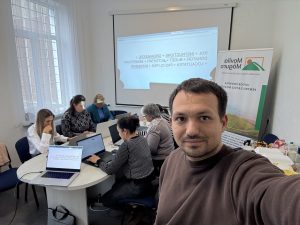

First you understand, then you teach
The model Denis has is simple, and that’s exactly why it works. First, an audit: he goes to the organisation, spends time with the people, and figures out how they work and where they run into problems. Then he builds a training programme that starts from those issues, not from a generic curriculum. The problems he finds are usually the same: from incompletely written prompts to hours wasted on tasks that Artificial Intelligence could solve in seconds. “When people hear about Artificial Intelligence everywhere but don’t understand how to implement it – that’s where I step in and show them how to do it right,” says Denis. As a result, these same people begin to “tame” the technology, turning hours of searching into seconds of assisted work, and naturally integrating the new tools into their actual workflow.
When utility is the currency of exchange
Denis’s company, AI Skills, is registered as an LLC (Limited Liability Company). His clients include private companies, public institutions, and organisations that can afford to invest in team training. But Denis decided from the very beginning that budget shouldn’t be the only criteria for who gets access to knowledge. And so he built a committed social component into the company.
When a public institution or an NGO with a genuine mission reaches out to him and has limited resources, the answer is usually “yes”. He has only one criterion: does this organisation do something meaningful for the people around it? If the answer is clear and positive, the training takes place. “Not all institutions can afford to pay for training. And that doesn’t mean the people there deserve any less to understand the world in which they live and work. When a university comes to me wanting to prepare its students but doesn’t have the budget, I go for free. That’s my way of showing my gratitude to them. I don’t do it for everyone, but I do it whenever I can and when I feel it makes sense.”
Those who have studied social entrepreneurship know that this is exactly the kind of decision that is difficult to sustain in the long term and easy to justify as a feeling, not as a strategy. Denis doesn’t seem to mind, for him, it’s simply the right way to operate.
Who are the beneficiaries?
The list of those trained by Denis reads like a portrait of Moldova’s public institutions, which form the backbone of the services we all rely on – employees of the Ministry of Internal Affairs, border police officers, students at universities that do not have such programsme, librarians across the country – people who work in institutions with limited resources, with diverse audiences, often overlooked in conversations about digitisation.
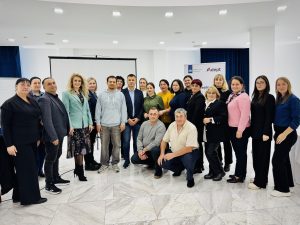
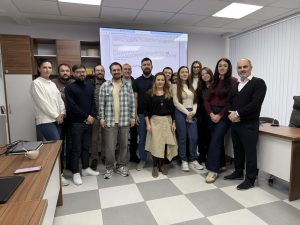
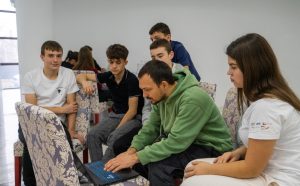
What do they have in common? They are not part of the private sector. They have limited resources. And they work with people – citizens, students, travelers, readers – who deserve to have those who serve them understand the tools of the world in which they live. A border officer who knows how to spot a deepfake is better prepared for the job. A librarian who knows how to use Artificial Intelligence to find resources is more useful to their community. People who don’t understand this technology aren’t just less efficient. They’re more vulnerable – to misinformation, to manipulation, to fakes presented as truths.
What the EU4Youth grant made possible
Denis learned about the ‘Building Back Better Through Social Entrepreneurship’ project, implemented by Junior Achievement Moldova as part of the EU4Youth programme, at an event dedicated to entrepreneurship. He applied that very same day, and the grant of approximately €5,000 he later received came at just the right time, when the company had just been founded and every financial decision counted double. He used it to buy a video camera, run his first Facebook advertising campaigns, and attract his first customers – the kind of investments that move a business from theory to practice.
“It was a timely boost – support that I would normally have had to fund out of my own pocket. Without it, things would have moved slower and more difficult. Not impossible, but more difficult.”
AI Skills has grown since then. It has clients, new projects, and is developing its own software tools, but the social aspect has remained – and has grown along with it. Because a more stable company can afford to say “yes” more often to those who cannot afford to benefit from such training. Denis Zacon works guided by a clear method and the belief that access to knowledge should not be a privilege, especially when our future is at stake.
MOST READ






SEE ALSO

Agricultural panic or opportunity in the EU? Ukraine’s next battle is going to be grain

‘It’s like returning to the Wild West’ – Moldova seeks to attract back its lost citizens

Moldova races towards EU membership as accession talks launch

Moldova between reforms and hybrid threats: the European path of a country on the front lines
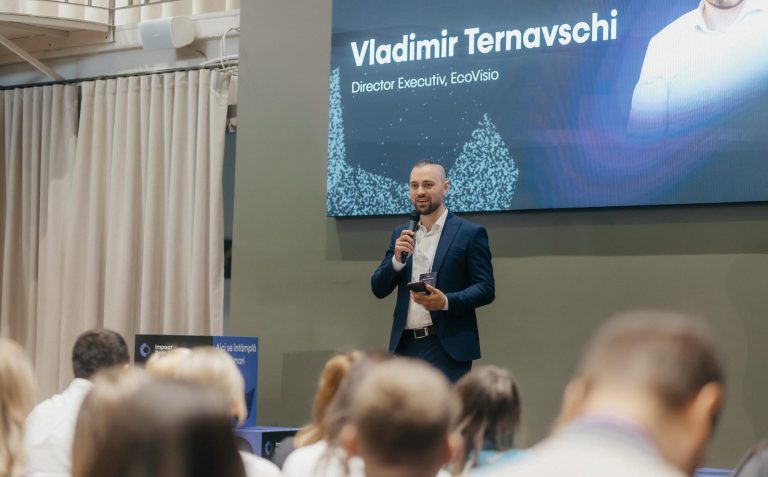
Heading an environmental organisation at the age of 29: Vladimir Ternavschi on his superpower to bring people and ideas together


The information on this site is subject to a Disclaimer and Protection of personal data. © European Union,
