

What does it mean to be part of the European family?
When we talk about European values, we usually mean human dignity, freedom, democracy, equality and the rule of law. But what do these values actually mean to people in different parts of Europe? And why do some take them for granted, whilst for others they remain something worth fighting for?
I suppose my interest in the topic of European identity began during my first academic Erasmus exchange at the Catholic University of Lille. One of the courses I took at the time was ‘Politics of European Identity and Culture’. In the first lecture, the professor asked us a simple question: “Do you feel European?” The large lecture hall fell silent almost immediately. Of the roughly 70 students, fewer than half raised their hands. Most were from EU countries, so this really surprised me. We were just an hour away from Brussels, the de facto capital of the European Union, yet many young people did not fully identify with a European identity.
The 2024 Eurobarometer statistics also confirm this: 34% of young people in the EU identify primarily with their country and nationality, while another 23% feel the strongest connection to their local community or region, and only about 15% of young people stated that they feel European first and foremost. At the same time, it is the younger generation that most often supports European values. Among young people aged 15-24, 81% said they considered these values important for the future of Europe.
It seems to me that one of the reasons is that many young people in EU countries have grown up in an environment of peace, democracy, open borders and stability. For them, this has become the norm. They do not remember major wars or authoritarian regimes within Western Europe, so freedom of movement, human rights and democracy are often taken for granted. But these things did not come about by themselves. They are the result of decades of European integration following the Second World War and a huge amount of political work aimed at building peace in Europe.
I grew up in a country where freedom and democracy have to be constantly defended and fought for. That is why my perception of European values has always been different. For many Ukrainians, security, the right to choose and democracy have never been taken for granted. Generations in Ukraine and Georgia have grown up amidst revolutions, protests and war. That is precisely why political engagement among young people there is often significantly higher. For many people, the European flag is associated not only with the EU as a political or economic union, but above all with freedom, independence and the right to determine their country’s future for themselves.
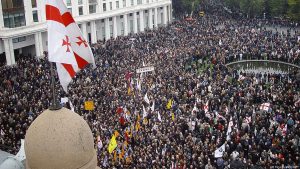
In 2003, Georgia witnessed the Rose Revolution, which became a symbol of the quest for democratic change and the fight against corruption. Just a year later, Ukraine experienced the Orange Revolution following the rigging of the presidential elections. Both movements were accompanied by mass protests and demands for fair elections, democracy and a European course of development.
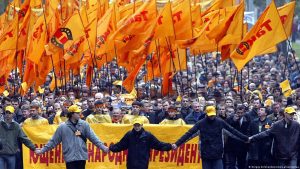
However, it was the Revolution of Dignity of 2013-2014 that became a turning point for Ukrainian society. After the Ukrainian authorities refused to sign the Association Agreement with the EU, students and young people were the first to take to the streets in protest. The violent dispersal of the protesters only intensified public resistance and transformed the student protest into a large-scale movement for democracy and human dignity. For many Ukrainians, the Euromaidan was not only a political protest, but a moment of finally realising that they were part of the European democratic space. It was then that European values ceased to be an abstract political idea and took on a very concrete meaning.
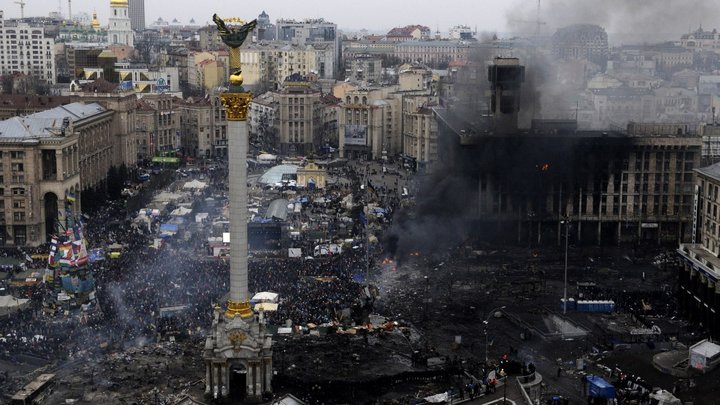
Following Russia’s invasion in 2022, this feeling only intensified. According to the results of the 2025 EU NEIGHBOURS east survey, 70% of Ukrainians would vote in favour of Ukraine joining the EU in a referendum, whilst only 9% are against it.
I also decided to ask Ukrainian students what European values mean to them. One of them replied:
“Ideas rooted in European philosophers, developed over thousands of years, establishing a political community with human rights, democracy, law and justice at its core.”
Similar sentiments can be seen in Georgia. Despite the complex political situation and the suspension of EU accession talks in 2024, the majority of the population continues to support European integration. According to a 2025 poll, 74% of citizens would vote for the country’s accession to the European Union. The ongoing protests in Tbilisi and other major cities, which have now continued for more than 500 days, also demonstrate that for many Georgians, the European path remains closely connected to the ideas of democracy, independence, and civil freedoms.
During a conversation with a Georgian activist, I asked him what European values meant to him. He replied:
“To me, European values to me mean the values of Georgia and other European countries combined to create a unique blend. The most important value to me is respecting the unique history, culture, and context of each European country.”
When asked why it is important for Georgia to be part of the European family, he said:
“Georgia’s independence and traditions are in danger due to Russia’s imperialist policies. Young people associate Europe not only with independence, but also with education, democratic development and future opportunities.”
Today, European values are often taken for granted. But security, democracy and freedom remain very fragile achievements. Even within the European Union, political polarisation, populism and signs of democratic backsliding are becoming increasingly apparent.
That is precisely why democracy cannot exist automatically. It requires constant public engagement, responsibility and a willingness to defend rights and freedoms.
For parts of Europe, democracy has become a matter of course. For many Ukrainians and Georgians, it remains a choice for which a high price must be paid. And perhaps that is why European values often hold not only political but also deeply personal significance for us.
LATEST
From displacement to enterprise: rebuilding my community through entrepreneurship
A message from the YED Coordinators
My personal experience as a Young European Diplomat viewing the EU for the first time
A blueprint for enlargement: what we can learn from Moldova, Ukraine, and Montenegro
Young European Diplomats Club


The information on this site is subject to a Disclaimer and Protection of personal data. © European Union,
