

Unmasking the past: the struggle for Azerbaijani identity under Russian colonialism
From the forced integration of the Russian language and the enduring resistance of the Azerbaijani people to the ongoing efforts to reclaim national identity, Russian and Soviet policies have had a profound impact on the Azerbaijani language and culture.
The Russian Empire annexed Azerbaijan in the early 19th century, with the Soviet Union later solidifying control. The Soviet government implemented policies to suppress Azerbaijani culture and language, introducing Russian as a mandatory second language, which aimed to weaken Azerbaijani national identity. The Soviet regime enforced the use of Russian in schools, government, and public life, making it the language of power and prestige. Azerbaijani children were taught in Russian, essential for career advancement. This Russification policy was a deliberate attempt to integrate Azerbaijan into the Soviet state and diminish local identities.
The pretext of “making Azerbaijanis literate” meant learning only Russian history and literature, while Azerbaijani culture was sidelined. The alphabet was replaced with Cyrillic, and Azerbaijani elites who resisted were either repressed or exiled. Azerbaijan, particularly its Muslim population, suffered under this cultural assimilation despite early advances like the first women’s school in the Muslim East (1901) and women’s suffrage (1918). Literature, music, and art were censored to conform to Socialist Realism, promoting Soviet ideals. Traditional Azerbaijani celebrations, such as Novruz, were suppressed or rebranded. Despite these measures, underground movements and private celebrations kept Azerbaijani culture alive.
Today, numerous initiatives aim to revitalise the Azerbaijani language and culture. The EU is also supporting the Azerbaijani people, by providing funding for cultural initiatives and helping to increase the resilience of the cultural sector. Language courses, cultural festivals, and educational programmes are reversing the damage done by decades of Soviet influence. It’s crucial to address disinformation suggesting that Azerbaijan embraced Russian influence. Soviet policies were imposed, but they were not adopted willingly. Azerbaijan’s history is one of resilience and a constant struggle to maintain identity against colonial pressures.
A taste of language
Azerbaijani is a Turkic language in the southwestern group, which includes Turkish, Turkmen, and Gagauz. The Turks, the ethnic roots of the Azerbaijani people, settled in modern-day Azerbaijan in the early first millennium. As their influence grew, the language evolved, uniting diverse ethnic groups into a nation with a unique culture and language.
During the mediaeval period, Persian and Arabic greatly influenced the Azerbaijani language due to the Persian Empire’s domination and the introduction of Islam. Under Safavid reign, Azerbaijani became the official language of the court and administration. Azerbaijani has influenced several languages: Persian with loanwords related to daily life, Georgian with terms for trade, and Turkish with words and expressions, particularly in literature and folklore.
Azerbaijani has various dialects, including those from Baku, Ganja, and Quba in the north and Tabriz, Urmia, and Ardabil in the south. These dialects reflect the rich cultural and historical diversity of the regions where Azerbaijani is spoken.
| English | Azerbaijani |
| Hello | Salam Salam əleyküm |
| How are you? | Necəsiz? Sən necəsən? (Nə var, nə yox?) |
| What’s your name? | Sənin adın nədir? Sizin adınız nədir? |
| My name is | Mənim adım |
| Where are you from? | Haralısan? (inf) / Haralısınız? (frm) |
| I’m from | Mən … lıyam i.e Azərbaycanlıyam, Bakılıyam |
| Pleased to meet you | Tanış olduğuma şadam |
| I don’t understand | Mən sizi başa düşmürəm |
| I don’t know | Bilmirəm |
| Do you speak English? Do you speak Azerbaijani? | Siz Ingiliscə danışırsınızmı? Siz Azərbaycanca danışırsınızmı? |
| Thank you | Təşəkkür edirəm / Çox sağ ol / Çox sağ olun (pl) |
| Goodbye | Sağol (inf) / Xudahafiz (inf) Sağolun (inf) / Salamat qalın(frm) / Görüşənədək (frm) |
For curious readers
Language as a soft power resource: The case of Azerbaijan by Gulshan Pashayeva (Article)
Language, which is widely viewed as a traditional (not to say extremely important) component of nationhood and a symbol of identity and group consciousness, can be used as an expression of soft power resources within this context.
Azerbaijan´s nation-building process: Role of Language Policy by Mehmet Çağatay Güler (Article)
The article examines Azerbaijan’s nation-building process by specifically focusing on language policy and how it shaped nation-building during the post-Soviet era. It aims to clarify the role and importance of language policy in Azerbaijan’s nation-building process.
A Pan-Turkic Dream: Language Unification of the Turks by Jara Garibova (Chapter of Joshua A. Fishman and Ofelia García, eds. Handbook of Language and Ethnic Identity)
This chapter deals with the historical context in which the idea of a common Turkic language was developed. First of all, a distinction should be made between the terms “Turkic” and “Turkish.” “Turkish” implies the Turks of Turkey and the language spoken in Turkey. “Turkic” is a broader term that refers to all ethnic groups of Turkic origin (including the Turks of Turkey), and their languages. Both “Turkish” and “Turkic” are represented by the single word “Türk” in Turkic languages.
LATEST
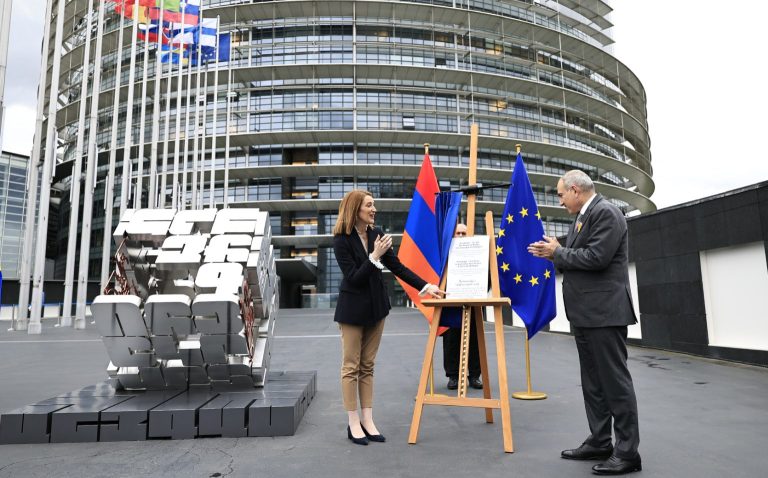
Where culture meets diplomacy: the Armenian alphabet in Strasbourg
From displacement to enterprise: rebuilding my community through entrepreneurship

A message from the YED Coordinators

My personal experience as a Young European Diplomat viewing the EU for the first time
A blueprint for enlargement: what we can learn from Moldova, Ukraine, and Montenegro


The information on this site is subject to a Disclaimer and Protection of personal data. © European Union,
