

The roles and jurisdictions of international courts: knowing your CJEU from the ECHR or the ECA
Almost everyone at some stage in their lives will face a situation in which they need to apply to a court. The process of gathering all the documents, writing letters and receiving approvals can be exhausting, which makes it easy to overlook important details such as identifying the appropriate court to apply. This blog explains the jurisdiction of various international courts, in particular the Court of Justice of the European Union (CJEU), the European Court of Auditors (ECA) and the European Court of Human Rights (ECHR), and outlines the differences between them.
Let’s start with a brief historical overview. The emergence of these courts is connected closely with the development of the EU and integration of European countries into this union. After the end of World War II, a period known for its cruelty and lawlessness, there was a need to establish an institution that would deal with human rights violations and prevent their impunity. That’s why in 1959 the ECHR was founded, becoming an important institution for the protection of human rights across Europe. Along with it, in the early 1950s the CJEU was established, whose aim was to interpret European law and facilitate economic integration of new member states. The ECA was formed slightly later, in 1977, when there appeared a need to control the budget of an already expanded Union and ensure its transparency.
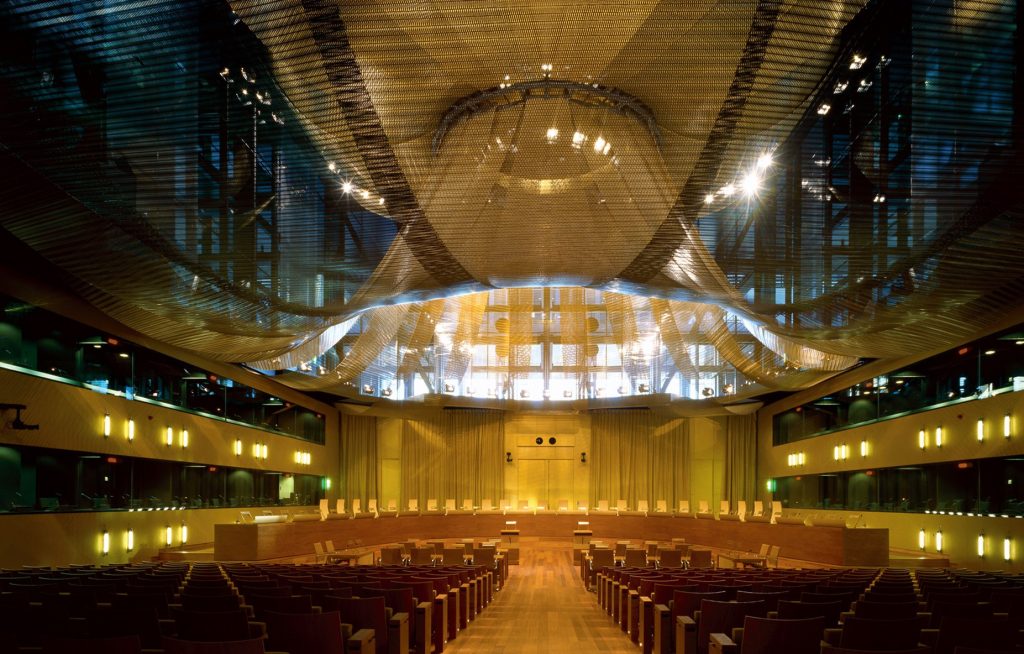
After all these years, the jurisdiction and functions of these courts have remained almost unchanged. The CJEU ensures respect for EU law as interpreted and applied by the Member States of the EU (27 countries), typically addressing companies and institutions. The jurisdiction of the ECHR, on the other hand, extends to all member states of the Council of Europe (46 members: 27 EU Member States and 19 non-EU countries) that have ratified the Convention for the Protection of Human Rights and Fundamental Freedoms, and considers all issues related to the interpretation and application of the Convention. At the same time, the ECA checks whether the European Union’s budget has been implemented correctly and the funds have been spent according to the plan.
The jurisdiction of these courts determines which groups are allowed to apply to each of them. As the ECA is responsible for controlling the budget, ordinary people cannot address it; in other words, ECA doesn’t interact with physical or legal entities. As for the CJEU and the ECHR, they are the courts that accept individual complaints. Regarding the ECHR, it considers applications connected to violations of only those rights and freedoms that are guaranteed by the European Convention on Human Rights, but not the Charter of Fundamental Rights of the EU. However, the CJEU is divided into two other courts – the European Court of Justice (ECJ) and the General Court, and in terms of applying as an individual, you can only address the General Court, and only in cases when actions are brought against the institutions of the European Union.
Many people often confuse CJEU and ECHR, that’s why it is significant to know that CJEU and ECHR are two distinct organisations with different jurisdictions. While the CJEU focuses on the economic integration of the EU members, the ECHR directly protects individuals.
Another important distinction between these courts is the process of decision implementation. The judgments made by ECHR are mandatory and their execution is controlled by a special Committee of Ministers of the Council of Europe. On the contrary, decisions of the CJEU are enforced through the EU’s legal system, including national courts of EU countries. The ECA does not issue judgments, but produces reports and recommendations.
Additionally, there is a significant difference regarding specific legal frameworks that are the basis for these courts. We have already mentioned that the ECHR operates under the European Convention on Human Rights; the CJEU is governed by the Treaty of the EU (TEU), a treaty that defines the goals, values, principles and structure of the EU, and the Treaty on the Functioning of the European Union (TFEU), an agreement that regulates how the EU functions (its policies, institutions and decision-making mechanisms). The ECA, in contrast, is governed only by the TFEU.
To conclude, different types of international courts such as the Court of Justice of the European Union (CJEU), European Court of Auditors (ECA), and European Court of Human Rights (ECHR) significantly differ in their legal framework, jurisdiction, and the applicants they accept. Nevertheless, each of them contributes to the broader standards of rule of law, and legal oversight in Europe.
LATEST

From displacement to enterprise: rebuilding my community through entrepreneurship

A message from the YED Coordinators

My personal experience as a Young European Diplomat viewing the EU for the first time

A blueprint for enlargement: what we can learn from Moldova, Ukraine, and Montenegro

Young European Diplomats Club


The information on this site is subject to a Disclaimer and Protection of personal data. © European Union,
