

The European choice of Belarus: ‘More Europe in Belarus, more Belarus in Europe’
Photo source: Reuters Connect
“Democracy is the foundation of our freedom, prosperity, and security… free speech, independent media, resilient institutions, and a vibrant civil society. This is Europe’s strength and we must increase our collective capacity to protect it at all times.”
Ursula von der Leyen, President of the European Commission, 2025
Being European is not just defined by your passport and the country you live in. Being European means sharing values of democracy, equality, protecting freedom, human rights, and the rule of law.
Although, obviously, Belarus is geographically located in Europe, Lukashenka’s autocratic regime in Belarus openly confronts Europe – absurdly calling it the “decaying West” and refusing any cooperation. However, we must not put the Belarusian people and the regime in the same basket – Belarusians share and endorse European values, and I wish to tell you how this is reflected now, and what it may lead to in the future.
To this day, Belarus is the only Eastern Partnership country not participating in the EaP officially: the Belarusian regime doesn’t aim to integrate with Europe, is interested purely in economic cooperation (if in any at all) and will not stick to one of the main priorities of the EaP – democratisation. So, let’s have a quick tour of the developments in Belarus and how Europe has reacted.
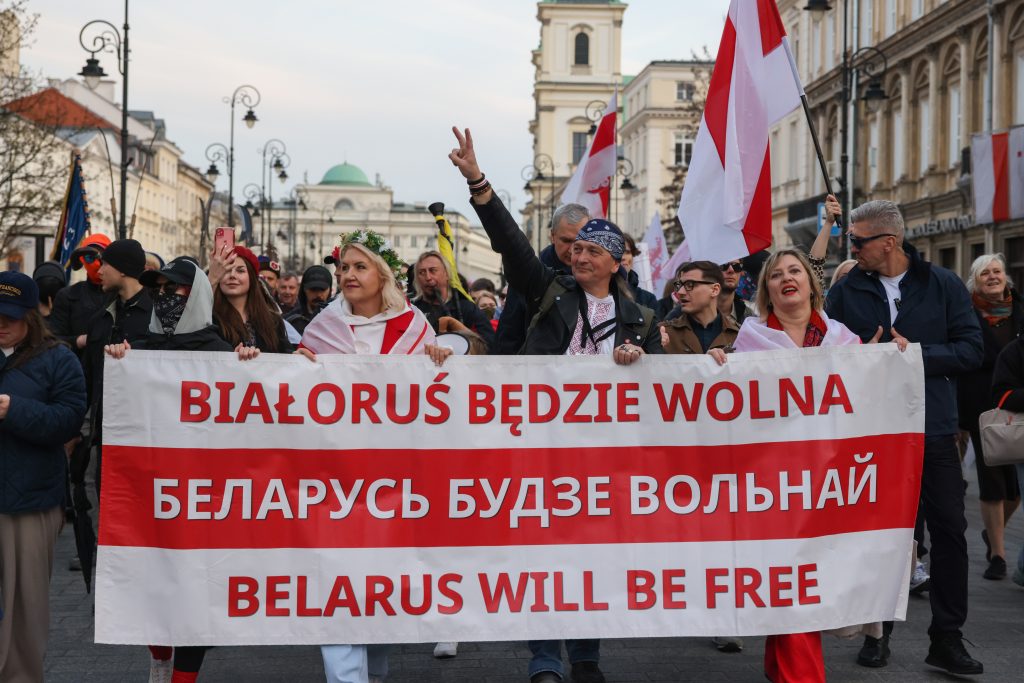
How are Belarusians promoting their European future?
First, the aim of the majority of the Belarusian democratic community is to promote our free and European future. One of the main steps for this was taken in 2023, when Belarusian democratic forces and civil society stated our European choice through the Declaration of Future Membership of Belarus in the European Union. As a continuation, last year, Belarusians published the resolution on a “European Alternative for Belarus”.
Second, Belarusians are developing a comprehensive package of legislation to show other Belarusians and Europeans that we are already preparing to be a democratic state; ready to act when the window of opportunity arrives; ready to be an equal member of the European family of nations. To be more precise, Belarusian experts have already prepared the whole text of the Constitution for a new Belarus and drafted many reforms for democratisation, which Lukashenka refused to perform in the 2010s and which can be used when the moment comes. These reforms cover many topics: from the transformation of classical governing institutions to the role of the Ombudsman or gender equality in a future Belarus. All these drafts are open to anyone to leave comments or propose improvements, and many European experts, members of NGOs, and parliaments have already provided their feedback for the Belarusian team.
Third, advocacy plays a crucial role in the Belarusian strategy. With many pro-democracy figures in exile, Belarus’ visibility on the European stage has risen. President-elect of Belarus, Sviatlana Tsikhanouskaya, regularly meets with the European Commission and European Parliament representatives, attends meetings of the Council of the EU, and cooperates with other EU and Council of Europe institutions. This shows how both Belarusians and Europeans are open to close cooperation with a future free Belarus.
Not to continue the whole long list of how Belarusians express their European direction, but I feel the need to highlight that the Coordination Council (proto-parliament in exile) has a specific fraction called “European choice” and that many other Belarusian political parties (independent and exiled, e.g. the United Civic Party) also focus on our European future in their day-to-day work.
How does the EU support Belarusians’ aspirations?
First, the EU distinguishes between the regime and the people. And here, people’s mobility is truly important: the more people travel and see the world, the more they wish to improve their own land. Thanks to Schengen visas, Belarusians have always travelled a lot around Europe – and even now, despite all of Lukashenka’s actions and the resulting EU pressure, visas continue to be issued, as Europe sees Belarusians not as supporters of the regime, and understands that people should not be isolated and locked up. Moreover, European sanctions are crucial to isolate Lukashenka’s elites. As many as eight sanctions packages were imposed specifically on the Belarusian regime due to repression, human rights violations, in addition to all those where measures against Belarus were aligned with restrictive measures against the Russian Federation for the war in Ukraine.
Second, in May 2024, European Parliament President Roberta Metsola and President-elect of Belarus Sviatlana Tsikhanouskaya signed a Letter of Intent on Cooperation between the European Parliament and the democratic forces of Belarus. This resonated strongly because it shows Europe’s support for democratic change in Belarus and highlights that EU institutions recognise Belarusians’ potential and have started building a shared future now – with Belarusians, not with Lukashenka’s nomenklatura. Similarly, with the same mission, a Memorandum of Understanding was signed between democratic forces and the European Economic and Social Committee in 2025.
Third, Europe strongly supports democratic Belarus politically. One of the formats is regular meetings of the Consultative Group between the European Union and Belarusian democratic forces and civil society organisations. Similarly, there is the Council of Europe’s Contact Group on Belarus. Importantly, these are not “another conference” – they are regular rounds of consultations, which include Belarusian political leaders, cultural workers, civil society organisations, independent journalists, youth organisations and European officials to stay on the same page and discuss how to assist Belarus now.
Furthermore, the European Parliament has a delegation for relations with Belarus, which has operated since 1994, working with the Belarusian parliament, and now with the Belarusian democratic forces, again strengthening Europe’s solidarity with the plight of Belarusians. The delegation supports Belarusians on a daily basis, delivers statements on the situation in the country, initiates resolutions, and organises events such as Belarus Days in Brussels, which lasted for the whole week in December 2024, an unprecedented gesture of solidarity with the Belarusian cause.
Last but absolutely not least, since 2020, the EU has provided vital financial assistance of €200 million to support Belarusian independent media, former political prisoners, human rights defenders, cultural and civil society initiatives. It is vital to retain the assistance in the same form or even expand it, as Belarusians are experiencing more and more pressure from the regime and facing emerging problems.
So what’s next?
I have a dream that Belarus will join the European family.
I wish to see a Europe where the democratically elected Belarusian delegation votes for the European Parliament’s decisions; a Europe, where young Europeans come on Erasmus to study in free Belarusian universities and vice versa; a Europe, where prosperous Belarusians businesses and start-ups contribute to the whole EU’s economy and trade; a Europe, where a Council of the EU meeting is held in Minsk; a Europe, where Belarusian towns and cities welcome European tourists without any fear of persecution.
For now, it is inspiring to see Europe’s support for Belarus, to hear that it will be glad to welcome our country and people. It excites me to see how many projects and assistance are provided to civil society to help them reach the desired goal – a free, democratic, independent and European Belarus – and I hope this support will be continued at all levels.
I have a dream that one day in Brussels the Belarusian white-red-white will be waving together with the European flag. Therefore, both Europeans and Belarusians must take action now to have a secure, strong and dedicated partner for the EU – a democratic Belarus. With peaceful, talented, respectful Belarusians, Europe will be #stronger.
Alena Stankevich
LATEST
From displacement to enterprise: rebuilding my community through entrepreneurship
A message from the YED Coordinators
My personal experience as a Young European Diplomat viewing the EU for the first time
A blueprint for enlargement: what we can learn from Moldova, Ukraine, and Montenegro
Young European Diplomats Club


The information on this site is subject to a Disclaimer and Protection of personal data. © European Union,
