

Stolen childhood: the human rights of Ukrainian children after 24 February
Every year, the world is confronted with countless violations of human rights violations, and judges them according to common law. Unfortunately, the victims of these violations are often children, and the United Nations Convention on the Rights of the Child (UNCRC) plays a central role in countering such violations. It is the most widely ratified international human rights treaty in history, and has helped to change the lives of children around the world for the better.
But what if the violations, the crimes become overwhelming in scale? What if they are committed every day, in the same country, by the same perpetrators? What if the victims and their parents literally have no voice against the humiliation – because their state has lost control of their city, which is completely occupied by the perpetrator?
That is how the full-scale Russian invasion of Ukraine on 24 February, 2022, changed the childhood of many in Ukraine overnight. Childhood, once measured in terms of school, summer camps, and family traditions, began to be measured in air raid sirens, evacuation routes, and casualties.
For millions of Ukrainian children, the full-scale invasion was not only a geopolitical rupture, but also a direct violation of their most fundamental rights – the right to life, to safety, to family, to identity. These rights are not abstract principles, they are enshrined in the UNCRC, which recognises children as independent rights-bearers, not simply passive recipients of protection. Ukraine ratified the Convention in 1991, committing to ensure that every child grows up in dignity and safety. However, after 24 February, these guarantees were fiercely challenged.
According to the United Nations Human Rights Office, thousands of civilians, including hundreds of children, have been killed or injured since the start of the full-scale invasion of Ukraine. The report, which covers the period from 24 February 2022 to 31 December 2024, documents the devastating impact of the armed conflict on children’s rights, and highlights the serious violations of their access to education and a normal life. Behind every number is a shattered life. The classroom left empty, a family forever changed and a future brutally cut short.
Unfortunately, Russian forces are not limited to inflicting such direct human suffering, and the violations go far beyond immediate physical danger. They include forced displacement and deportation. Since 2022, at least 200 children have reportedly been forcibly transferred from Ukraine to Russian-controlled territory or to the Russian Federation. This is a common practice, confirmed in United Nations documentation.
In May 2023, the International Criminal Court took action on charges related to the unlawful deportation (abduction) of Ukrainian children, issuing arrest warrants based on evidence provided by prosecutors regarding forced displacement and related war crimes. Under international law, including the UNCRC and the Geneva Conventions, children have the right to preserve their identity, nationality, and family ties.
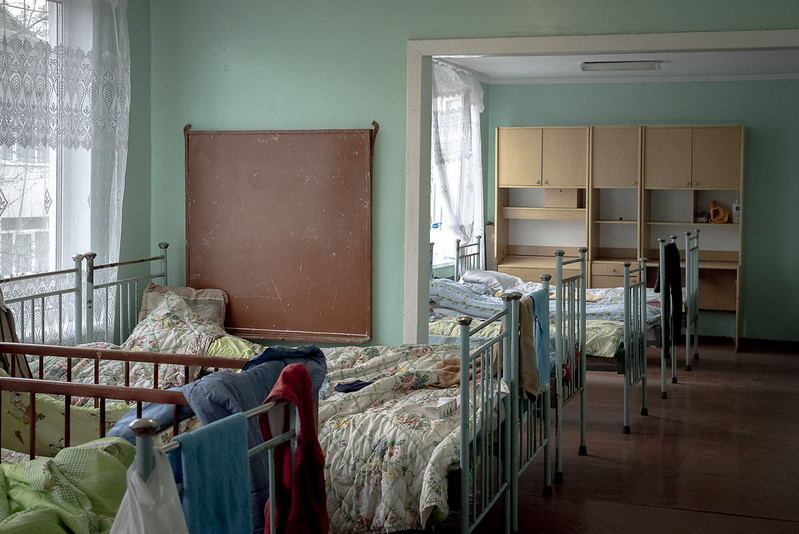
War is about absolute destruction. According to a UN report, at least 1,614 school buildings have been damaged or destroyed by fighting, forcing millions of children to adapt to distance learning or miss school altogether, depriving them of the stability and routine that school life usually provides.
While the statistics are far from comforting, Ukrainian civil society, educators, and volunteers are working tirelessly to preserve fragments of a normal childhood and prove once again that Ukrainians are an indomitable nation. Underground classrooms operate in metro stations. Teachers continue online lessons from bomb shelters. Psychologists offer support to displaced families. Rights for people are written by people, and, accordingly, fulfilled by them also. The future of a country is not built on territory or infrastructure alone. It is built on children who will one day become its teachers, journalists, engineers, artists, and parents. Protecting children in wartime means protecting the future itself,protecting not just individual lives, but the social fabric of the nation. Every restored class, every reunited family, every act of accountability for crimes committed against children is an investment in the Ukraine that will emerge after the war.
The resilience of Ukrainian children is impressive, but resilience should never replace protection. They deserve more than just survival – they deserve the chance to develop, to dream, to remain true to their language and culture, and to build the peaceful country that war has so stubbornly sought to destroy. In Ukraine, 24 February, 2022, showed how fragile international guarantees can become when faced with deliberate violence. But it also made a fundamental point clear – accountability is mandatory, and silence is complicity.
The question is not just how Ukraine protects its territory. The question is how it protects its next generation, and in this generation lies the true future of the state. Children are much more than a vulnerable segment of the population or a subject of negotiations and manipulation. Ultimately, you too were once a child.
“Because first and foremost, we protect children. All of our children. Since 24 February, Children’s Day has been every day for us. All 462 days of the full-scale war. 462 days of our battle – first of all, for our future, hence, for children. For their freedom and their destiny. For the Ukraine we will leave to them. The Europe we will build together. The world in which they will live freely. Today we are fighting for what this world will look like.”
Volodymyr Zelenskyy, Conference ‘UA: War. Unsung Lullaby’, 31 May 2023
LATEST
From displacement to enterprise: rebuilding my community through entrepreneurship

A message from the YED Coordinators
My personal experience as a Young European Diplomat viewing the EU for the first time
A blueprint for enlargement: what we can learn from Moldova, Ukraine, and Montenegro
Young European Diplomats Club


The information on this site is subject to a Disclaimer and Protection of personal data. © European Union,
