

Revitalising youth volunteering: insights from an Erasmus+ training
The importance of volunteering is ever-increasing in wartime Ukraine. I firmly believe that developing key competences for efficient volunteering and learning how to promote volunteering in local communities can contribute to revitalising the volunteering culture in our country. Thus, to enhance these competences, I took part in “Volunt4YOU(th)”, an Erasmus+ training course in Portugal last June, organised by the “Ama Avida” organisation.
During the week, I joined 29 other participants from 10 European countries in various activities aimed at tackling reduced civic participation. For example, we listened to real-life stories from our facilitators, who were volunteering extensively, launched our own campaigns, and interacted with the local community. We were also involved in discussions about obstacles and opportunities for volunteering, which allowed us to dig deeper into the topic.
For me, the most interesting feature of this training course was the mandatory follow-up activity. This means that after the end of the Erasmus training, participants are obliged to implement an activity about the course and/or its objectives. I consider it exceptionally efficient as it helps to maximise the impact and sustainability of the learnings and practices developed by promoting the training’s ideas beyond the course into the real world.
Primarily, the training enabled me to grasp the significance of volunteering from both sides – the life of volunteers and the people who are being assisted. The host organisation for this training, Ama Avida, has led numerous volunteering projects all over the world, and so I had an opportunity to learn from people with first-hand experience. During the training, the founder of the organisation exposed us to her stories of helping people in need in places such as Mozambique and Argentina. On the other hand, we discovered a story of a Ukrainian war refugee and how volunteers helped her navigate the obstacles of forced migration. “Volunteering is a way to stay in other people’s lives,” our facilitator told us. Indeed, I thought I understood the dynamics and importance of volunteering, but now I believe I fully realise the influence that volunteering has on improving lives, encouraging empathy, and establishing deep relationships between people from all backgrounds.
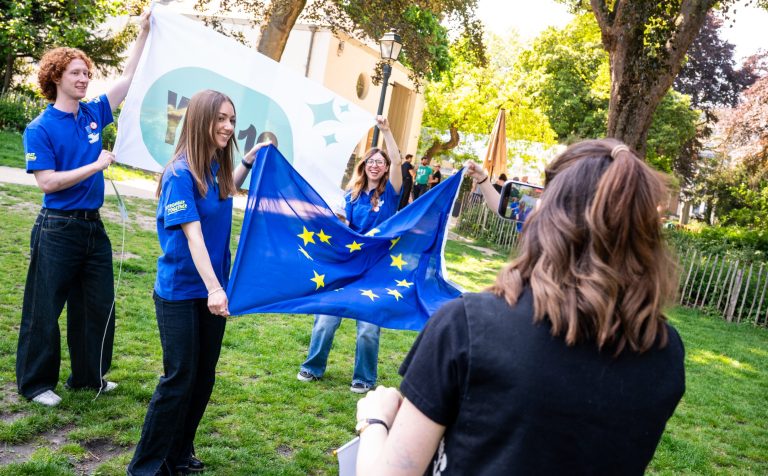
Not only were we exploring the features of volunteering theoretically, but in the framework of the training, we also launched our own campaigns. It exposed us to the real-life volunteering experience in all its stages, from deciding on the topic of our campaign, which we eventually chose to be mental health, to interacting with locals and explaining the importance of psychological well-being. This was indeed a rewarding practice: when I saw the smiles and support of people, I knew our efforts for the creation of this campaign were not in vain. Again, this has pushed me to be more proactive in my own volunteering engagement as I saw the impact it may have.
My personal takeaway from the training was that non-formal education techniques are usually the key to effectively engaging youngsters. We explored approaches to learning that are more interactive and immersive, thus encouraging greater comprehension and memory retention. It has inspired me to incorporate more informal education elements during my own volunteering projects to encourage youth for active citizenship.
Beyond that, I have gained a deeper comprehension of the particular difficulties that young people face while trying to get involved in their community’s life, such as cultural norms, lack of information, or communication difficulties. More importantly, we analysed why those complications exist and how to tackle the obstacles, to ensure the possibility of volunteering opportunities for all those interested.
Since I took part in “Volunt4YOU(th)”, I will never think again that the volunteering work which I do is small-scale or not that meaningful. Now, I feel more responsible for the issues that our society faces, because I understand that I am capable of helping, and that every bit of help is valuable. As Sherry Anderson said, volunteers don’t get paid, not because they’re worthless, but because they’re priceless.
LATEST
From displacement to enterprise: rebuilding my community through entrepreneurship
A message from the YED Coordinators
My personal experience as a Young European Diplomat viewing the EU for the first time
A blueprint for enlargement: what we can learn from Moldova, Ukraine, and Montenegro
Young European Diplomats Club


The information on this site is subject to a Disclaimer and Protection of personal data. © European Union,
