

Reflections from the 2026 European Forum for Young Leaders
For generations, Georgians have been raised with the weight of the expectation that whatever the future world holds, it is ours to build and ours to fix. This sentiment is often echoed by our elders through traditional bittersweet refrains like, ‘’We couldn’t leave you anything better, we’re sorry, but the country is yours’’. These ideas create an idiosyncratic tension for young leaders: the duty to fulfill a golden prophecy while simultaneously inheriting the unfinished work and systemic challenges left behind by those before us.
This reality echoed with me throughout the European Forum for Young Leaders in Gdynia, Poland. It was during these three days that I experienced a pivotal shift in perspective – the sobering move away from being told I am the “future” to recognising that the future has already arrived.
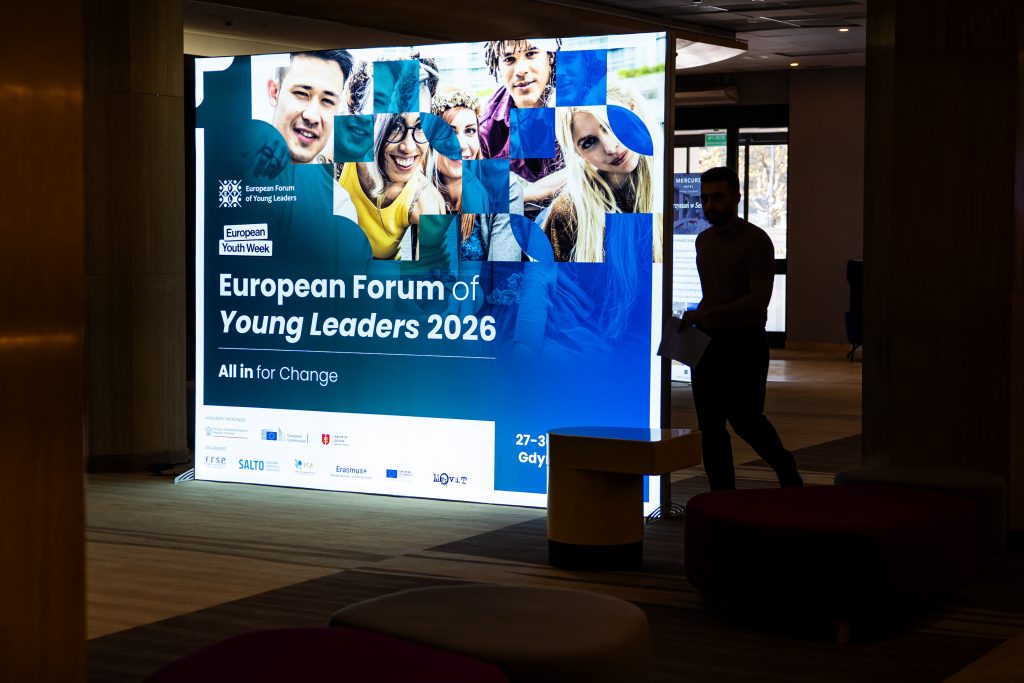
We all face challenges and this forum exactly underlined how shared, yet how different they all are from one another. In Gdynia, the city of history and man-made opportunity – an example of resilience and human strength, we sat down to speak of our own realities, experiences and most importantly aims for the future. Over the days of intensive collaborations, discussions and conversations focused on sharing our knowledge, I understood that leadership is not something reserved for tomorrow – but a responsibility we carry today.
The forum helped me explore communication, empathy, inclusivity, and awareness in another sense, as skills essential for navigating an increasingly complex world. Listening to experienced leaders and engaging with peers from across Europe and not only, made one thing clear: we are not in preparation to become leaders – we are already leading in our own ways. And Future Leaders have one thing in common – our work is an ongoing process of refinement, sharpening our skills to become leaders of greater caliber and impact than we are today.
Coming from Georgia, where youth leadership is often underestimated, this realisation carried specific weight. In Georgian language we have this word: “შესაძლებლობა” which exactly translates as the possibility and the capacity to act. During this forum, I saw first-hand what the possibility and opportunity of being and becoming can unlock in people.
Our discussions ranged from empathy and self-awareness to resilience and preparedness. With the help of the speakers I examined how leadership today expands opportunities for tomorrow and how understanding different perspectives strengthens cooperation. Beyond structured sessions, my time in Gdynia was equally valuable for cultural exchange – learning about other’s political realities, and social challenges. It was a true example of sharing knowledge without borders, lines and stigmas.
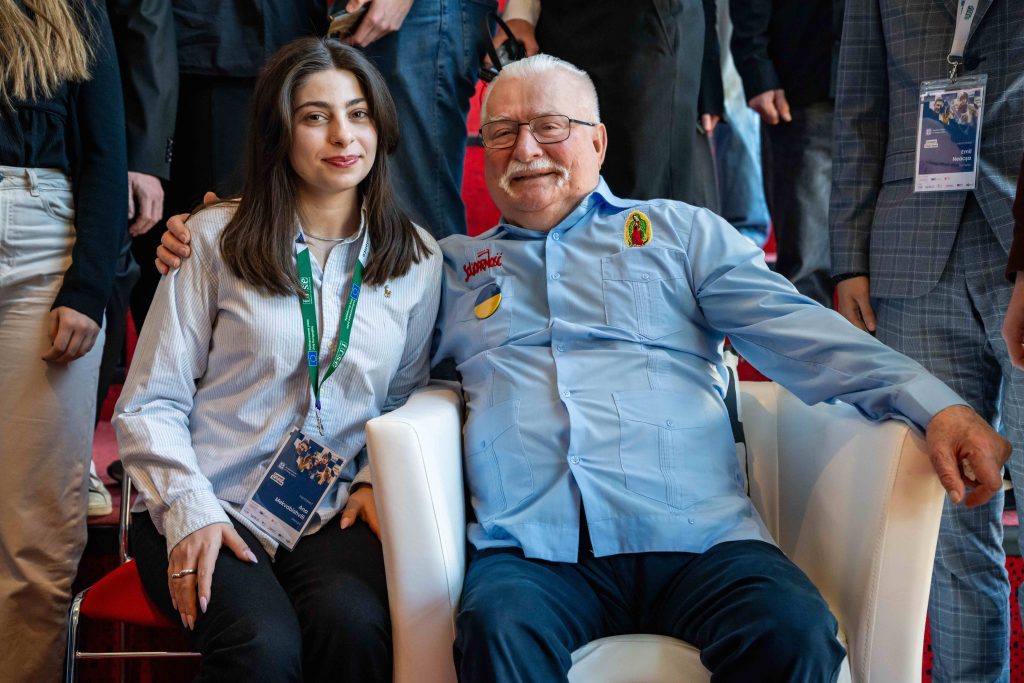
Discussions covered: democracy under pressure, preparedness – which are not symbolic concepts, but practical skills that must be intentionally acquired. I was deeply moved by leaders like Lech Wałęsa, who spoke on the historical responsibility of leaders, and Anja Zloporubovic, whose insights on youth activism highlighted the power of grassroots engagement. The address by Oleksandra Matviichuk, Olena Glazkova and Olena Gorduz on the realities of war and our collective readiness as global citizens was particularly striking.
This experience reshaped my mindset. I left Gdynia not with abstract inspiration, but with concrete takeaways. Once again I was reminded that leadership requires continuous learning, that resilience is a choice we make in the present to protect the future. That history is written by our actions and equally so by our non-actions; every historical figure once stood where we are now, they simply chose to engage with their reality differently – and so ought we, for the sake of our countries. Leadership means building connections and trust. A leader is one who creates something out of nothing. Who is an empath, an aware, an educated person. Above all, leadership is a decision, defined by future ambitions, present actions and consistent movements.
Ilia Chavchavadze, a towering figure in Georgia’s history, established a principle that remains our guiding light for resilience in hardships: that only movement is the source of a nation’s strength and vitality. This philosophy underscores the necessity of constant action and reflects the core themes of the European Forum for Young Leaders: Resilience, Independence, Power, Appreciation, History, Democracy, Development, Knowledge and many more. It serves as a stark reminder that to stand still is to stagnate, but to move is to survive and lead.
I am a leader because I decided to be one. It isn’t a motivational speech; it is a discipline. I’ve learned to focus on the “three Ws”: What needs to change, Who needs to change it, and what is the first Way to start. I will trust my intuition more now, knowing it is the intersection of experience and intelligence. We are real, genuine leaders who must empower and include others while navigating challenges with integrity. We are miracles of our own making, training ourselves today to be responsible for the development of tomorrow.
I believe I will meet the people I have encountered during these days in different settings and we will have the chance to exchange information with excitement about a better future we have helped our countries to build by our leadership.
The celebration of 30 years of EU volunteering and 100 years of the existence of the city Gdynia could not have passed better. The lessons I will carry forward will guide my work as a young leader and a volunteer. The challenges we face as young leaders in our countries, combined with the knowledge gained from this experience, will shape how I will contribute to my community in the future, and so will all the participants.
Author: Ana Mekvabishvili
LATEST
From displacement to enterprise: rebuilding my community through entrepreneurship
A message from the YED Coordinators
My personal experience as a Young European Diplomat viewing the EU for the first time
A blueprint for enlargement: what we can learn from Moldova, Ukraine, and Montenegro
Young European Diplomats Club


The information on this site is subject to a Disclaimer and Protection of personal data. © European Union,
