

Marking 25 March as Belarusian Freedom Day
Independence is what we can’t imagine our countries existing without. Independence is what we describe as the opportunity to be free, to decide on our country’s future, to speak our language, to develop a national culture and identity.
Any democratic state has its own story of a fight for freedom and independence, and Belarusians are no exception in fighting for it. Unfortunately, to this day, the struggle of Belarusians is incomplete. The country is being dragged deeper and deeper into Russia’s war in Ukraine, is being russified, and those opposing it are being repressed.
However, in these turbulent times, Belarusians manage to preserve our history and identity, continue to stand up for independence and a European future. And one of the examples is the annual commemoration of Freedom Day on 25 March.
What do Belarusians celebrate on 25 March?
For the first time in the long and harsh Belarusian history, the country was proclaimed independent when the first Belarusian government, the Belarusian People’s Republic, adopted the charter of independence on 25 March, 1918.
“Now we, the Council of the Belarusian People’s Republic, cast off from our native land the last burden of state dependence that the Russian tsars violently imposed on our free and independent homeland. From this moment on, the Belarusian People’s Republic is proclaimed an independent and sovereign state.”
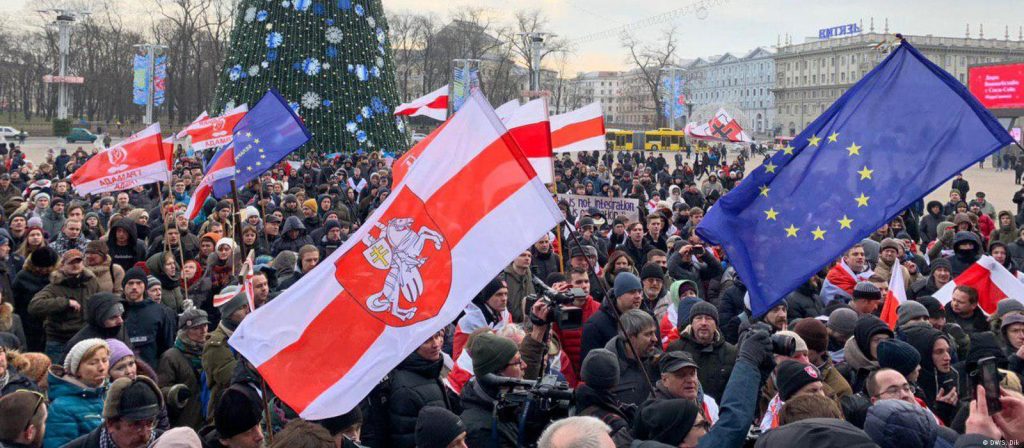
Moreover, in 1918, alongside independence, the white-red-white flag became our national flag, which is now a symbol of Belarusian resistance and the fight for independence and democracy.
However, Belarusian independence was short-lived, and soon after, in 1919, Belarus was taken over by the USSR, and the Council of the Belarusian People’s Republic was forced into exile, where it continues to operate from Canada to this day.
In 1990, 25 March was named Freedom Day (“Дзень Волі” in Belarusian) and has been called that ever since. Yet, though the name is pretty suitable, it focuses on freedom, and we should remember that on this day, we mark the Day of the Proclamation of Belarusian independence.
However, it is worth mentioning that by a controversial and fraudulent 1996 referendum of Lukashenka – the one which also cancelled our national symbols – the official Belarusian Independence Day is set on 3 July, the day of liberation from the Nazis in 1944. This also proves the aim of the current regime to forget the past and build a new one, focused on the victory over the West.
Why is Freedom Day important for Belarus?
While no one challenges the importance of independence, Lukashenka sells it for “brotherhood” with Russia, rewrites Belarusian history, and erases identity. For more than 30 years of Lukashenka’s rule in Belarus, the economy has stagnated and militarised, children have been brainwashed with state propaganda in schools, and culture is being suppressed with the Russian World’s ideology.
That is why on 25 March, it is essential to highlight the current situation in Belarus – including the crimes of the regime’s repression machine – to draw international attention to the Belarusian struggle, and to contrast Belarus’ current dependence on Russia and its potential European future.
Therefore, 25 March is a major Belarusian national holiday, when we recall our brave past, call that Belarus should belong to its people, and that Belarus must be free.
How do Belarusians celebrate?
Year after year, to show disapproval of and opposition to Lukashenka’s actions, and the will of the people to be free, Belarusians unite on 25 March in annual demonstrations and actions all over the world: peaceful rallies, solidarity actions, evenings of writing of letters to political prisoners, events with the Belarusian diaspora, white-red-white flag-raising ceremonies, quizzes, and discussions.
In 2018, Belarusians celebrated 100 years of the Charter on Independence of the Belarusian People’s Republic, when Alexander Lukashenka allowed Belarusians to officially gather in a rally in Minsk – though still not recognising the importance of the day – which was the largest celebration in Belarus.
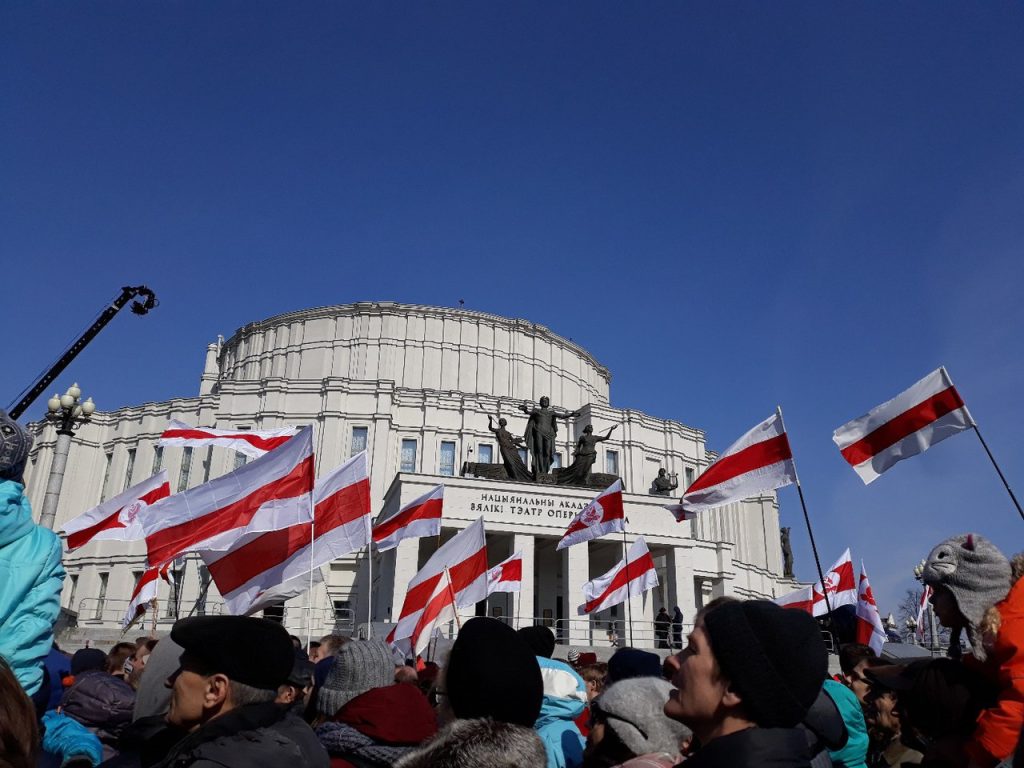
However, while Belarusians were marking 2025 Freedom Day all over Europe, from Batumi to Brussels, Lukashenka set 25 March as the official day of his inauguration after falsifying another presidential election. By organising this “self-reappointment” ceremony on Freedom Day, Lukashenka tried to show his victory over the democratic opposition and steal the attention from our national holiday.
This year, for the fifth time in a row, the Mayor of Washington has announced 25 March as Belarus Freedom Day, and the mayor of Philadelphia has joined in as well.
What can I do on Belarusian Freedom Day?
Belarusians welcome international partners and friends to join Freedom Day, which is also known as the International Day of Solidarity with Belarus. To express your solidarity and support, you can make a social media post, join the rally, meet the diaspora in your city, organise an event, or a solidarity evening.
While Belarusians are still fighting for their freedom, we, as youth, should value democracy and the efforts of everyone who helped bring it to the EU. We should remember the crucial role of independence and freedom. We are #StrongerTogether, and we shouldn’t lose our hope for a free, democratic and European Belarus.
“March 25 has always been the greatest national holiday for me personally and for our emigration, the Belarusian emigration… I am very pleased and want to greet the youth who took part in this celebration. I think that by doing so they show their love for Belarus, for all Belarusian things, and at the same time their faith in a different future in Belarus.”
Ivonka Survilla, Chairwoman of the Council of the Belarusian People’s Republic, 25 March, 2016
Alena Stankevich
Main photo: A rally in honour of Belarusian Freedom Day in Vilnius, Lithuania, 25 March 2025 Reuters Connect
LATEST
From displacement to enterprise: rebuilding my community through entrepreneurship
A message from the YED Coordinators

My personal experience as a Young European Diplomat viewing the EU for the first time
A blueprint for enlargement: what we can learn from Moldova, Ukraine, and Montenegro
Young European Diplomats Club


The information on this site is subject to a Disclaimer and Protection of personal data. © European Union,
