

How the war became an instrument of disinformation
The run-up to an election is often a highly volatile and sensitive period. It is a prime time for disinformation and loud promises. The competition between candidates leads election campaigns to appeal to people’s fears, hopes and sense of identity. This is natural, but it makes society more vulnerable to manipulation. In this article, we will look at just one example of how Russia’s invasion of Ukraine in 2022 became a tool in elections, and examine two examples: the parliamentary elections in 2024 in Georgia and in 2026 in Hungary.
Competition and the struggle for voters’ attention often lead to more aggressive rhetoric, mutual accusations and the polarisation of society. During the pre-election period, the spread of fake news, half-truths or emotionally charged information increases significantly. This is done to influence people’s choices, particularly via social media. An important question here is: how are fake news and disinformation created, and what is the difference between them?
Let’s start with fake news: this is false or distorted information created with the aim of attracting attention, often through sensational or emotionally charged content. Such material is usually intended to deceive and manipulate the audience. The main goal of fake news is to cast doubt on truthful information and make people accept lies as the truth. For example, fake content can be created using graphic editors by altering text on images, editing photographs, or creating entirely artificial visual materials.
Disinformation is a broader concept. It is not a single isolated act, as in the case of fake news, but a deliberate process or series of actions. It involves the deliberate use of false information to influence people’s opinions or behaviour. The key point is that the person spreading disinformation understands that the information is false and acts with a specific intent. At the same time, there is the concept of misinformation. Unlike disinformation, this is the unintentional dissemination of false information. In such cases, the person passing on the information is usually unaware that it is false and has no intention of misleading others.
The creation and dissemination of disinformation usually follows a specific pattern. First, emotionally charged content such as photographs, videos and other visual materials is gathered, which easily attracts attention and provokes strong reactions. This material is then transformed into distorted or misleading narratives. This may involve taking facts out of context, editing images, or combining unrelated elements to create a plausible but false story. The next stage involves disseminating these narratives through various communication channels, including social media, messaging apps, and sometimes individual media outlets. Due to the speed and reach of these platforms, such information can spread very quickly to a wide audience. It is particularly important to emphasise the role of emotional appeal. Disinformation often appeals to fear, outrage or anger, as these are the emotions that drive the wider dissemination of content. This takes on particular significance during election periods, when such material can have a significant impact on public opinion and political sentiment.
Having defined the key concepts, we can now turn to practical examples.
Let us consider the case of Georgia, where parliamentary elections were held in 2024. The pre-election period in Georgia was marked by the widespread dissemination of disinformation and manipulative narratives. One of the key themes was the creation of anti-Western messages, which portrayed Western countries as forces allegedly interfering in Georgia’s internal affairs and attempting to influence the election results, but that is not the focus of this blog today. Conspiracy theories and messages contrasting “peace” and “war” were actively used in the public sphere, portraying political opponents as a threat to the country’s stability. The Georgian Dream political party used the theme of Russia’s war against Ukraine in its election campaign, featuring side-by-side photos of the destruction caused by Russia in Ukraine and, by contrast, “normal life” in Georgia. Captions on the banners urge voters to “say no to war” and “choose peace”. In some cases, the section of the poster showing the destruction is accompanied by the numbers on the electoral lists of pro-Western opposition parties. This approach can be described as fairly simple, yet effective, as it appeals to the collective trauma associated with the 2008 war, which remains a sensitive issue for Georgian society.
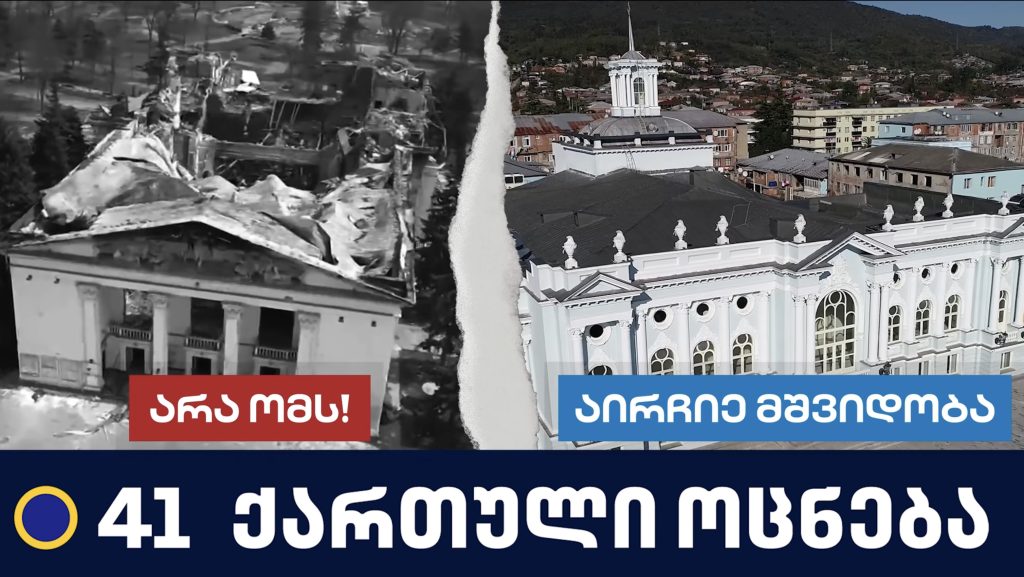
Georgian Dream promotes images of bombed Ukrainian cities as an electoral fearmongering tactic
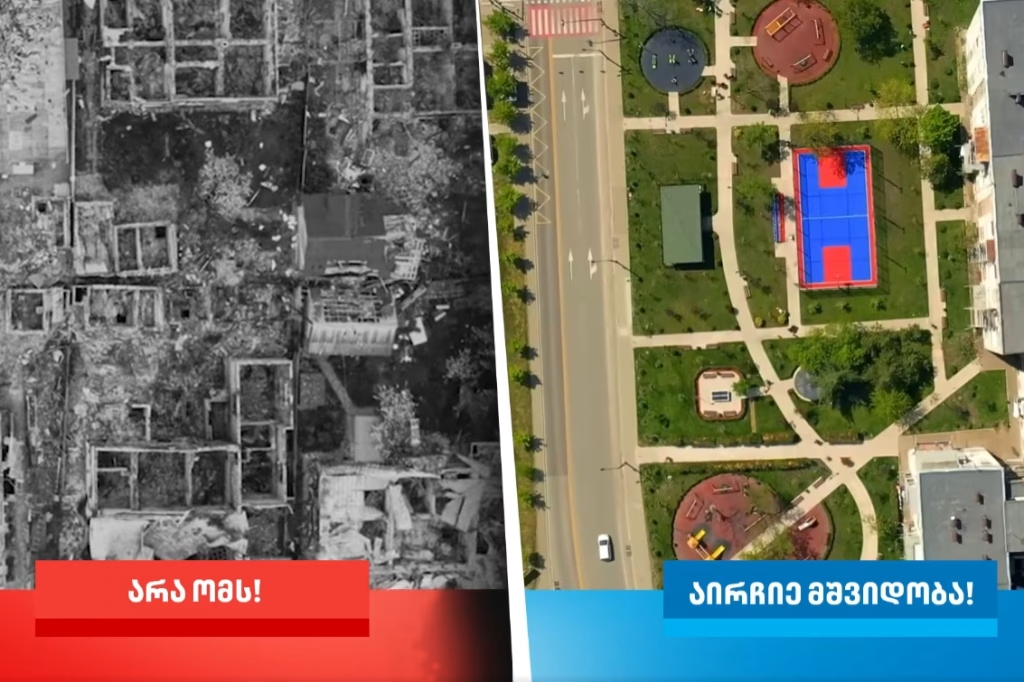
A similar campaign strategy was employed in the run-up to the local elections. The Georgian Dream party circulated video footage containing images from Ukraine: cemeteries of fallen soldiers, destroyed infrastructure, the aftermath of shelling, drone strikes on residential buildings, as well as scenes of civilians affected by the war. In particular, a couple was shown standing by a ruined house in Kyiv where their son had been killed. These images stood in stark contrast to the vibrant footage of Georgian cities, which showcased development and stability. The visual sequence was accompanied by short slogans: on one side, “No to war!”; on the other, “Choose peace”. Additionally, the slogan “Peace for Georgia – more opportunities for Tbilisi” was used.
In Hungary, parliamentary elections took place on 12 April 2026, the image of Ukraine was not portrayed in comparison with ruined cities, but rather by constructing, in the eyes of voters, an image of Ukraine as a source of threat. The ruling Fidesz party launched an anti-Ukrainian campaign on several levels and with various slogans and I will cite just a few examples of these campaigns.
Anti-Ukrainian rhetoric was also used as a tool to discredit political opponents. As in Georgia, where the main message was that without the current government the country would face the threat of war, a similar line of reasoning was employed in Hungary. In particular, the Tisa party was accused of planning to drag Hungary into the war in Ukraine due to its alleged links with what the ruling rhetoric called the “pro-war lobby in Brussels”. Such claims were reinforced by visual propaganda, notably billboards depicting the President of Ukraine in the context of appeals for financial support to the European Union, or posters showing Zelenskyy alongside opposition leader Péter Magyar.
Hungarian Prime Minister Viktor Orbán also made statements about Ukraine’s alleged interference in the country’s internal affairs. In particular, he claimed that Ukraine had channelled “billions of dollars” through Hungary to support a “pro-Ukrainian candidate” from the US Democratic Party with the aim of countering Donald Trump. According to Orbán, Ukraine was also attempting to influence domestic political processes within Hungary itself.
Such statements fit into a broader narrative about the need to “protect” Hungary from so-called “Ukrainian colonialism”. At the same time, there is no evidence to support such allegations. On the contrary, Ukraine has not made any claims to Hungary’s sovereignty, and in the context of the war, it is in fact containing the threat posed by Russian aggression, which has a far broader impact on European security.
When the risk of losing an election increases, political forces may resort to dubious and unethical methods, including exploiting the theme of war and using tactics to intimidate voters. In Georgia, this approach proved effective, while in Hungary its impact was limited. This can be explained by several factors. Firstly, in Georgia, political competition had long been less consolidated, which reduced the number of credible alternatives for voters. In Hungary, by contrast, the presence of a more structured opposition created a range of choices. Secondly, historical experience plays an important role, Georgian society has relatively recent experience of war, which makes it more sensitive to security issues, whereas in Hungary this factor is less pronounced. Thirdly, voters’ perceptions were also influenced by information-related factors, in particular public investigations and discussions of possible abuses or external ties. Taken together, these aspects demonstrate that the effectiveness of election strategies depends to a large extent on the specific socio-political context.
My advice is to practise information hygiene. There are certain signs that can help you spot dubious or false information in news reports or social media posts:
1. The material focuses not on facts, but on emotional impact. These may include provocative headlines, overly dramatic details, or visual elements that are unrelated to the content but evoke strong emotions.
2. You should be critical of so-called “expert” comments. If the expert in question does not have a clearly established reputation or is anonymous, this may be a sign of manipulation.
3. You must check all links provided in the publication. Reliable information is usually backed up by primary sources: official statements, direct quotes or authentic materials. If the links are incorrect, lead to suspicious websites or do not cite a specific source, there is a high probability that you are looking at a fake.
Find out more
Factsheet on Tackling online disinformation
Georgian Dream again uses images of war-torn Ukraine, urges voters to ‘choose peace’
LATEST
From displacement to enterprise: rebuilding my community through entrepreneurship

A message from the YED Coordinators

My personal experience as a Young European Diplomat viewing the EU for the first time
A blueprint for enlargement: what we can learn from Moldova, Ukraine, and Montenegro
Young European Diplomats Club


The information on this site is subject to a Disclaimer and Protection of personal data. © European Union,
