

Freedom in Action: what Ukrainians abroad have learned after four years of resilience
For a long time, freedom has been a central value for Ukrainians. It is a lived historical experience, a shared cultural memory, and a personal pain passed from one generation to the next. In the Ukrainian tradition, freedom was never given – it was always earned.
The historical roots of freedom in Ukrainian identity
Since the era of the Cossacks, freedom has meant the right to live without foreign domination and to determine one’s own destiny. Ukrainian thinkers and artists have long explored this idea, reflecting on freedom not only as a political reality but as a deeply human value.
Hryhorii Skovoroda, an 18th century philosopher, exemplified this approach in his writings, poetry, and personal life, emphasising the essential importance of freedom for individuals and for the Ukrainian people. In the 19th century, Taras Shevchenko emerged as the defining voice of national liberation. Through his poetry and art, he called for the emancipation of the Ukrainian people, combining literary brilliance with a powerful moral and political vision. His work gave voice to generations yearning for freedom, inspiring courage and resistance in the face of oppression. At the end of the century, Lesia Ukrainka demonstrated that even under personal suffering and the harshest hardships, the human spirit can remain unbroken. Through her plays, poetry, and essays, she highlighted the resilience of individuals and nations alike, showing that freedom is an inner strength, sustaining hope and dignity even in the darkest times. In the twentieth century, freedom became an act of internal resistance: the artists and intellectuals of the ‘Executed Renaissance’, dissidents, and the generation of the Sixtiers paid with imprisonment, exile, and even death. Today, this struggle continues as Ukrainians defend their country, often at the cost of their lives and beliefs.
Life abroad: freedom far from home
The theme of emigration has long been important for Ukrainians. At the end of the 19th and the beginning of the 20th centuries, large numbers of Ukrainians left their homeland in search of a better life and the hope of building a free Ukraine far from home. This experience is vividly captured by Ivan Bahrianyi in his novel Tiger Trappers, which portrays Ukrainian communities in the Far East (Zelenyi Klyn) preserving their freedom far from home. Even thousands of kilometres away from Ukraine, they maintained their customs, language, and identity, proving that freedom is not merely a physical condition, but a living, enduring force carried in the hearts, minds, and actions of a people. Over the decades, the Ukrainian diaspora continued to grow, maintaining its language, culture, and identity abroad.
Before the full-scale invasion in 2022, millions of Ukrainians already lived outside the country, forming established communities in Europe, North America, Australia, and beyond. After 24 February 2022, Russia’s full-scale invasion triggered one of the largest forced migrations in Europe since World War II. Today, millions of Ukrainians live outside their home country as a direct consequence of the war. According to official data, around 4.3 million Ukrainian citizens are living under temporary protection status in EU countries. After the launch of Russian full-scale invasion, the international community responded with unprecedented support, providing shelter, humanitarian aid, and opportunities for Ukrainians displaced by war. The EU countries hosting the highest number of beneficiaries of temporary protection from Ukraine were Germany, Poland, the Czech Republic, Austria, Slovakia, Spain, France, Lithuania, Ireland, and other EU member states.
As of early 2026, approximately 119,500 Ukrainians are living in Ireland under the EU’s Temporary Protection Directive. Of these, around 42,000 people are hosted by Irish families and communities that opened their doors without hesitation to people fleeing war. For a country the size of Ireland, this is a significant number, and it reflects one of the strongest per‑capita responses to the Ukrainian crisis in Europe. Ireland’s response goes beyond statistics. It reflected solidarity expressed through everyday actions. Churches, schools, community groups, and volunteers came together to support Ukrainian arrivals with language classes, cultural events, job workshops, and simple human connection. Irish neighbours helped families find housing, access healthcare, register for work, and settle into local life. Many hosts say the experience has enriched them – hearing a new language in schoolyards, sharing meals, and celebrating traditions together.
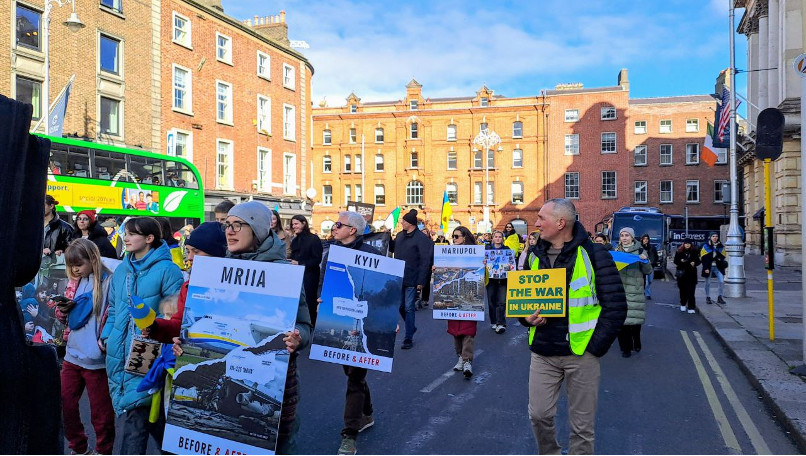
Photo taken by Ukrainian YEA Sofiia Shakhova.
For Ukrainians, arriving on the Emerald Isle became another chapter in a long history of emigration. Ireland itself has a long and complex history of emigration. Some estimates suggest that the Irish diaspora may total as many as 70 million people, with the largest concentration in North America, where around 35 million people claim some degree of Irish heritage. This global diaspora has played a vital role in Ireland’s economic growth and development, with Irish communities acting as a significant force in cultural and civic life. The shared experience of migration links the stories of Ukrainians and Irish families, creating a foundation for understanding, solidarity, and cultural exchange. Wherever Ukrainians settled, the spirit of their homeland followed. Communities built churches inspired by traditional wooden architecture, founded Saturday schools to preserve the language, and created cultural centres that remain active today. To date, according to the latest figures from the Department of Education, there are now 18,268 Ukrainian pupils enrolled in Irish schools, 11,348 primary school students, and 6,920 at secondary school. Some 100 Ukrainian post-primary teachers have also been admitted to the Teaching Council register in the last year. Starting in 2025, high school students in Ireland will have the opportunity to take the Ukrainian language as part of their Leaving Certificate. This milestone marks a significant step in Irish-Ukrainian cultural cooperation and deepens educational and cultural ties between the two countries.
After 24 February 2022, millions of Ukrainians were forced to flee overnight. Across the EU, over 4 million remain under temporary protection. In Ireland, displacement did not mean disappearance. Ukrainians have shared their culture, upheld their values, and represented their country through volunteering, community events, small businesses, studies, and fundraising for the Armed Forces. They continue to take an active role in civic life, bringing Ukraine with them wherever they go.
What Ukrainians abroad have learned after four years of resilience
Four years of full-scale war have reshaped the Ukrainian experience abroad. For those forced to leave, identity became a deliberate responsibility. To remain Ukrainian means speaking the language to children born in exile, explaining Ukraine to colleagues and neighbours, and defending truth where it is distorted. Living abroad is not a pause from Ukraine; it is a different form of duty. Across Europe, Ukrainians have assumed the role of civic and cultural representatives. Through public discussions, academic forums, cultural initiatives, and peaceful gatherings, Ukrainians present a country that is resilient, modern, and grounded in dignity. At the same time, they organise demonstrations against Russian aggression, drawing attention to those held in Russian captivity and to Ukrainian children who have been abducted and unlawfully deported, reminding the international community of the ongoing human cost of the war.
Ukraine also offers a broader lesson: displacement does not erase identity. Exile can deepen commitment. A nation under attack can still preserve its institutions, rebuild infrastructure within hours, reopen businesses, and protect daily life as a statement of endurance. Ordinary routines become acts of stability. In the Ukrainian understanding, courage is fidelity to values under pressure. It is the refusal to surrender moral clarity for comfort. Long before European integration became a formal goal, freedom shaped Ukraine’s civic movements and resistance to authoritarianism. From the Orange Revolution to the Revolution of Dignity, and now in defence against full-scale aggression, Ukrainians have chosen liberty over submission – consistently and at great cost.
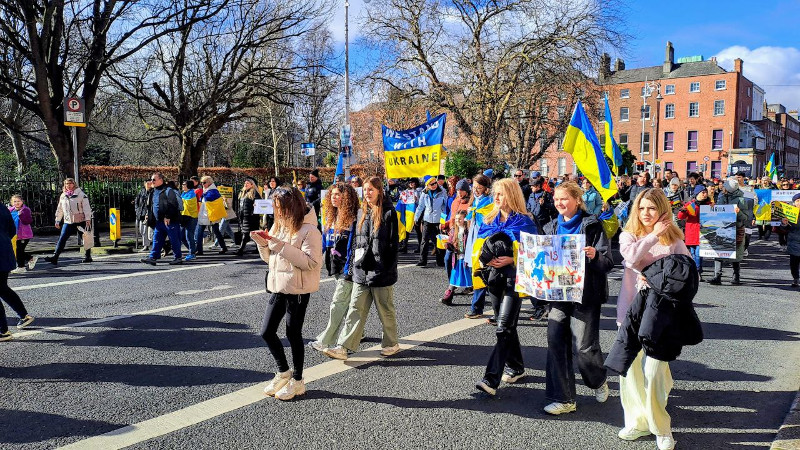
Photo taken by Ukrainian YEA Sofiia Shakhova.
Hope, memory, and the future of freedom
Today, across Europe, Ukrainians continue to live by this same principle. They carry Ukraine in their hearts wherever they go. By doing this, they are not standing apart from Europe – they are enriching it. Their strength, love for freedom, and sense of responsibility reflect the very values on which the European Union was built. And so, perhaps Bahrianyi’s words resonate even more deeply today: the brave always have happiness – not because their path is easy, but because they remain faithful to who they are. In that faithfulness lies freedom and hope.
LATEST
From displacement to enterprise: rebuilding my community through entrepreneurship
A message from the YED Coordinators
My personal experience as a Young European Diplomat viewing the EU for the first time
A blueprint for enlargement: what we can learn from Moldova, Ukraine, and Montenegro
Young European Diplomats Club


The information on this site is subject to a Disclaimer and Protection of personal data. © European Union,
