

European Parliament warns of increasing repression of human rights activists across borders, including in Belarus
Today, the European Parliament urged the EU to tackle actions by authoritarian regimes to coerce, control or silence political opponents and other critical voices abroad.
Human rights defenders are a key pillar of democracy and the rule of law, and they are insufficiently protected, say MEPs in the own-initiative report adopted by 512 votes to 76, and with 52 abstentions.
According to MEPs, 80% of cases of transnational repression are the responsibility of 10 countries, including Belarus, China, Türkiye, Tajikistan, Russia, Egypt, Cambodia, Turkmenistan, Uzbekistan, and Iran. The text highlights that more than 1,200 direct physical incidents have been recorded, in 103 countries, over the past decade.This is the first time that a detailed definition of transnational repression has been adopted by Parliament. For MEPs, these are “attacks and threats perpetrated by states, authoritarian regimes and their proxies, which aim to defend and promote their interests across national borders to coerce, control or silence dissidents, political opponents, journalists, activists, human rights defenders and members of the diaspora.”
The report details a wide range of physical methods: targeted killings, abductions, violence, harassment and forced returns, disappearances, and expulsions.
The misuse of legal instruments is also part of the arsenal of threats against rights defenders: either through consular services, extradition procedures, arrests or abusive use of Interpol’s ‘red notices’, and accusations of terrorism or undermining state security. Finally, MEPs denounce non-physical methods, such as digital surveillance, intimidation, blackmail and threats against the families of human rights defenders.
On EU agreements with third countries, MEPs want transnational repression to be dealt with systematically, introducing human rights clause monitoring. Strict market surveillance is needed, they add, and the export of spyware and dual-use goods to authoritarian regimes found guilty of transnational repression must be prohibited.
They also call on the EU to hold states and perpetrators of transnational repression accountable through targeted sanctions and the EU Global Human Rights Sanctions Regime (EU Magnitsky Act).
Parliament actively supports international efforts to promote democracy and human rights worldwide. Every year MEPs award the Sakharov Prize for Freedom of Thought to those who have fought for human rights. In 2025, the Sakharov Prize was awarded to journalists imprisoned in Belarus and Georgia, Andrzej Poczobut and Mzia Amaglobeli.
Find out more
MOST READ







SEE ALSO

EU denounces Russia’s malicious cyber ecosystem targeting Union and its international partners
EU Foreign Affairs Council to discuss support to Ukraine and new Partnership Mission for Armenia
DG HOME: Poland sees new research and changes to policies on migrant integration
With Sweden’s contribution to the Ukraine Energy Support Fund, total lifetime contributions reach €2 billion
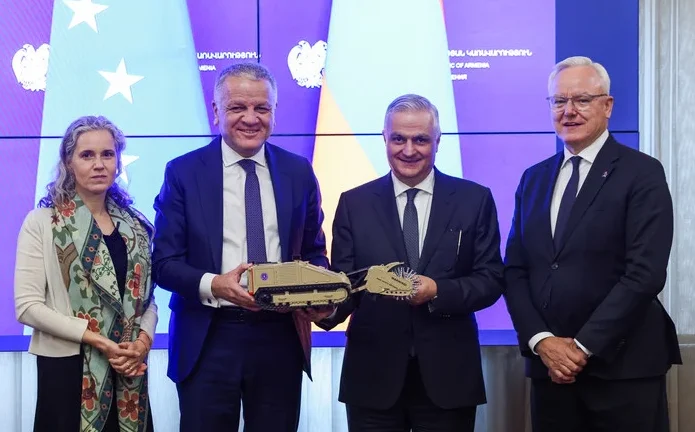
EU donates advanced demining machine to Armenia


The information on this site is subject to a Disclaimer and Protection of personal data. © European Union,
