

Lost Ukrainian Atlantis: the flooded memory of Polina Raiko’s house
War destroys not only human lives but something deeper – culture, memory, and identity. This is the story of a unique house, where even the walls speak through art. It is located in Oleshki, Kherson region, a town temporarily occupied by Russian forces from the first day of the full-scale invasion of Ukraine.
On the morning of 6 June 2023, explosions at the Kakhovka Hydroelectric Power Plant triggered one of the most devastating war crimes committed by Russian forces. The destruction released massive floodwaters downstream, submerging entire settlements and transforming the landscape of the Kherson region within hours.
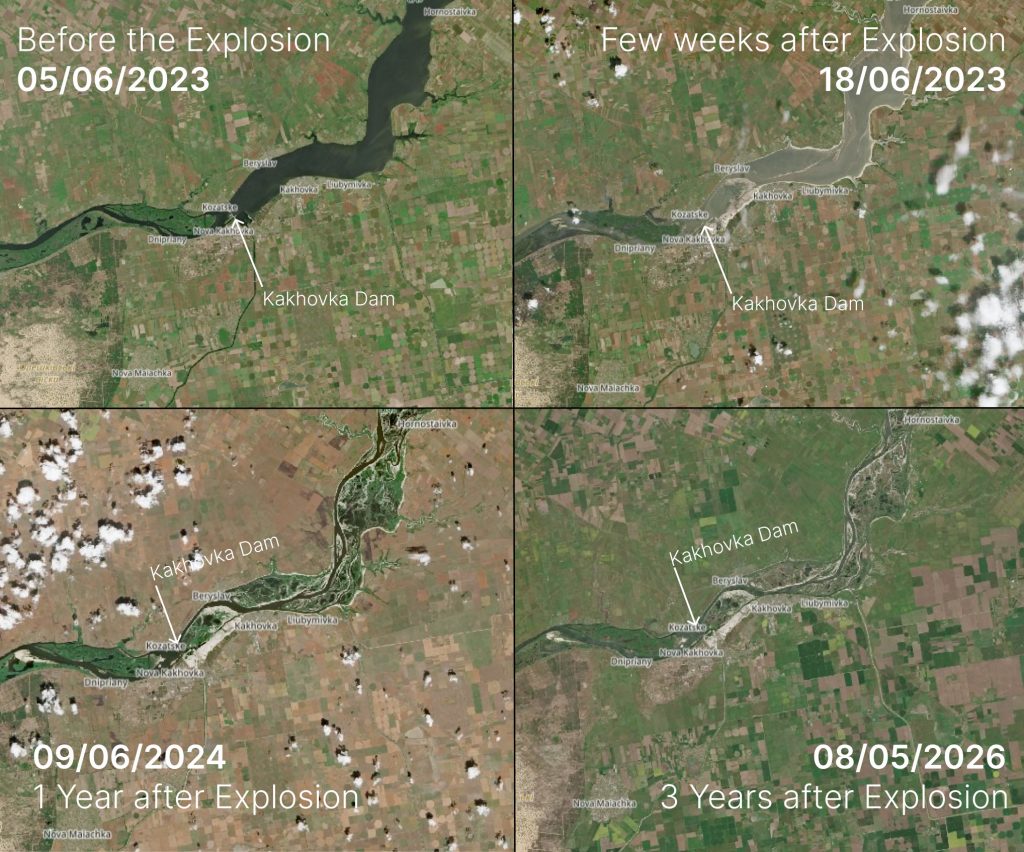
Among the flooded homes was Polina Raiko’s house-museum, one of the most unique examples of Ukrainian naïve art. Polina Raiko was a self-taught artist from Oleshki, who intuitively painted religious, fantastical, and folkloric scenes on the walls of her house, which is often referred to as “outsider art”. She started to draw at the age of 69 with the cheapest materials she could afford. Raiko described the process almost as something mystical:
“I work in the garden, get tired, paint a dove, and suddenly feel joyful again. I look at it and feel as if I am not alone. I keep asking myself – was it really me who painted this? My soul becomes happy, deeply happy.”
At first glance, her work looks bright and joyful. Although it was instinctive, emotional, and deeply personal, it emerged as a way to process the grief and loneliness that followed her throughout her life. Art became a way to reclaim happiness. Her frescoes depicted moments from her life: grief when her daughter tragically died in an accident, and her son, who was sentenced to prison. It did not exist separately from everyday life, it grew directly from it.
Eventually, she was recognised by a wider audience. Local artists and historians tried to support her. She completed her life’s largest project, her own divine world, her house, before her death at the age of 75. Polina Raiko’s autobiography project. It is considered a significant work within Ukrainian naїve art. She was frequently mentioned alongside other Ukrainian artists like Kateryna Bilokur and Mariia Prymachenko.
The house later received protected status under the Law on the Protection of Cultural Heritage. Before Russia’s full-scale invasion of Ukraine, this house-museum was a venue for festivals, residencies, and film shootings.
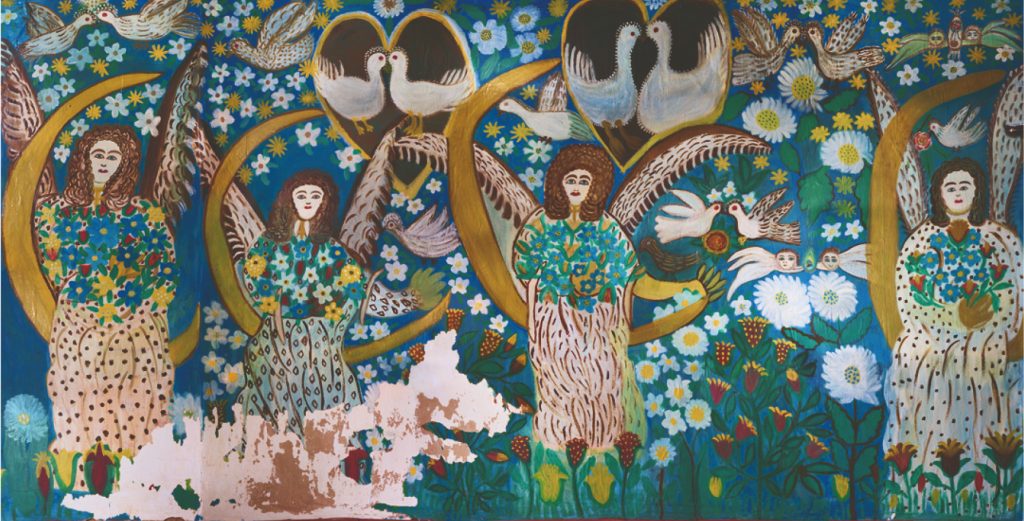
After the dam collapsed, floodwaters covered almost 90% of the interior, walls were ruined because of the water inside. After a few weeks of the flooding, one of the most widely shared reactions came from Ukrainian artist and researcher Simon Khramtsov, who described the condition of the house after seeing footage from inside:
“Most of the interior walls have collapsed. About 30-40% of the frescoes have been preserved, but the ‘wall with the sisters’ is completely lost… I don’t know how long it will stand like this.”
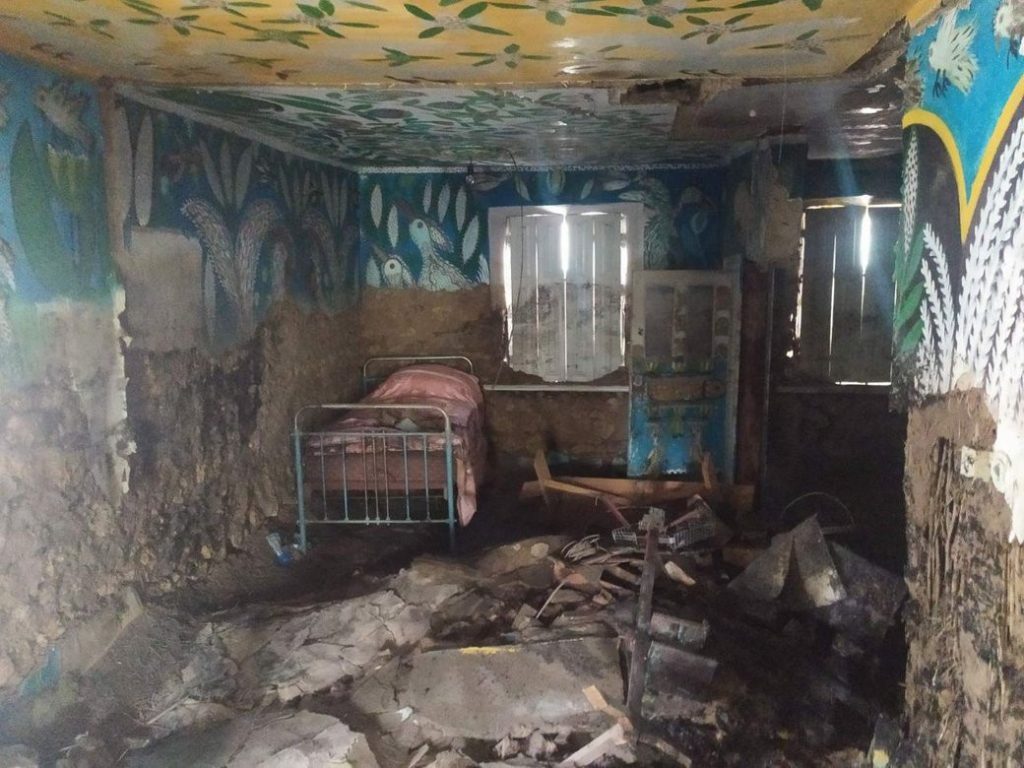
The destruction not only caused physical damage, but erased an entire interior world – a kind of Ukrainian Atlantis, submerged under water and time.
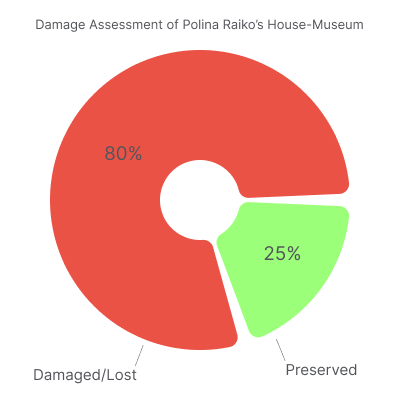
Damaged/Lost 80%, Preserved 25%. Approximate damage assessment of Polina Raiko’s house-museum after the flooding caused by the destruction of the Kakhovka Hydroelectric Power Plant. Source: estimates are based on eyewitness accounts and public statements by researchers and representatives of the Polina Raiko Charitable Foundation.
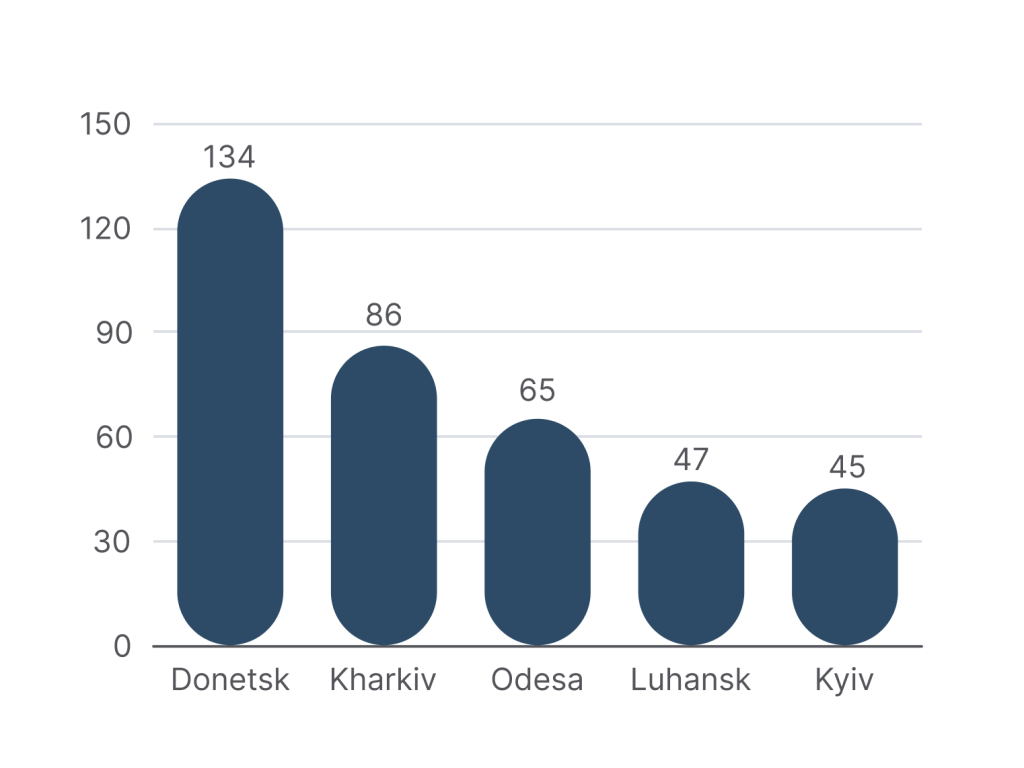
The loss of Polina Raiko’s house reflects a broader pattern of cultural destruction across Ukraine. As of 15 April 2026, UNESCO has verified damage to 526 cultural sites, including 36 heritage sites in the Kherson region. However, there is still a lack of comprehensive information, as researchers are unable to fully assess the damage due to the ongoing Russian occupation. While the flooded house-museum became one of the symbolic cultural losses after the destruction of the Kakhovka Dam, the data shows that this case reflects a broader nationwide pattern of damage to cultural heritage.
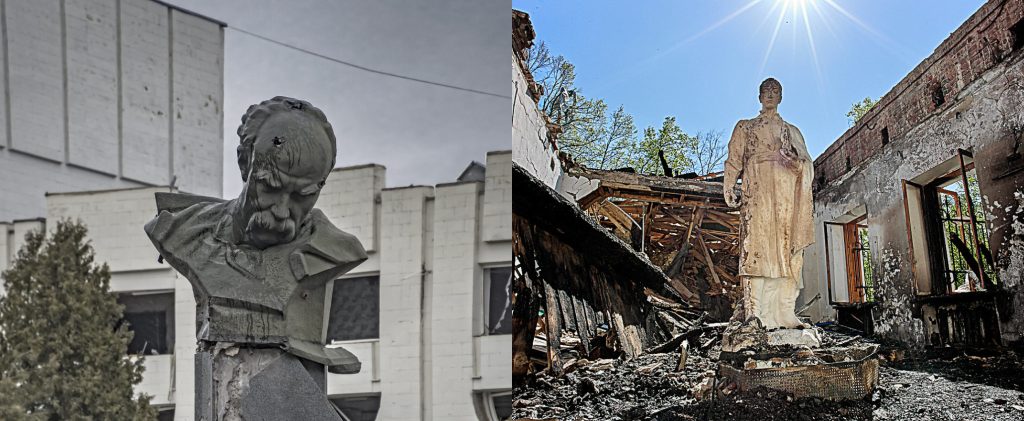
Across occupied and frontline territories, monuments, museums, libraries, and cultural spaces have become vulnerable to shelling, flooding, looting, and neglect. Another example of an attack on cultural memory is the bust of Taras Shevchenko in Borodianka, Kyiv region, the monument to Ukraine’s major poet marked by a bullet hole in the forehead fired by Russian troops. Similarly, Hryhorii Skovoroda Museum in the Kharkiv region where the Russian army shelled the roof of the building, and the entire museum was engulfed by fire. The 18th-century building, home to Hryhorii Skovoroda, which preserved the memory of his last years of life, has now become a historical legacy.
Cultural heritage is more than frescoes, monuments, or museum collections. It preserves our memories, our values, grief, traditions, and so much more. In times of war, these places become especially vulnerable, not only to physical destruction but also to disappearance from public memory. The destruction and looting of cultural sites by Russian forces across occupied territories shows how far war extends beyond the battlefields.
Museums, memorials, libraries, churches, and historical buildings are not random objects of damage. They are spaces where identity and historical continuity are preserved. When such places are destroyed, inaccessible, or removed from their communities, an important part of cultural memory is threatened as well.
In this context, documenting damaged heritage sites becomes more than archival work. Satellite imagery, photographs, testimonies, and digital preservation projects increasingly serve as ways of protecting memory when physical preservation is impossible. No one knows when they will renew access to the Polina Raiko house-museum as the territory is currently occupied by Russian troops.
“In total, approximately 20% of the house-museum has been preserved. We contacted an American foundation that works on the preservation of art after flooding. They shared a method for preserving the remaining parts of the house. However, due to the occupation of the city, it is impossible to carry this out,” artist Semen Khramtsov said in an interview for Svidomi.
In many ways, the fate of Polina Raiko’s house mirrors the experience of Ukrainians themselves – marked by destruction, but also by continuity. Despite war and loss, Ukrainian culture is not erased, it is carried forward, preserved, and reimagined. What remains is not only what has been damaged, but also what continues to exist beyond it: a living identity that still has much to reveal to the world.
While a lot of physical art pieces remain largely inaccessible and fragile due to the full-scale Russian invasion of Ukraine, some art examples have been digitally preserved. Through the efforts of the Museum of Stolen Art team, you can still experience a high-quality 3D tour.
LATEST
Why does Armenia’s future belong to the youth who defend it?
Global warming is heating up gender differences
A YEAs impression: study visit to the Mission of the Republic of Moldova to the European Union
Young European Ambassadors at the European Youth Week 2026: Generation Enlargement Workshop
From Gyumri to the European Parliament: my experience at the European Youth Week 2026 in Brussels


The information on this site is subject to a Disclaimer and Protection of personal data. © European Union,
