

War against Ukraine: 21st package of sanctions hits Russian energy, financial services and crypto
On 23 July, the Council of the European Union adopted the 21st package of restrictive measures against Russia in response to its war of aggression against Ukraine. It includes economic sanctions hitting the sectors that have the greatest impact on Russia’s economy and its ability to fuel its war of aggression against Ukraine, and the largest batch of individual listings of the last four years, totalling 218, of which 48 individuals and 170 entities.
“With each round of sanctions, we squeeze Russia’s economy and its capacity to prolong its illegal war,” said Kaja Kallas, EU High Representative for Foreign Affairs and Security Policy. “Our 21st package includes the highest number of listings in four years. We’re hitting over a hundred banks and crypto operators, 40+ vessels in Russia’s shadow fleet, and several oil refineries in Russia and Belarus. More than 50 military-industrial entities are included, key actors involved in the production of Russia’s long-range drones. Russia will only negotiate to end its illegal war and stop killing civilians if it is pressured to do so. Sanctions add to this pressure.”
Financial services and crypto
The EU has significantly expanded action against Russia’s financial and banking sector. The Council has imposed asset freezes and a prohibition to make funds available to 94 banks and major financial institutions, and to an important figure in Russia’s banking establishment. It extended its transaction ban to 33 additional Russian credit and financial institutions.
Furthermore, it is introducing a transaction ban against a Kyrgyz bank connected with the SPFS (System for Transfer of Financial Messages) ban and three other non-Russian banks for circumventing sanctions.
The EU is adding four designations related to the cross-border A7 network, including its new links to Africa. It is also extending its transaction ban to 14 crypto-related service platforms based in Georgia, Panama, the UAE, the Marshall Islands, Kyrgyzstan, and Belarus.
For the first time, the EU is introducing the possibility of a full third-country ban for crypto-asset services, as a strong deterrent to countries hosting platforms that help Russia evade EU sanctions. This new instrument will enable the EU to ban any transaction between an EU operator and any crypto provider used by Russia.
Russia’s revenue generation
Concerning energy, the latest package pauses the automatic adjustment of the oil price cap mechanism until 15 July 2027. “This is to ensure that Russia’s profits from oil sales remain contained, despite the exceptional market situation caused by the closure of the Strait of Hormuz,” says the Council in a press release.
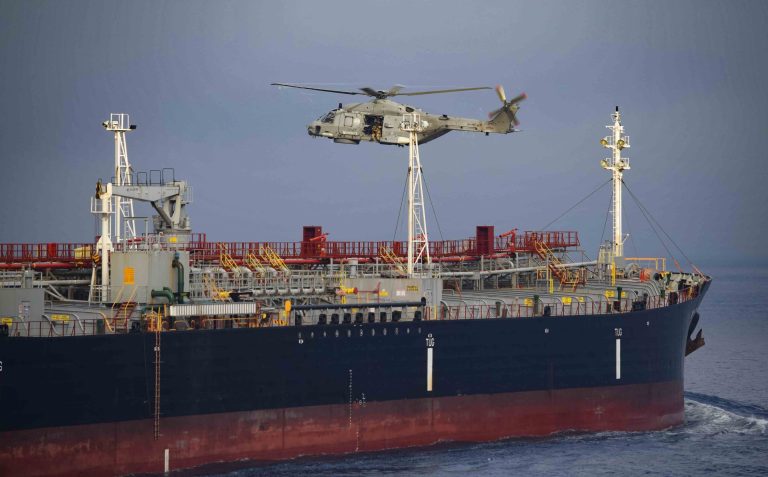
The agreement foresees an interim review of the suspension to ensure that the mechanism remains necessary and proportionate. The EU is also continuing to target the shadow fleet by extending the scope of the existing rules to also cover vessels supporting the shadow fleet, by providing bunkering and other services, and listing 41 more vessels on top of the 632 already sanctioned. These measures target non-EU tankers that are part of the shadow fleet circumventing the oil price cap mechanism, that support Russia’s energy sector in other ways, or transport military equipment for Russia or stolen Ukrainian grain. The EU has designated 8 entities and 1 individual active in the shadow fleet ecosystem, including companies operating on behalf of Russia’s oil majors and, for the first time, a crewing agency providing support to the shadow fleet.
Furthermore, the EU is targeting the oil sector – particularly refineries. It is designating 18 entities and 1 individual in the oil sector, including 3 refineries in Russia, a major Belarusian oil refinery, and a company created to sell Belarusian petroleum products within Russia. In addition, the package creates the possibility to prohibit transactions with listed refineries in Russia and in third countries which process or refine Russian crude oil and petroleum products. In that framework, the EU is imposing a transaction ban – entering into force in six months – on a Georgian refinery trading and processing Russian oil in Kulevi. Furthermore, the EU added five oil traders to the entities subject to a transaction ban for frustrating the prohibition on purchasing Russian crude oil and petroleum products.
The EU has also exerted pressure on Russia’s critical infrastructure, as the Council decided to designate a key cross-border energy supplier, a prominent figure of the Russian Railways, and extend its transaction ban to two Russian ports and four Russian airports.
The package introduces a notification obligation for the sales of LNG tankers and a possibility to introduce new restrictions on the sale of LNG tankers to Russian citizens and companies, and introduces other contractual obligations to mitigate the risk of reselling to Russia or for use in Russia.
The EU is also targeting other means of Russia’s revenue generation by designating seven major actors in the gold sector, one of the most important diamond companies, and several entities active in the mining and metallurgy sectors.
Russia’s military industrial complex
To constrain Russia’s ability to wage war and carry out strikes, most notably through the use of long-range drones, the package introduced 56 individual listings of persons and companies involved in the Russian Military Industrial Complex. These include 37 listings directly linked to long-range drones, targeting their production and supply chain.
The Council also added 51 new entities to the list of those subject to tighter export restrictions on dual-use goods and technologies, due to their support for Russia’s military and industrial complex in its war of aggression against Ukraine. Some of these entities are located in third countries (China, including Hong Kong, India, Kazakhstan, Kyrgyzstan, Türkiye, and the United Arab Emirates) and contribute to Russia’s circumvention of export restrictions, including on microelectronics, computer numerical controlled (CNC) machine tools and equipment for semiconductor processing.
Banning Russian combatants from the EU
The package introduced the basis for a comprehensive visa ban for combatants and ex-combatants of the Russian armed forces and other proxy groups, participating in the Russian war of aggression in Ukraine.
The Council will decide when the ban is to enter into force.
Trade
The EU has agreed to expand the existing export ban to include items and technologies used by Russia’s military industry, such as nickel powders, metal and alloys used in corrosion-resistant coatings in jet engines; beryllium powders used in propellants and in high performance alloys; self-adhesive films, tapes and strips used in the aerospace and defence sectors; aviation items specific to unmanned aerial vehicles (UAVs), such as ground support equipment, jamming/interception systems, launch systems and servomotors, as well as flight termination systems for drones and missiles.
In addition, the EU has introduced further restrictions on the import of goods that generate significant revenues for Russia (worth over €60 million), such as copper ores, nickel ores, lead ores, precious-metal ores, unwrought zinc, alkaline-earth metals, zinc oxides, chromium oxides, glassware, imitation pearls and car parts.
The package also includes measures on Belarus intended to mirror those imposed on Russia, in particular trade measures (import bans on goods generating significant revenue for Belarus as well as export restrictions related to the military industry) and legal protection.
Russia’s war propaganda machine
The EU has designated 8 individuals for spreading Russia’s war propaganda and contributing to its manipulative war narrative on Ukraine.
War crimes
Under this package, the EU has designated a Major General and war criminal, who has engaged in the torture, executions, and desecration of bodies of Ukrainian military personnel, including prisoners of war. This listing comes in addition to further designations under Russia’s Human Rights regime, adopted on 13 July.
Other measures
The EU has strengthened the legal protection of EU operators in litigations stemming from EU restrictive measures by allowing EU courts and member states not to recognise or enforce any court decision that was obtained in legal proceedings lodged in Russian courts.
The relevant legal acts will shortly be published in the Official Journal of the EU.
Find out more
MOST READ




SEE ALSO
EU4Energy Phase III supports Armenia’s electricity market reform through regulatory expert exchanges
United Kingdom EU’s €90 billion Ukraine support loan
Kallas: ‘We’re turning up the pressure on Russia’s shadow fleet’
Von der Leyen welcomes agreement on 21st sanctions package against Russia
Report on impact of EU Carbon Border Adjustment Mechanism on Georgia’s economy recommends supporting businesses in adopting low-carbon and energy-efficient technologies


The information on this site is subject to a Disclaimer and Protection of personal data. © European Union,
